

One Above All: Marvel's Most Powerful Being Explained
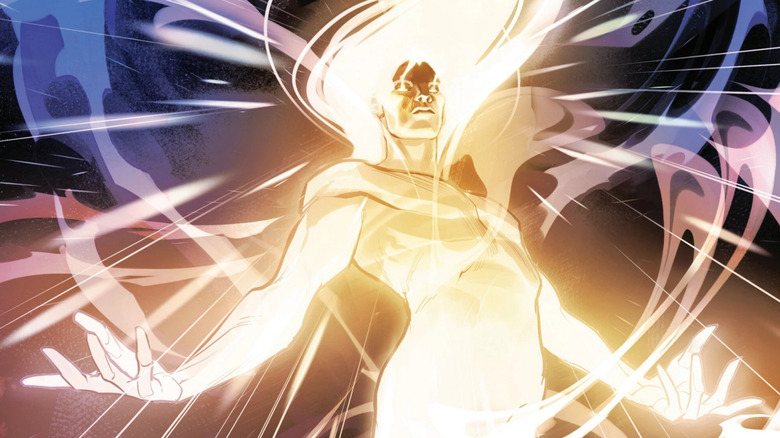
There is a cute moment in Joss Whedon's 2012 film "The Avengers" wherein Captain America (Chris Evans), a good Christian boy, meets Thor (Chris Hemsworth), the Norse god of thunder. Cap is warned by Black Widow (Scarlett Johansson) that it would be unwise to engage Thor in hand-to-hand combat, as he is nigh indestructible and hugely powerful. He's practically a god, she says. Cap, being a good Christian, notes that "There's only one God, ma'am, and I'm pretty sure He wouldn't dress like that."
Of course, this little flippant comment hints at a larger theological question about the Marvel Universe. Namely: Is there a God in it? Thor is the Norse god of thunder, but the Marvel Cinematic Universe initially went out of its way to assure people that he's not an actual god, but a super-advanced space alien that just happens to look and behave like Thor.
This notion was undone, however, in the film "Thor: Love and Thunder," as Thor went to Mount Olympus and sat among a panoply of gods, hailing from all known religions. This scene implies that there is no One True God above all of them, necessarily, but a pluralistic theogony of deities at work.
With all these cosmic beings prancing about, though, Marvel had to eventually address the question as to whether or not God — in the Judeo-Christian sense — palpably existed in the Marvel universe. They answered the question in a 2004 issue of "Fantastic Four."
There is a God, it seems. It is the One Above All. It is the ineffable, all-power creator of the multiverse. Whether or not this is the same being as Yahweh seems unlikely, as Yahweh has also shown up in Marvel Comics.
The One Above All has a God-like role in the Marvel universe
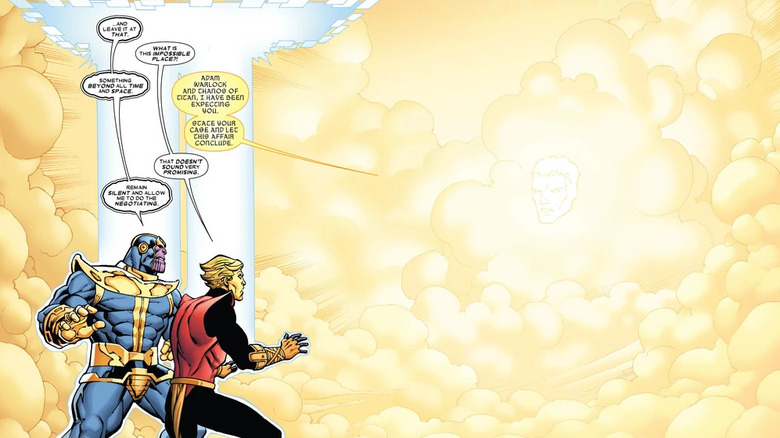
The being known as One Above All was first mentioned directly in 2004's "Fantastic Four" #511, when the surviving members of the Fantastic Four went to Heaven to rescue the soul of Ben Grimm, aka The Thing. Over the years, like any comic book character, the details surrounding One Above All, or OAA, have been slowly elucidated. OAA was said to have created itself, and is responsible for all life in the multiverse. There are innumerable parallel timelines in Marvel, but One Above All is, well, above all of them.
In Marvel mythology, aspects of the universe are represented by humanoid gods, and the creation myth of the universe went like this: OAA created Oblivion, the personification of the void that existed before the universe was created. OAA also inadvertently created a sub-deity called the Demiurge, which is sort of the living consciousness that lives in Earth's atmosphere. The Demiurge, in turn, created all the Elder Gods known on Earth. This was about four billion years ago. A creature that OAA didn't create, Vinruviel, corrupted all the Elder Gods, turning them into demons devoted to fighting one another. (Maybe it's Vinruviel's fault that Marvel characters are always fist-fighting each other.) This story was told in the newer "Incredible Hulk" comics, published in the mid-2020s.
OAA is said to live in the "House of Ideas," perhaps another term for Heaven. "House of Ideas," as Marvel-heads know, was a nickname for the Marvel Comics writers' bullpen, so the Marvel "Heaven" is actually a cute in-joke. OAA also lives outside of all time and space, and is more powerful than all Its creations combined. OAA is a hands-off kind of deity, preferring to stay out of the affairs of mortals. It is, however, a benevolent force, representing noble human concepts like justice, love, and compassion. A lot of this information can be found on the Marvel Nerds website.
Other gods across the Marvel universe
To make the House of Ideas in-joke more explicit, OAA is depicted as looking like legendary Marvel Comics artist Jack Kirby, and OAA can sometimes be seen wielding a giant pencil. The OAA, then, is just the artist at work, like Bugs Bunny in "Duck Amuck."
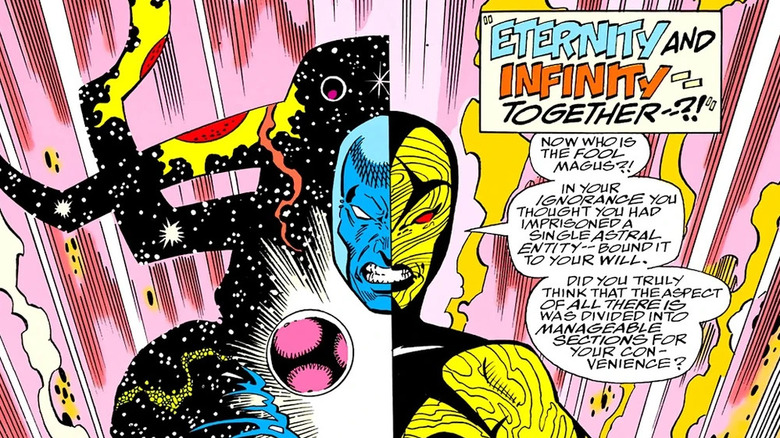
OAA actually has a lot of employees. Throughout the history of Marvel Comics, readers have been introduced to many all-powerful, ineffable space deities that could easily stand in for the God as He is described in various religious texts. Marvel, however, tends to refer to these space deities as "cosmic beings" and not as "gods." Eternity, for instance, bodily encompasses the whole of the cosmos. Infinity is a being that embodies time.
They all answer to the Living Tribunal, a large golden humanoid with three faces, representing equity, vengeance, and necessity. The Living Tribunal is called in when matters of godlike power are at hand. In "Warlock and the Infinity Watch" #1, for instance, he made judgements about single beings possessing all the Infinity Gems, making them perhaps too powerful for the universe to handle. (The Living Tribunal actually had a cameo in an episode of "Loki.")
Throughout his appearances, though, the Living Tribunal mentions that he answers to the One Above All. The cosmic laws are written, it seems, by OAA, who oversees the whole of the multiverse.
And that's just a small smattering of the cosmic beings in Marvel Comics. Many fans of the Marvel Cinematic Universe are already familiar with Galactus, and fans of "Eternals" will know all about the world-creating beings known as Celestials. But readers of the comics might be able to tell you about Love and Hate, Eon and Epoch, or Lord Chaos and Master Order. Some will mention the Stranger or the In-Betweener, and The Watcher from "What If...?" is another cosmic being.
The One Below All and the Devils of the Marvel universe, explained
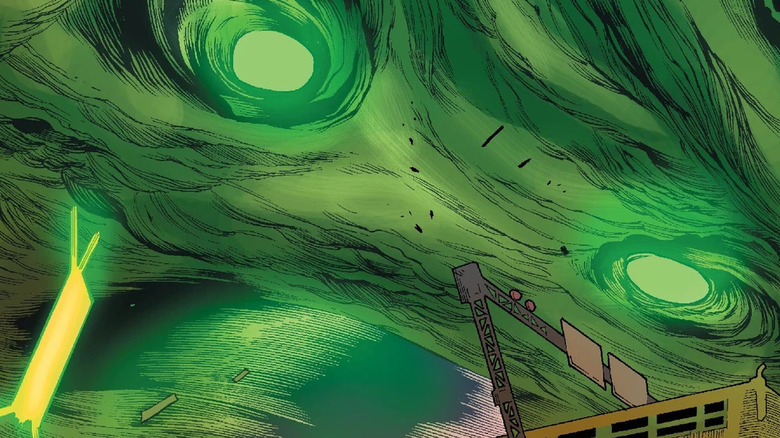
Of course, the Marvel Universe is so lousy with ambitious, greedy villains that one might wonder if there are also demons and devils, or even an all-encompassing Devil figure to counterbalance the benevolence of One Above All. As it so happens, there is. Naturally, this being is called One Below All.
Remember that creation myth? Let's go back to Vinruviel for a minute. Long story short, Vinruviel, a being of corruption and violence, forced the gods to fight. By then, Vinruviel had become an evil creature known as the Mother of Horrors. All that fighting made OAA angry for the first time, and the anger manifested somewhat accidentally as One Below All. This whole story was told in "Incredible Hulk" vol. 6 #3, published in 2023, and in "Immortal Hulk" #50, published in 2021.
The One Below All, although born of anger and violence, served as a solid counterpart to the One Above All in that it provided a cycle of life and death that made sure the universe was balanced. One Below All is sometimes associated with Satan, although he should not be confused with Mephisto, a different Devil analogue in Marvel Comics, nor the Son of Satan, nor any of the other demons that prance through the Marvel Universe. There are many demons and demonic beings throughout Marvel, and listing them all here would take up too much space.
To finish, we should mention that Yahweh, inarguably the Judeo-Christian God, has also turned up in Marvel Comics, starting all the way back in the 1950s in Bible stories. Yahweh appeared in Marvel stories occasionally as well, but usually as a comedic character. In "Howard the Duck" comics, it's revealed that since World War II, He has been an alcoholic. That might explain a lot.