

After Alien, Ridley Scott Nearly Made A Sci-Fi Horror Movie That Could Have Been A Classic
We may receive a commission on purchases made from links.
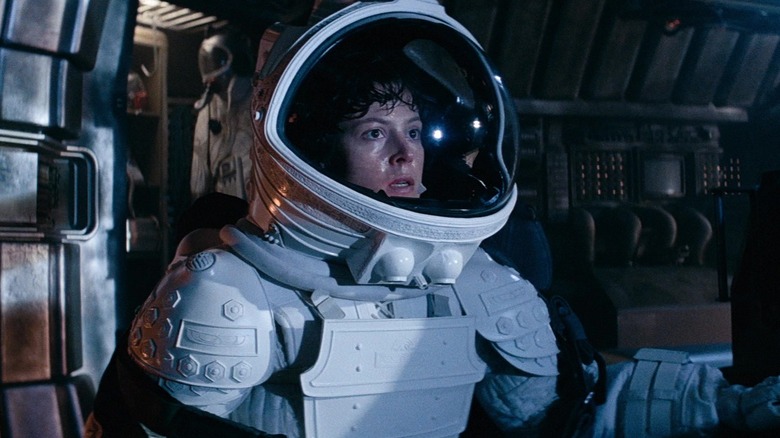
Ridley Scott became a pretty big deal rather quickly. His first feature film as a director was 1977's "The Duellists," a lush, episodic film about two men (played by Harvey Keitel and Keith Carradine) who spend the Napoleonic Wars periodically meeting to engage in duels. Adapted from a short story by Joseph Conrad and also starring Albert Finney and Stacy Keach, "The Duellists" wasn't a big hit financially, but it won Best Debut Film at Cannes, cementing Scott as a talent to keep an eye on. He fulfilled his promise in 1979 with the release of "Alien," his classic sci-fi horror movie about a creature made of teeth and aspic stalking miners on a starship.
Scott eventually followed "Alien" up with another sci-fi film, the sleepy android noir "Blade Runner," released in 1982. That film infamously tanked at the box office, although it spawned a passionate cult following in the ensuing years. Nevertheless, its failure seemingly led Scott to avoid the sci-fi genre for decades before he finally returned to it with his 2012 "Alien" prequel/spin-off movie "Prometheus."
There was a moment in the late 1980s, however, when Scott was tempted to make an "Alien"-like sci-fi/horror flick again. The project was originally called "Dead Reckoning," although its title changed to "The Train" as it developed. As recounted in David Hughes' 2012 book "Tales from Development Hell," Scott's legendary "Alien" creature designer H.R. Giger even contributed to the would-be film before it was derailed.
Based on how its screenwriter, Jim Uhls, is quoted as describing its premise in Hughes' book, it sounds like "The Train" would have been fun, even if it was something of a retread of the concept for "Alien." At the very least, it had a cool monster.
The Train would have reunited Ridley Scott with H.R. Giger
If Jim Uhls' name sounds familiar, it's because he wrote the film version of "Fight Club," a movie that, like "Blade Runner," bombed in theaters before attracting a passionate cult fanbase. Uhls, it appears, wrote the "Dead Reckoning"/"The Train" screenplay on spec. As he explained:
"It was a sci-fi action thriller set in the future, in which an altered form of life gets loose on a high-speed runaway underground train. The creature was a humanoid with a genetically-altered brain that was intended to be used as the 'hard drive' in an artificial intelligence project."
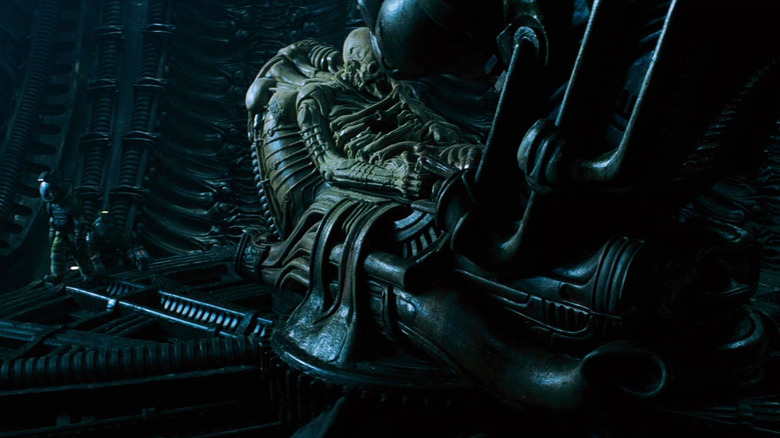
Sounds rad. From there, Uhls sold the script to Carolco, and two of the studio's producers, Andrew Vajna and Mario Kassar, tapped Ridley Scott to direct. Scott was interested and even went so far as to recruit H.R. Giger to craft some of the movie's designs. Giger, as mentioned earlier, was the Swiss surrealist who designed the bizarre-looking creatures and sets for "Alien" (despite Fox executives being concerned that his work was too "obscene"). After that, he went on to serve as a conceptual artist on films like "Poltergeist II: The Other Side."
When Giger got a call from Scott, he went to work designing the titular train. By his estimation, the train itself would be a bizarre, semi-organic nightmare vehicle with teeth and fluids. Giger loved the idea of a weird ghost train and adored the concept so much that he eventually reworked his idea for the 1995 sci-fi/horror film "Species." Select photos of his designs were published by Cinefantastique Magazine in 1996, as you can see on the official H.R. Giger website. This may be the closest we'll get to seeing what "The Train" would have looked like.
The Train eventually fell apart after Ridley Scott stepped away
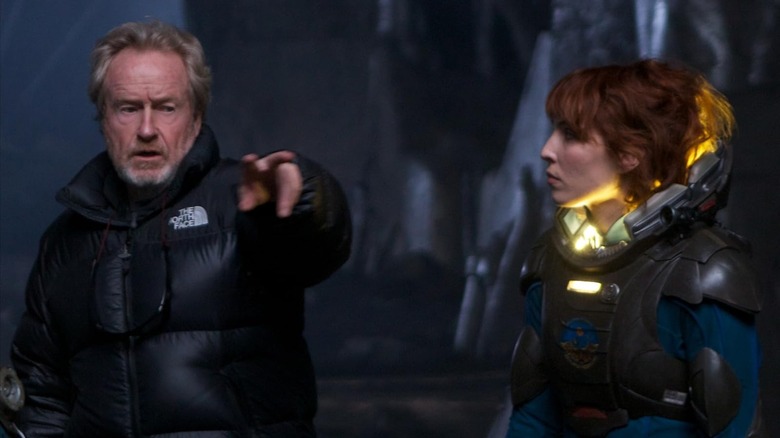
As H.R. Giger continued to work on concept art for "The Train," Ridley Scott went unexpectedly silent on the matter. It seems that Scott and producer Joel Silver had been butting heads over "The Train," so Scott ultimately washed his hands of the matter and moved on to his next directorial effort: 1991's Oscar-winning "Thelma & Louise."
After that, Silver brought the idea to Roland Emmerich, who was best known at the time for directing the German sci-fi film "Moon 44." By then, though, Silver had begun tinkering with the project's script, and its title changed to "Isobar," then again to "The ISOBAR Run." Emmerich's frequent co-writer Dean Devlin and screenwriter Steven E. DeSouza ("Commando," "Die Hard") both took a stab at rewriting the screenplay, and even the story's central monster. As Jim Uhls put it:
"The creature was changed to be an evolutionary leap. [...] A super-adaptive humanoid that was caught thriving outside, in the environment that's hostile to humans. It is put onto the train to be transported to a special lab. It breaks free, then it must adapt faster and more dramatically to stay alive inside the train. It requires massive doses of adrenaline to do this, so it kills people to get it."
There was even a point in the development of "The Train" where its monster was going to be made of plant material. Of course, it sounds like it had become a whole different thing by then. It also seems that H.R. Giger's designs were mostly abandoned after Scott bowed out. Either way, the project fell apart for good when Carolco went bankrupt after the failure of director Renny Harlin's notorious 1995 flop "Cutthroat Island."
But, oh, what could have been.