

The Tragic History Of Guillermo Del Toro's At The Mountains Of Madness, The Best Horror Movie Never Made
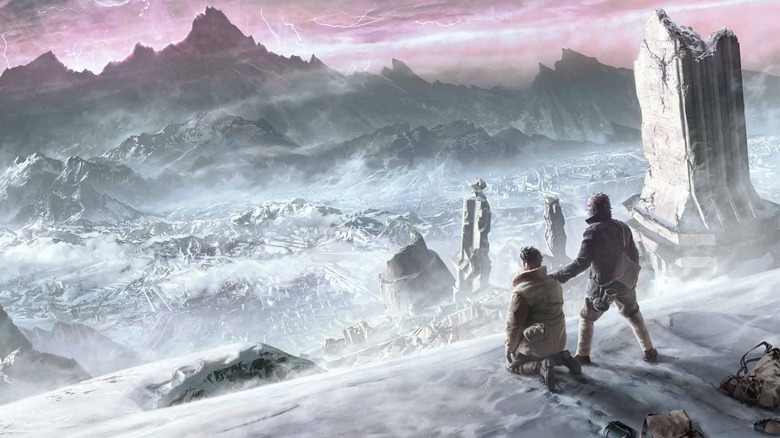
Welcome to The Best Movies Never Made, a weekly lookback at the most fascinating, strange, and tantalizing films that came within striking distance of reality, but never actually made it in front of cameras — and maybe should have.
Filmmaker Guillermo del Toro is a relentless dreamer and a voracious consumer of culture. He's also insatiably curious. I've heard him say multiple times that the day he stops being curious is the day he will die.
The man's art is a matter of life or death to him. When a project fires his imagination, he pours every ounce of his talents into its creation. He can do it all: write, design, storyboard with an incredible degree of intricacy, and bring an uncommon level of complexity to a narrative. He's a storyteller who thinks deeply about not just what he's saying but how he's saying it.
"Pan's Labyrinth" firmly established del Toro as a prestige filmmaker. He directly segued into "Hellboy II: The Golden Army," which would've been a much bigger success had it not released a week before "The Dark Knight." This was a huge strategic error on Universal's part, because del Toro's next film for the studio was going to be his H.P. Lovecraft-inspired passion project: "At the Mountains of Madness."
This movie was del Toro's shot at making an ambitious piece of blockbuster prestige horror, an Antarctic tale of terror packed with tentpole production value, stomach-turning makeup effects, and rigorous location shooting. At $150 million, it was a commercial gamble, but with James Cameron producing and Tom Cruise attached to star, it seemed like a carefully managed risk. Having read the script, I believe it could've been one of the greatest horror movies ever made. Instead, it will likely forever be known as the greatest horror movie never made.
Guillermo del Toro made At the Mountains of Madness more accessible but still horrifying
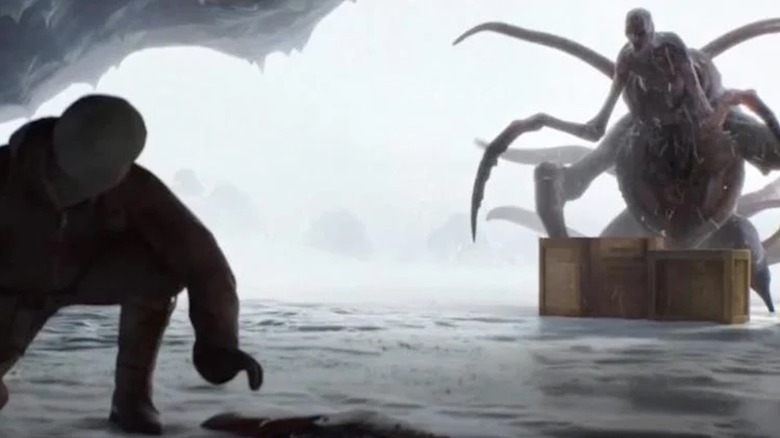
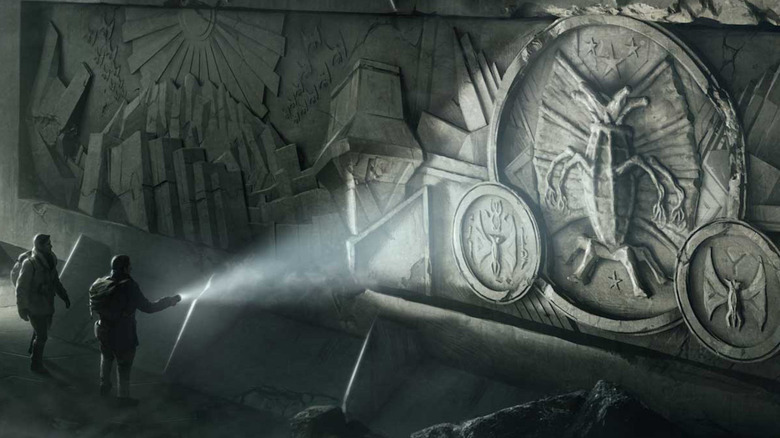
For those who haven't read H.P. Lovecraft's work before, his novella "At the Mountains of Madness" details an expedition to Antarctica led by William Dyer, a geologist and professor from Miskatonic University. His mission is to ascertain the whereabouts of an earlier group that's gone missing, led by a Professor Lake. Dyer and his crew discover that Lake's team has been slaughtered, which kicks open the door to Lovecraft working his dark narrative magic with the all-powerful "Old Ones," as well as the Shoggoths: horrifying, ancient, cosmic creatures whose look was revealed in Guillermo del Toro's "At the Mountains of Madness" test footage, seen above.
What's most rattling here, without spoiling it, are the specifics regarding a lost city found in Antarctica, and what it says about our existence as a whole. Lovecraft's bleak vision of humanity's place in an unstable, incomprehensibly vast cosmos is difficult to explain, much less adapt to film, because its horrifying power is derived from its vagueness. His stories are puzzles without solutions. In the works of Lovecraft, exploration is perilous. Be careful where you poke around — you might just awaken an alien civilization that could transform the Earth into a monstrous hellscape.
Enter del Toro and his writing partner Matthew Robbins' "At the Mountains of Madness" screenplay. They clearly realized that everyday moviegoers don't know the first tentacle-flipping thing about Lovecraftian lore, so they reframe the story as a 1930s-set action-packed horror epic, but without watering the material down whatsoever. They make it more accessible, yes, and they do sacrifice some of the eerie atmosphere of Lovecraft's novella, but they also capture the mountainous majesty of its mythos. As with del Toro's gloriously gothic rendition of Mary Shelley's "Frankenstein," this unmade film is not a straight adaptation so much as a movie in conversation with Lovecraft's work.
Tom Cruise and Guillermo del Toro's collaboration would've been perfectly timed
The "At the Mountains of Madness" script is a riveting, intellectually stimulating, mind-melting horror that ponders the abject terror of a universe so vast it feels malevolent. And 2010 was exactly the right time for everyone involved: With the backing of James Cameron and a commitment to shoot the film in native 3D (as was the rage post-"Avatar"), Guillermo del Toro was primed to make his first true blue blockbuster. Meanwhile, Tom Cruise, who'd survived his couch-jumping antics by flaunting his dorky sense of humor in "Tropic Thunder," seemed poised to give his most emotionally harrowing performance since "Magnolia" as the overly ambitious William Dyer.
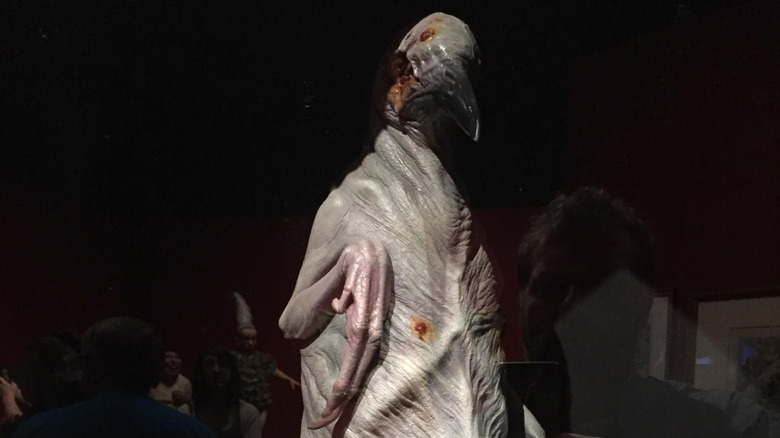
Over the years, del Toro has shared a few designs and pre-viz clips for "At the Mountains of Madness," and they underscore his commitment to get the eldritch horror of Lovecraft's tale skin-crawlingly spot-on (right down to the book's creepy albino penguins, pictured above).
Matthew Robbins and del Toro wisely give their characters more personality than Lovecraft did. Dyer is a suitably dashing protagonist who narrates the story from the present as a man hanging onto his last shred of sanity (Cruise should come unglued onscreen more often). His considerable intellect is offset by hard-nosed dogsled captain Larsen, who would've been played with rugged intensity by Ron Perlman. Alongside other explorers, they make one monstrous discovery after another, which includes a terrifying confrontation with the great Cthulhu. They ultimately come face-to-face with a Shoggoth that absorbs human members of the expedition (and dogs), producing hideous combined distortions of its prey.
It's mainstream R-rated horror, yes, but it's suffused with the fearsome soul of Lovecraft.
Guillermo del Toro was determined to make an R-rated, mega-budget horror film
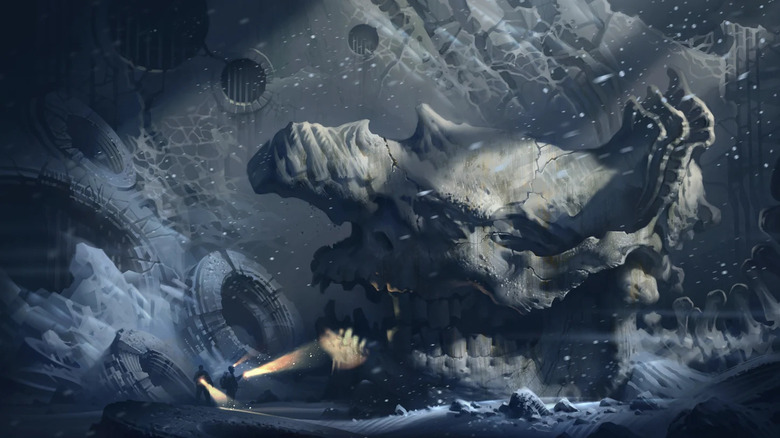
The allure of Guillermo del Toro's "At the Mountains of Madness" is intoxicating: It would've been John Carpenter's "The Thing" writ wretchedly, wickedly large — horror on a scale we've never seen on film. And the Antarctic expanse is a brutal, unforgiving force unto itself. That this movie's Antarctica also would've masked complex lifeforms that arrived on Earth eons ago only ramps up the tension.
However, the insurmountable issue with getting "At the Mountains of Madness" before cameras was always Guillermo del Toro's insistence on not being tied to a PG-13 rating. I've interviewed him just about every step of the way through his quest to make the film. As he told me in 2010:
"What I love about tentpole horror — which is not done much anymore, if at all — is that there was a time when you could see something like 'Alien' or 'The Shining' or 'The Thing.' Movies that came not as a B-movie product of a studio, but as an A, tentpole, big release, high-end production like 'The Exorcist,' and so on and so forth. And what I would love with ['At the Mountains of Madness'] is for it to have all the luster and the scope of a tentpole horror movie, but be R-rated. Not because I want to do gore for gore's sake, but because it is a very adult movie, and the consequences of things are really deep and disturbing."
The following year, when I interviewed him about "Pacific Rim," he was adamant that he would still make the project. By 2012, sadly, he was less optimistic, feeling that Ridley Scott's thematically similar "Prometheus" had put his project on ice. Since then, the film's likelihood has only gotten more distant.
Guillermo del Toro still hasn't recovered from the collapse of At the Mountains of Madness
Guillermo del Toro seems to have checked out on "At the Mountains of Madness." In 2025, he confessed to Empire, "It's too big, too crazy, too R-rated, I guess." Back in 2022, he floated the possibility of realizing the project with stop-motion master Phil Tippett (on the heels of "Mad God"), but there's been no movement on that front since. The last time I spoke to him on the subject, he expressed a desire to rewrite the screenplay.
The filmmaker's reluctance to revisit this movie is understandable. When Universal killed it in 2011, he was devastated. As he told The Talks:
"Oh, you want to commit suicide! You never get over it! Never get over it. When you have a 30-year career, you can get better at it, you can start to expect when these things will happen. [...] So, when I'm designing, I always try to not to get too crazy because I know it could happen that it doesn't get made. But I can get into a deep depression for a long time when that happens. Sometimes it almost takes you out! The collapse of ['At the Mountains of Madness'] really took the wind out of my sails."
"Frankenstein" fixed a hole in del Toro's filmography, but I can't help but feel that he has unfinished business with H.P. Lovecraft. Now that R-rated prestige horror is hot again (see: "Sinners"), del Toro could easily argue for "At the Mountains of Madness" with an A-list star like Ryan Gosling or Timothée Chalamet attached. There's so much potential. But there's also potential for further heartbreak, and del Toro doesn't need another soul-crushing experience with Cthulhu.