

John Carpenter's Forgotten Sci-Fi Classic Gave Jeff Bridges His First Best Actor Oscar Nomination
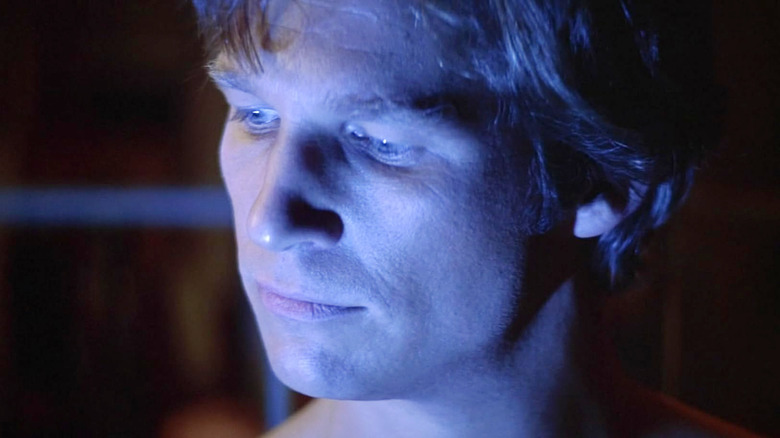
It's been almost 30 years since "The Big Lebowski" hit theaters. And how has Jeff Bridges spent that time? Playing variations on Jeffrey "The Dude" Lebowski, the chillaxed, job-avoiding hero of the Coen Brothers' 1998 cult classic. Bridges' portrayal of Rooster Cogburn in the Coens' 2010 "True Grit" film adaptation? That's just The Dude in a cowboy hat with a drinking problem and not enough sleep. His Oscar-winning role as Otis "Bad" Blake in 2009's "Crazy Heart" (a movie that changed writer/director Scott Cooper's life)? He's like if Jeffrey had become a country singer and ... also developed a drinking problem. Dang, maybe The Dude was right to steer clear of steady employment.
Ribbing aside, one of the things that makes Bridges' turn in the John Carpenter-directed "Starman" so special is how different it feels from the most iconic performance of his career. (Fittingly, the actor snagged his first Best Actor Oscar nod for his efforts, having previously landed Supporting Actor nominations for his work in "The Last Picture Show" and "Thunderbolt and Lightfoot.") The "Halloween" filmmaker's under-appreciated 1984 sci-fi feature casts Bridges as the titular space traveler, who's new to both life on our pale blue dot and having a fixed physical form. So, he fashions a body for himself using the DNA of one Scott Hayden, a recently deceased fellow who happens to look and sound identical to Bridges.
This, naturally, leads to funny moments like Bridges' extraterrestrial quickly realizing just how bad smoking is for you and learning about the unspoken rules of the road. ("Red light stop, green light go, yellow light go very fast.") Yet, as carefully as the Dude modulates his behavior to suggest he's still figuring out this whole walking-around-and-talking thing, it's the way he subtly evolves his character emotionally that truly impresses.
Jeff Bridges and Karen Allen give Starman's love story a beating heart
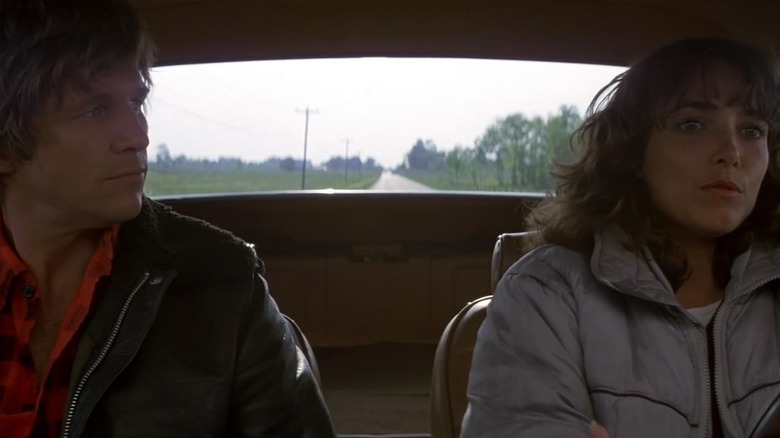
As a filmmaker, John Carpenter has long maintained a healthy skepticism towards the people and institutions that control our world. "Starman" is no exception, either, as it begins with its namesake making the trip to Earth after finding the Voyager 2 space probe and accepting its invitation to visit our planet at face value. This leads to Starman's vessel being shot down by the U.S. government in the movie's opening scene (which involved a very real forest fire), bringing him face to face with Scott's understandably terrified widow, Jenny (Karen Allen).
Obviously, Jenny is weirded out when Starman uses Scott's hair to clone his body for his own use and is initially reluctant to help him rendezvous with his fellow non-Earthlings before he dies from being ill-fitted to survive on our planet. As the movie progresses, however, it soon becomes clear that Jenny and Starman's awkward first encounter was really this film's version of a meet-cute. From there, the pair's literally out of this world love story evolves into what uncredited writer Dean Riesner ("Dirty Harry") described to the Chicago Tribune in 1985 as "a 'Getting to Know You On the Run' kind of picture, like 'The 39 Steps' and 'The Defiant Ones,' only now it was about a girl [Allen] and an alien."
Riesner wasn't wrong, but what's unique about "Starman" is that it flips the formula pioneered by those movies. Here, it's Allen as the world-weary, cynical female lead, while Jeff Bridges' Starman is the inexperienced character who slowly melts her defenses as he comes to better understand humankind. Allen and Bridges are equally spot-on in their respective roles, which makes it all the more of a shame that "Starman" didn't fare better.
Starman didn't impact John Carpenter's career the way he had hoped
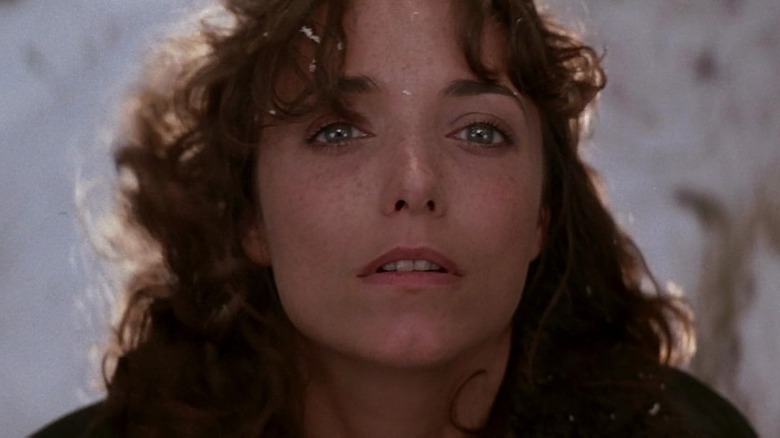
"Starman" is quite different from every other entry in John Carpenter's filmography, and that was on purpose. It was his attempt to "jettison his thriller-exploitation image," as that 1985 Chicago Tribune article puts it, and create a fairy tale for adults about reawakening one's heart in the wake of a loss. It's not lacking for accomplished spectacle or action (i.e., Carpenter's specialties), but they're not the focus here. That was perfectly fine by Columbia, which had already spent years trying to get "Starman" off the ground by the time Carpenter came aboard.
Sorry to say, things didn't go the way Carpenter had hoped. The film was largely well received by critics and helped elevate Jeff Bridges to an even bigger star, but it flopped at the box office, with a $28.7 million take that barely exceeded its $25 million budget. It was also criticized for being derivative of classic sci-fi pictures like "The Day the Earth Stood Still," along with then contemporary titles like "E.T. the Extra-Terrestrial" and "The Brother from Another Planet." But again, look more carefully at Carpenter's movie, and you'll realize it's closer to being a somewhat dramatic riff on "It Happened One Night" (albeit with one of the leads being an alien with magical powers).
Carpenter would go on to direct several more bangers in the years that followed (including the second and third films in his Apocalypse trilogy), but he never tried his hand at anything like "Starman" again before he essentially retired from directing. Would his career have gone differently if the movie had performed better? No one can say for certain, but like a chance meeting with a visitor from another world, maybe we're lucky it happened at all.