

Before A Fistful Of Dollars, Clint Eastwood Wasn't A Fan Of Sergio Leone's Work
We may receive a commission on purchases made from links.
Sergio Leone's Westerns rewrote the rules of filmmaking, but the Italian director didn't start his career with that genre. His first proper film (he'd previously replaced a director on a feature) was 1961's "Il Colosso di Rodi" or "The Colossus of Rhodes," a mythological epic that starred Rory Calhoun as the Greek hero Darios. It was a fairly unremarkable effort from Leone, at least compared to the films he made afterward, which showcased a more distinct stylistic vision. Clint Eastwood certainly seemed to agree, dismissing "The Colossus of Rhodes" in the book "Conversations with Clint" as "not my favorite picture."
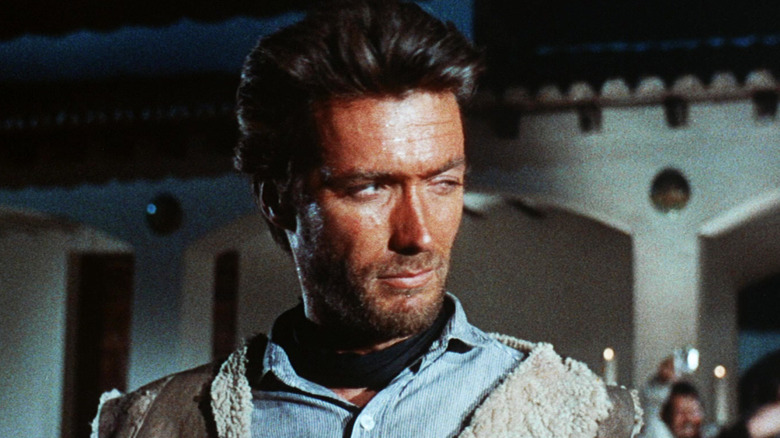
1964's "A Fistful of Dollars" introduced Eastwood to the world as the Man with No Name. Prior to the film's debut, the actor was known for playing Rowdy Yates on "Rawhide," but his big-screen gunslinger was an entirely new character — laconic, ruthlessly efficient, and imposing. Though "A Fistful of Dollars" took some time to reach the United States, it and its two sequels ultimately proved that Eastwood had what it took to become the big-screen megastar he became.
As such, you might expect Eastwood to have had nothing but good things to say about the trilogy's director. For the most part, that's been the case, but the actor didn't hold back in a 1979 interview with journalist Paul Nelson, in which he was less than complimentary about Leone's first directorial effort.
Clint Eastwood was underwhelmed by The Colossus of Rhodes
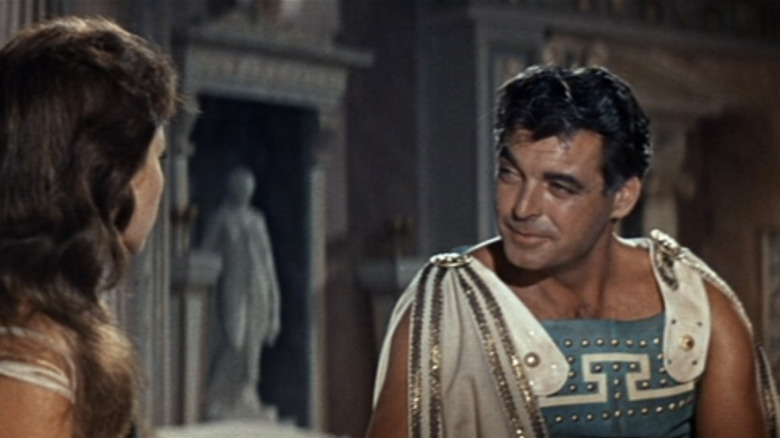
In "Conversations with Clint: Paul Nelson's Lost Interviews with Clint Eastwood, 1979-1983," Clint Eastwood recalled receiving the screenplay for "A Fistful of Dollars." He said, "When they sent me that script to do it, I wasn't interested at all." On top of that, Eastwood wasn't exactly a fan of Sergio Leone at the time. "Leone only directed one film before," he added. "A thing called 'Il Colosso di Rodi,' 'The Colossus of Rhodes,' and that wasn't my favorite picture. It was a Rory Calhoun t**s-and-sandals thing." Eastwood's more colloquial term refers to a "Sword and Sandal" picture, a precursor to the Spaghetti Western, in which European filmmakers created historical epics modeled on big-budget Hollywood counterparts. Clearly, Eastwood wasn't impressed.
Ultimately, the actor was convinced to say yes to Leone after reading the script for "A Fistful of Dollars" and hearing positive things about the director. "When I read it, I was interested," he continued. "Because, as a Western, I saw the possibilities in it, provided the director was as good as people said." According to the actor, Leone had a reputation in Rome as "a man with a great sense of humor" and "a very imaginative guy," which ultimately led him to take a chance and say yes.
Still, even after agreeing to star, Eastwood rewrote the "Fistful of Dollars" script, removing exposition and making his character much more enigmatic. As the actor put it, "You could hold all [his character's] background in abeyance, let the audience figure out who he is." That went against the tradition from which Leone came, and in that sense, the actor and director helped sharpen each other, that is, before Eastwood stopped making Westerns with Leone by the end of the 1960s.
Clint Eastwood and Sergio Leone parted ways after the Dollars trilogy
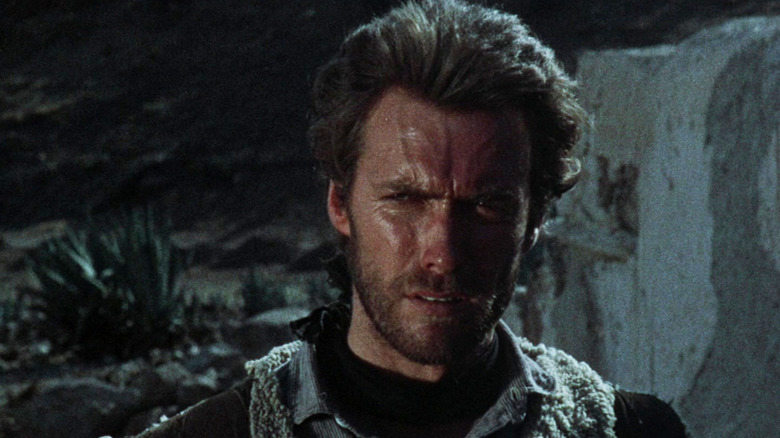
After "A Fistful of Dollars" came "For a Few Dollars More" and "The Good, the Bad, and the Ugly." By the end of this "Dollars" trilogy, Clint Eastwood was a movie star — though not yet quite the screen legend we know him as today. To ascend to even greater heights, the actor had to branch out and explore new characters. As such, while Clint Eastwood felt positive about the "Dollars" trilogy, he wasn't necessarily interested in Leone's next idea for a new Western.
The director wanted Eastwood for the main part in his twist on the Western's greatest hits "Once Upon a Time in the West," but the actor simply didn't want to rehash what he'd done in his previous Leone collaborations. Ultimately, the role of mysterious gunslinger Harmonica went to Charles Bronson. Meanwhile, Eastwood didn't stray far from the genre that gave him a movie career, making multiple Westerns in the wake of his "Dollars trilogy." But he was completely uninterested in inhabiting the same antihero that had roamed the plains of Leone's Spaghetti Westerns.
At that point, then, his decision not to appear in Leone's next Western had nothing to do with his dislike of "The Colossus of Rhodes." After three films with the Italian director, Eastwood had clearly disabused himself of the notion that Leone was only good for derivative "t**s and sandal" nonsense. But that didn't mean he wanted to spend the rest of his career playing some version of The Man with No Name. For his part, Leone took what he'd learned from working with his U.S. star and created a new trio of films that came to be known as the "America trilogy." The two never reunited for another movie.