

Martin Scorsese Had One Unsettling Goal With His Western Masterpiece
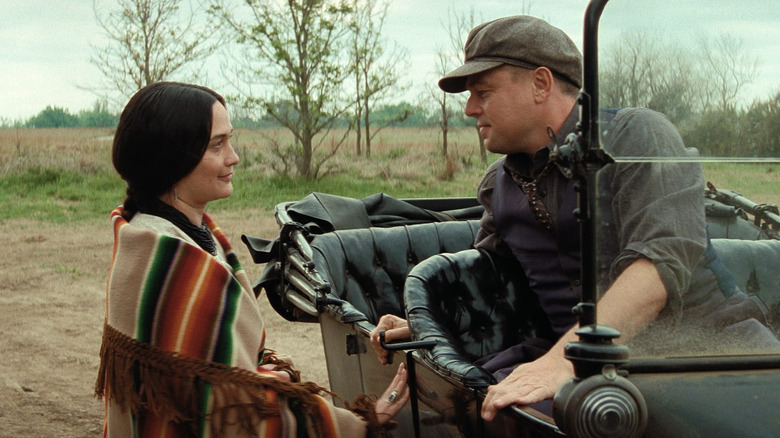
"Killers of the Flower Moon," the latest masterpiece from Martin Scorsese, is not an easy watch. For one thing, the Western film stretches on for nearly 4 hours, and you truly feel the epic weight of that length. For another, the subject matter is intentionally uncomfortable. While there are moments of deliberate humor, it's not a crowd-pleaser. Scorsese's film finally has a domestic physical release in the form of a must-have new 4K from The Criterion Collection, and the special features include a documentary about the making of the movie where Scorsese and his cast and crew delve head-first into the difficult nature of the story they're trying to tell. They reflect on how making the audience uncomfortable was essential to telling this story.
It's a true story, too. Adapted from the non-fiction book by David Grann, "Killers of the Flower Moon" is set in the aftermath of World War I, and tracks a series of murders of members of the Osage Nation in Oklahoma. The Osage were smart enough to purchase the land the United States government forced them onto, and that land ended up being rich in oil. That oil made the Osage extremely wealthy — a fact that didn't sit well with some local white people. Soon, wealthy Osage were being killed under the orders of William King Hale (Robert De Niro), who plans to snap up their money.
This saga is seen primarily through the eyes of Hale's dimwitted nephew Ernest Burkhart, played by Leonardo DiCaprio. Ernest falls in love with Osage woman Mollie, played by Lily Gladstone, and the two marry. This is where the difficult nature of the story takes hold, because according to Scorsese, DiCaprio, Gladstone, and others, "Killers of the Flower Moon" can be seen as a love story. And yet, while Ernest seemingly loves Mollie, he also actively takes part in the murders of several of her family members — and poisons Mollie, too.
Scorsese makes movies about complicated people
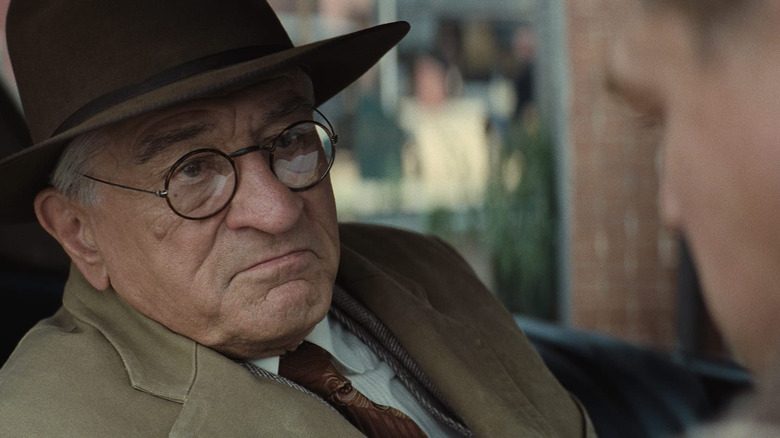
Scorsese has never been interested in telling straightforward stories about good vs. evil. He makes movies about complicated, morally flawed people, and "Flower Moon" is filled with maddeningly contradictory characters. Even though De Niro's Hale is a villain orchestrating several murders, Scorsese points out in the documentary that, "He really loved the Osage and they loved him." Indeed, De Niro's brilliant, scary performance is so memorable because he works hard to make it seem like Hale doesn't see the evil in what he's doing. He simply thinks he's entitled to that money, even if it means he has to kill a few people to get it. "We did it so that we make it clear that he believed his own story," Scorsese says of the character.
DiCaprio's Ernest may not be as scheming as Hale, but he's just as morally complex, if not more so. When DiCaprio originally signed on to the film, he was supposed to play Tom White, an FBI agent looking into the murders. However, DiCaprio ended up thinking Ernest was a far more interesting character, so the script was reworked to make White a supporting character (played by Jesse Plemons) while Ernest and his relationship with Mollie became the main focus.
"He obviously had genuine feelings for her but realized there was tremendous wealth in the family," DiCaprio says. "The complexity of how that relationship unfolded is shown in the movie in a very interesting way, and we played with how much we wanted to show the audience as far as Ernest's complicity in some of these murders." Not only does Ernest have firsthand knowledge of the murders of several of Mollie's family members, he also starts to poison her under the guise of giving insulin for her diabetes. How much knowledge Ernest has about the poisoning is left deliberately vague in the film — although at one point, Ernest injects himself with the medication to see what happens. In one of the film's closing scenes, Mollie asks Ernest if he knew he was making her sick, and he seems incapable of answering. "Leo doesn't like to be comfortable, thankfully," Scorsese says. "He and I share that. We don't want to be comfortable with this stuff. We want to get into the real truth of human nature if we can."
Lily Gladstone and Leonardo DiCaprio worked hard to develop the love story of Killers of the Flower Moon
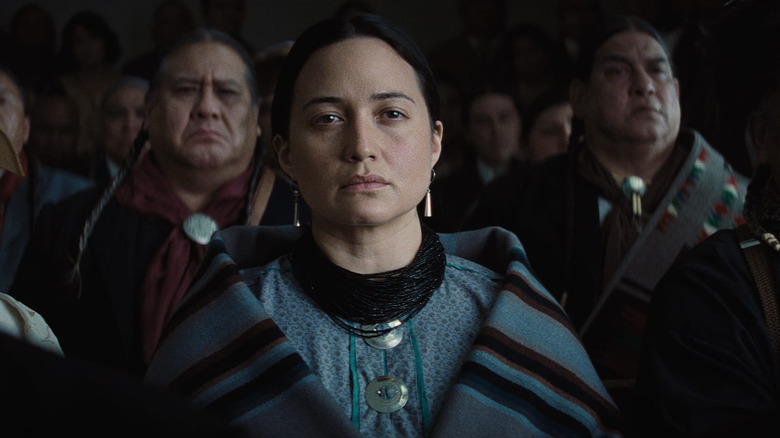
Gladstone, who won a Golden Globe for her performance and was Oscar nominated for Best Actress for her work (and really should've won that, too), has perhaps the most difficult job in the entire film. She spends a huge chunk of the story sick in bed and she also has to somehow show her love for Ernest without making her character seem completely oblivious to his devious ways. In the doc on the Criterion disc, Gladstone says that she and DiCaprio went into the film thinking "this may be an impossible task to tell what this love story is, in a way that is going to connect with people and feel real."
Scorsese's longtime editor Thelma Schoonmaker adds that DiCaprio and Gladstone worked to "shape that love story" and come up with ways to show they loved each other, and there are numerous scenes between the married couple that would seem genuinely sweet and loving — if we didn't know what Ernest was truly up to. "It's a love story," Scorsese says. "Despite what happens in it."
Could Ernest really poison his wife and kill her family members and also love her? "Maybe both things could be true," Scorsese says, and that's at the heart of the film: the murderous characters in "Killers of the Flower Moon" can't quite seem to grasp the horror of what they've done. Maybe that's just how some people justify the terrible things they do.