

This Live-Action One Piece Star's Father Is A Massive Martial Arts Movie Legend
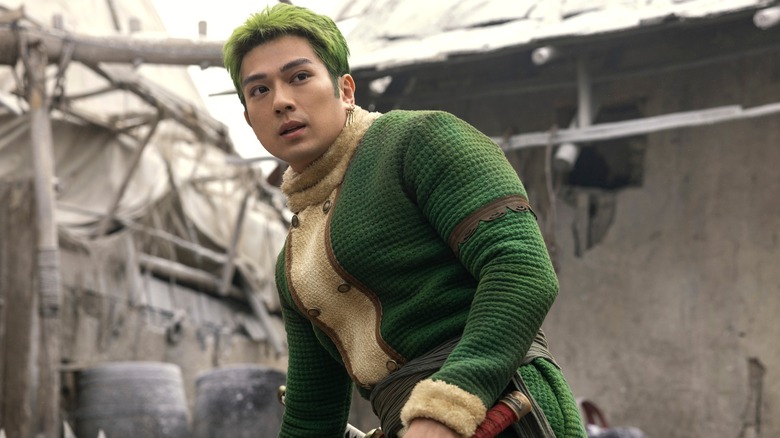
Eiichiro Oda's ongoing action-adventure saga, "One Piece," has already crossed the 1000-chapter mark. Given how big of a commitment it is to invest in such a sprawling narrative, it makes sense to take stock of the basic beats of the story before you start watching the anime series. If a 1000+ episode anime is not your beat, then there's Netflix's live-action "One Piece," which has already passed the biggest adaptation challenges by faithfully capturing the source material's tone. The casting for the live-action Straw Hats Crew has been top-notch so far, especially in the case of master swordsman Roronoa Zoro, who is played by Mackenyu.
The "Pacific Rim: Uprising" actor has a robust background in martial arts: He practiced Kyokushin Karate since age eight, and underwent professional training to embody Zoro's clean, dynamic fight style. As anime battles tend to be greatly exaggerated, such kineticism is often impossible to capture in live-action. That said, Mackenyu has already figured out what makes Zoro tick. It's no easy feat for an actor to work with three swords (with one being held by his mouth, no less), but Mackenyu makes it look effortless enough to help us suspend disbelief.
As it turns out, Mackenyu's father, Sonny Chiba, was a martial arts legend who also achieved stardom due to his professional fighting talents. Apart from being a sports prodigy from a formative age, Chiba also earned a black belt and a fourth degree in Kyokushin Karate. Chiba's acting career began with two tokusatsu (Japanese live-action that heavily uses practical special effects) entries, but his breakthrough role was Shigehiro Ozawa's "The Street Fighter." Chiba went on to star in several English-language American films, so let's take a closer look at this accomplished martial artist's career.
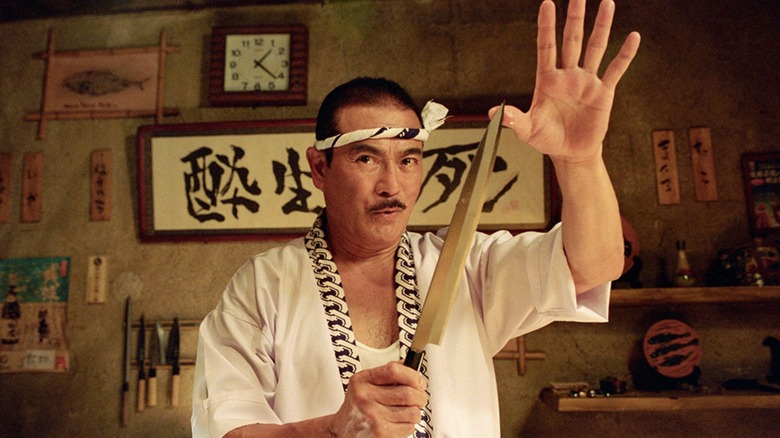
You might remember Sonny Chiba as Hattori Hanzo in Kill Bill: Volume I
Chiba's acting credits are astounding. The "Karate Warriors" star has featured in more than 125 films (!) for Toei Studios alone, while also mastering fight choreography and stunt work. It is no surprise that a passionate filmmaker like Quentin Tarantino is a fan of Chiba's work, so much so that he used the opening of "Karate Kiba" (Chiba's first martial arts movie) during the fake Bible passage scene in "Pulp Fiction."
This deep cut tribute feels more special in the context of Tarantino's 2003 revenge epic "Kill Bill: Volume I," where Chiba plays master Japanese swordsmith Hattori Hanzō. You might remember the character as Bill's (David Carradine) mentor, who took a blood oath to never make "instruments of death" again, but ended up fashioning Beatrix Kiddo's (Uma Thurman) "Japanese steel."
After achieving international fame due to his role in "Street Fighter," Chiba dabbled in action thrillers like "The Bullet Train" and "Golgo 13: Assignment Kowloon" while also starring in science fiction films like "Message from Space." Soon after, Chiba portrayed a feudal-era samurai named Yagyū Jūbei Mitsuyoshi on more than one occasion, branching to television roles in the late 1980s. This time period was arguably the busiest for Chiba, as he starred in several prominent titles like "The Storm Riders" while building a strong portfolio of projects that capitalized on his many talents. While the actor prioritized martial arts choreography in the 2000s, he notably appeared in Takashi Miike's "Deadly Outlaw," Kinji/Kenta Fukasaku's "Battle Royale II," and Justin Lin's "The Fast and the Furious: Tokyo Drift."
The legacy of martial arts in action cinema is incomplete without Chiba's unparalleled contributions, which you can honor by watching (or revisiting) his impressive filmography.