

Why Battlestar Galactica Dove Into Stories About Religion While Star Trek Avoided Them
"Battlestar Galactica" co-creator Ronald D. Moore cut his teeth writing for "Star Trek: The Next Generation" and "Deep Space Nine." In fact, "Battlestar Galactica" was largely shaped by Moore wanting to break conventions he rarely could on "Star Trek."
That meant "Galactica" was filled with character conflict, including philosophical debates on a subject "Star Trek" rarely touches — human religion. "Star Trek" creator Gene Roddenberry was an atheist and he thought the paradise of "Star Trek" could only happen in a post-religious world.
"[Roddenbery's view] was a very secular humanist idea, which I don't have a problem with philosophically, but I didn't believe as a storyteller that in just a few centuries we would discard this fundamental thing that had informed our societies for so long," said Moore in a conversation with legendary sci-fi author Harlan Ellison at the 2006 Screenwriting Expo 5.
Religious themes were a natural fit for "Galactica." Glen A. Larson, the creator of the original 1978 "Battlestar Galactica," was a Mormon and his faith underpinned the series. The series also featured two characters named for Greek gods, Apollo (Richard Hatch) and Athena (Maren Jensen). There was also another Battlestar called the Pegasus, commanded by a man with the biblical name of Cain (Lloyd Bridges). One of the evil Cylons was named Lucifer (Jonathan Harris), and the series also included a satanic villain known as Count Iblis (Patrick Macnee).
Moore's "Battlestar Galactica" kept the names Apollo and Athena — reimagined as pilot call signs for Lee Adama (Jamie Bamber) and Sharon Agathon (Grace Park) — and eventually brought in the Pegasus and Cain (played by "Star Trek" alum Michelle Forbes). The Greek cultural touches became the plank of religious themes in "Battlestar Galactica."
Battlestar Galactica reimagined man vs machine as a religious conflict
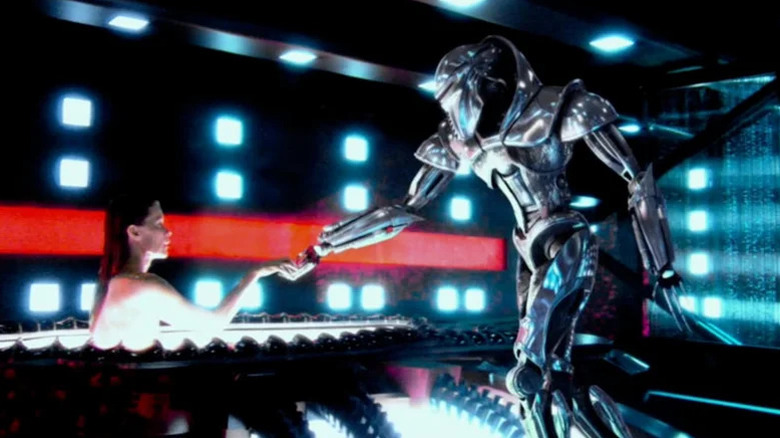
In "Battlestar Galactica," humanity worships a pantheon called "the Lords of Kobol," named for the planet their ancestors left for the 12 colonies. We recognize these Lords as the Greek/Roman gods: Zeus, Hera, Ares, etc. Mankind's robotic creations, the Cylons, reject their parents' polytheism.
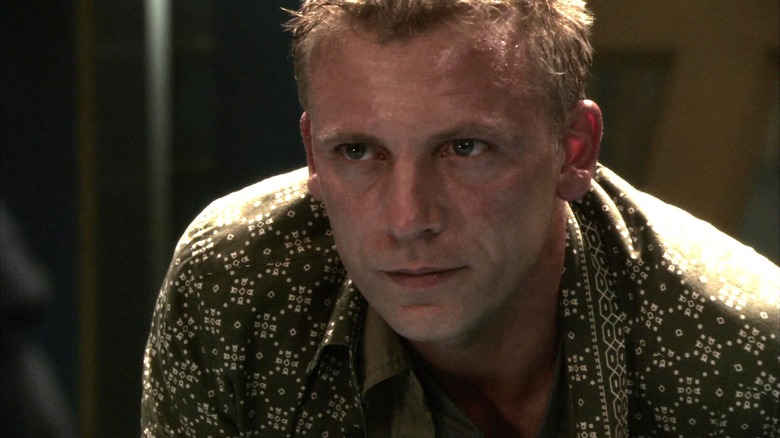
In the "Battlestar Galactica" pilot mini-series, Cylon Number Six (Tricia Helfer) tells Gaius Baltar (James Callis) that "God is love." Cylon Number Two/Leoben Conoy (Callum Keith Rennie) muses that maybe God decided that he made a mistake creating man, and that the Cylons are their replacements. Commander Adama (Edward James Olmos) responds: "God didn't create the Cylons. Man did. And I'm pretty sure we didn't include a soul in the programming."
The mini-series includes some discrepancies, admittedly; some of the human characters use "god" in the singular or "Jesus" as an expletive. But in the series bible that Moore wrote after the mini-series, he firmed up the world-building. The series from then on kept true to humans worshipping the Lords of Kobol while Cylons believe in "the one true God."
"The Cylon God values love above all else, and those who oppose love, who seek to bring evil into God's creation, they must be destroyed," the "Battlestar Galactica" bible reads. That highlights the contradiction of the Cylons' beliefs and their actions, or how differently they interpret "love" than we do.
Moore also wrote that the Cylons' inheriting the thought patterns to create a religious belief system shows how similar they are to humans. Indeed, the Cylons kick off the series by annihilating the twelve colonies and saying it was all God's plan. Espousing a religion of love while wielding "God's words" to persecute your neighbors is about as human as it gets.
How religion became the dominant theme of Battlestar Galactica

Even within the humans and Cylon casts, there are religious divisions aplenty on "Battlestar Galactica." Some of the human characters, like President Laura Roslin (Mary McDonnell) and Starbuck/Kara Thrace (Katee Sackhoff) are devout believers, but hardly all of them are. Leoben and Six are evangelists for the one true God, while Cylon Number One/John Cavil (Dean Stockwell) often puts the G-word in air quotes.
The humanoid Cylons are all variations on a limited number of models; Ronald Moore's series bible says this shows how the Cylons believe everything essential or worth preserving about humanity can be distilled into a few individuals. The Cylons also believe their parents worshipping so many different gods is a sign of humanity's chaotic nature. They prefer the machine-like order and clarity of one God with a single plan.
The Cylons' monotheism is closer to modern Abrahamic religions. Moore even said (in a 2005 interview with Beliefnet) that he was inspired by the real history of how monotheistic religions displaced paganism. But the Cylons' dislike of humans' many gods still works because we are hardly united on religion.
Moore (speaking to Slice of Sci-Fi in 2009) noted that he is an agnostic. His non-committal to a single faith animated how "Battlestar Galactica" explored "the basis of faith and how can you come at it: one God, many gods, no gods, who knows."
In his aforementioned conversation with Harlan Ellison, Moore said that as religion became a bigger and bigger theme, the show had to decide if there was any truth to the characters' beliefs. So, the controversial ending of "Battlestar Galactica" answered that there is a God, but it remained an abstract presence with unclear motives. Many would pray for even that certainty.