

Chuck Norris' Best Role Was In A Movie Clint Eastwood Passed On
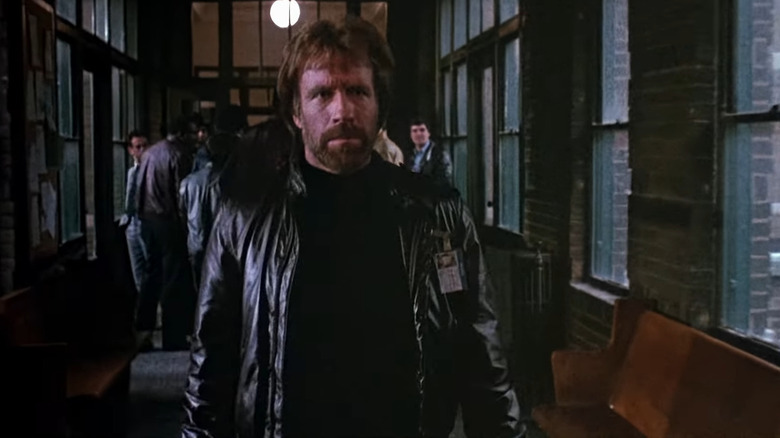
Andrew Davis' 1985 film "Code of Silence" starred the late Chuck Norris as a Chicago cop named Eddie Cusack who finds himself caught in a whirlwind of violent crime. Not only has he discovered that a fellow cop tried to get away with murdering an innocent bystander — and the frustrating code of silence used to protect such corrupt actions — but he finds he has to protect the daughter of a mob boss (Molly Hagan) whose family was murdered by a rival gang. The plot is off-the-rack action schlock that one might commonly find in any violent crime flick of the 1980s, but "Code of Silence" stands above other Chuck Norris vehicles for its sheer quality; /Film certainly thought so, and called "Code of Silence" Norris' best movie.
"Code of Silence" also received pretty good reviews and has a 68% approval rating on Rotten Tomatoes (based on 19 reviews). Variety noted that it was "quite good, for the type" of movie it was. Norris starred in a lot of mid-range action movies in his career, but "Code of Silence" seems to be one of his better leading-man movies.
And here's some fun trivia: "Code of Silence" was originally conceived to be a sequel to "Dirty Harry." One can look up the title in the public copyright database and see that the screenplay for "Code of Silence," written by Michael Butler and Dennis Shryak, was originally called "Dirty Harry IV: Code of Silence." That was in 1979. By then, Don Siegel's 1971 original, Ted Post's "Magnum Force" (1973), and James Fargo's "The Enforcer" (1976) had already hit theaters, with "Code of Silence" lined up next.
It seems that Warner Bros. ended up passing on the script, though, and would instead make 1983's "Sudden Impact."
Chuck Norris' Code of Silence was originally going to be the fourth Dirty Harry movie
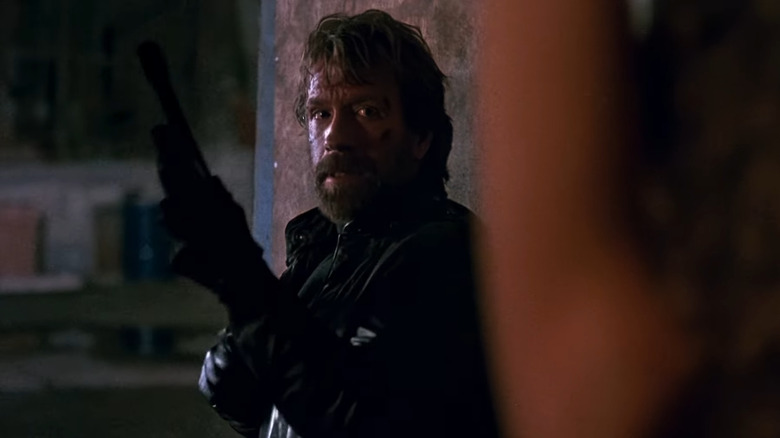
Roger Ebert's review of "Code of Silence" was surprisingly positive, and the critic gave the film three-and-a-half stars (out of four). He noted that Chuck Norris was best known, even at the time, for Z-grade martial arts movies, but that this one was spectacular. Ebert wrote:
"It grabs you right at the start with a complicated triple-cross, and then it develops into a stylish urban action picture with sensational stunts. How sensational? How about an unfaked fight on top of a speeding elevated train, ending when both fighters dive off the train into the Chicago River?"
Ebert was also based in Chicago, though, so he may have felt a rush of local pride. The film was also directed by Andrew Davis, another Chicagoan, so there were clearly a lot of familiar details that denizens could enjoy.
One can kind of see the DNA of "Dirty Harry" in "Code of Silence." Harry Callahan, played by Clint Eastwood, was often depicted as something of a loose cannon, a cop who wouldn't conform to the demands of the higher-ups. Indeed, critics commonly cite "Dirty Harry" as a criticism of the then-new Miranda Rights; in the film, the evil Scorpio killer (Andrew Robinson) cannot be apprehended because his Miranda Rights were violated. This allowed him to keep committing acts of mayhem and violence. The only way to circumvent Miranda Rights was for Harry to go rogue and mete out violent justice in his own idiom. "Dirty Harry" argues for rogue police work and unchecked police power.
The Chuck Norris' character in Code of Silence is very different from Dirty Harry
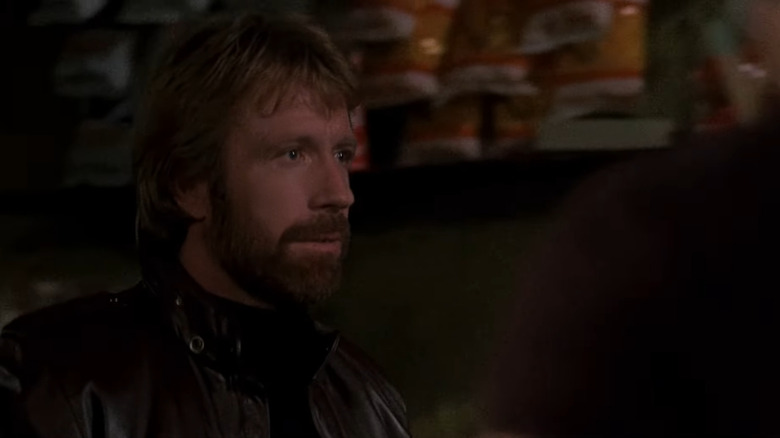
In the world of "Code of Silence," though, the script is flipped. Norris' character, originally meant to be Dirty Harry, does indeed have to go rogue to inflict justice on the world, but this time, it is against a corrupt police officer who is protecting one of their own. Indeed, Norris' character is referred to as a "straight arrow" in "Code of Silence," which is certainly not how one might describe Dirty Harry. Clearly, the script was altered quite a bit before it made its way into Chuck Norris' hands. There is a third credited screenwriter, Mike Gray, on the final movie, and one might safely assume he made the bulk of the film's changes.
According to the website B and S About Movies, the road "Code of Silence" took from being a Dirty Harry sequel to being a Chuck Norris vehicle was a little circuitous, as it was in development for several years, and even had Kris Kristofferson attached as the lead character for a spell. By 1985, Chuck Norris was already a force to be reckoned with at cinemas, having appeared in films like "Lone Wolf McQuade" and "Missing in Action." He seemed like a logical choice.
In a fun article printed in Paste, Norris' co-star, Molly Hagan, recalled a moment on the set where she said something that offended him. There was a scene in which Hagan's character had just learned that her family had been wiped out, and she overheard Norris talking to the director about how his character shouldn't lean in to comfort her. She remembers saying to Norris, "You must, because if you don't, you're an a**hole." Hagan didn't think Norris was an a**hole, but his character. She ended up apologizing anyway.