

Star Trek: The Next Generation's USS Enterprise Was Surprisingly Easy To Design
We may receive a commission on purchases made from links.
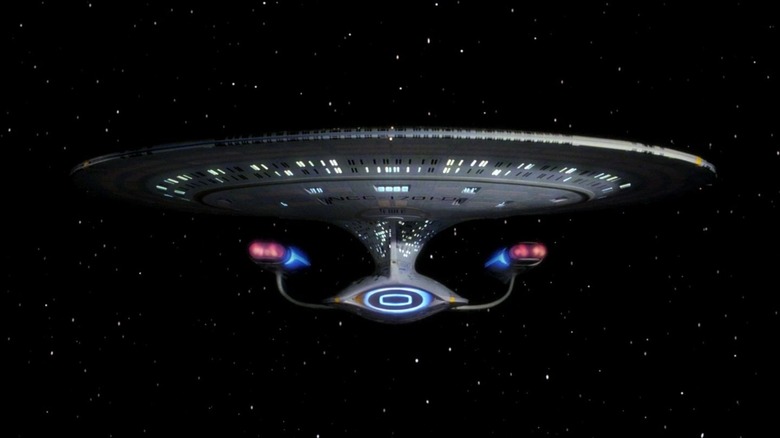
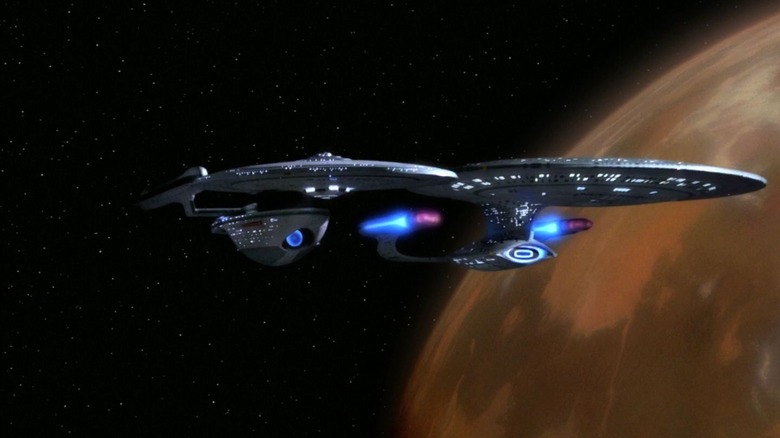
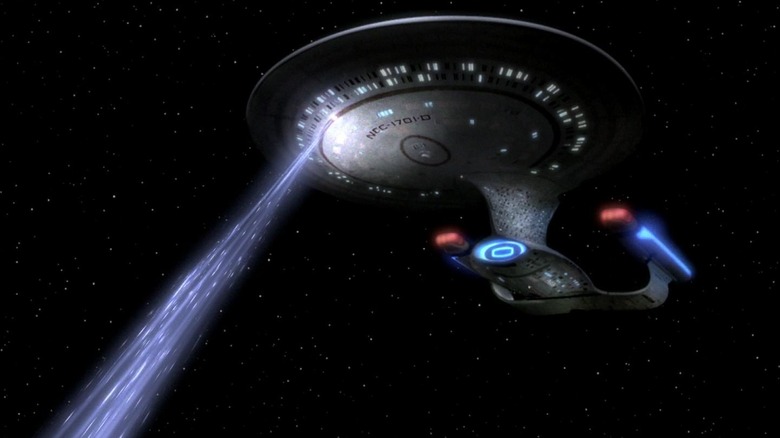
As a longtime fan of Gene Roddenberry's "Star Trek: The Next Generation," I find it difficult to objectively judge the design of the U.S.S. Enterprise-D. Its curved lines, oval saucer, and Jupiterian eye-like deflector dish are now simply a part of my subconsciousness. A friend pointed out that the ship's saucer section might be a little too large, giving the impression that the Enterprise is top-heavy. It's a fair criticism, but I would argue that its large flat head, pleasant shade of gray, and elegant bulging curves give the ship a peaceful quality. It's not all squares, points, or right angles. It's soft and nonaggressive. The design of the Enterprise-D implies pacifism, which is fitting, seeing as "Star Trek: The Next Generation" lives by pacifist ideals.
The Enterprise-D was designed by artist Andrew Probert who also designed the retrofitted U.S.S. Enterprise for "Star Trek: The Motion Picture." Both ships were, of course, extrapolated from the original Enterprise from the 1966 "Star Trek" TV series, designed by Matt Jeffries. All three ships abided by four design rules, laid out by show creator Gene Roddenberry. Rule #1: warp nacelles came in pairs. Rule #2: the two nacelles had to have a line of sight across the hull. Rule #3: the nacelles had to be visible from the front. And Rule #4: the bridge had to be at the very top of the ship's primary hull.
It seems that Probert had all these rules in the back of his mind when he was designing the Enterprise-D, back when "Star Trek: The Next Generation" was still being developed, and he just sort of banged out a sketch, not even asked to design the ship. According to Paula M. Block's and Terry J. Erdmann's book "Star Trek: The Next Generation 365," it was a very smooth, easy process.
Andrew Probert designed the Enterprise-D without even being asked to do so
Andrew Probert, because he worked with Roddenberry on "Star Trek: The Motion Picture," was the natural choice to invent some of the new ships and interiors for "Next Generation." However, Probert wasn't asked to design the ship itself, he was only asked to design the bridge where the bulk of the show's action would take place. Probert recalled Roddenberry telling him that his design was going to be very important, and he theorized that he was maybe only the fifth person ever to be hired to work on the series.
But when he started thinking about the bridge, his mind was on the outside of the vessel. Just for fun, he drew the Enterprise-D, mostly just in a fit of creative pique. The drawing was noticed by Robert Gerrold, a writer for "Star Trek," and a producer in the earliest days of its development. As Probert himself said:
"Although I was brought on to design the bridge, naturally I wanted to design the exterior of the ship if given the opportunity. I was doing little doodles of what I would like to see the new ship look like, and I tacked one of those doodles on the wall in front of me. One day, David Gerrold came in to talk, and he glanced up and said, 'Hey, is that the new ship?' I said I didn't know, so he said 'Let's find out," and he pulled it off the wall and left. A little while later, he came back, slapped it down in my desk and said, 'Yup, that's the new ship.'"
Probert didn't even think his drawing would ever be seen, much less used. But there it was. He doodled it, and it came to life.
Gene Roddenberry only had two notes
Later on Andrew Probert learned that David Gerrold was already on his way to a meeting with Gene Roddenberry, as well as "Next Generation" producers Bob Justman and Herbert Wright. Gerrold showed Probert's sketch to the team, and they all fell in love immediately. One can see a photo of Probert's initial sketch online in various places. There really wasn't much of a change from those initial drawings to the final ship.
Gene Roddenberry, it seems, only had two notes for Probert. For one, Roddenberry wanted the ship to be a little longer. The Enterprise-D, it should be noted, is twice as large as the Enterprise seen in "Star Trek: The Motion Picture," something Probert came up with. Roddenberry liked the idea of an extra-long ship, and actually requested that Probert make its warp nacelles even longer than they had been. He was used to the longer engines on the original Enterprise. Probert accommodated. All told, the Enterprise-D was 2,180 feet long.
Also, in Probert's original sketch, the top of the Enterprise-D's saucer section was perfectly smooth. Roddenberry reminded Probert that he liked the bridge of a starship to be right on the top. "I feel it gives people an idea of the scale of the ship," he said.
And that was that. The Enterprise-D was born. Since then, of course, Trekkies were eventually introduced to the Enterprise-B and the Enterprise-C (both seen in flashback or time-travel stories), and the feature films based on "Next Generation" saw the intro of the Enterprise-E. For my money, though, the design never got better than the Enterprise-D. It's just such a lovely, smooth, comforting ship to look at.