

Meryl Streep's Project Hail Mary Role Explained
Spoilers follow.
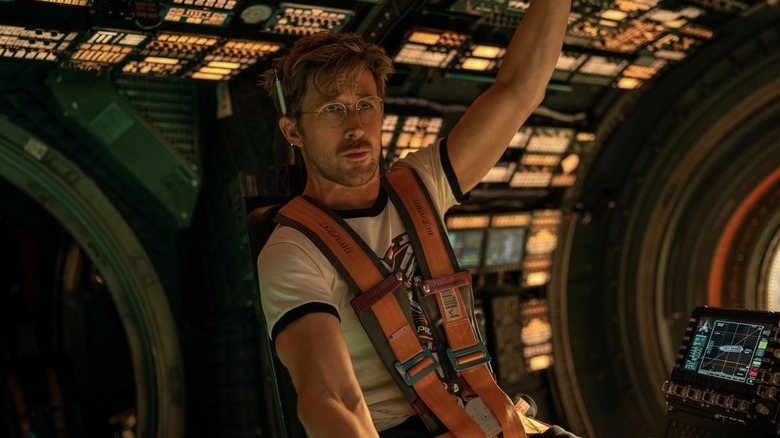
In Phil Lord's and Christopher Miller's "Project Hail Mary," Earth is in trouble. A mysterious, ineffable force seems to be robbing the sun of its energy, causing it to swiftly go out. Ryan Gosling plays a beleaguered scientist named Dr. Ryland Grace, who is enlisted by the world's governments to travel to a nearby star that seems to have inexplicably survived a similar crisis. Dr. Grace will have to gather information on the distant star and send it back to Earth in a Hail Mary attempt to save the world.
While on his mission, Dr. Grace encounters an unexpected visitor. It seems that the distant star is also being studied by an extraterrestrial ship piloted by an alien scientist. The alien looks like a three-foot-wide tarantula made of rock, but is intelligent and friendly, and wants to work with Dr. Grace; his homeworld's sun is also suffering a similar fate as Earth's. Dr. Grace and the alien — nicknamed Rocky — spend a good deal of the movie learning how to communicate, and Dr. Grace develops a computer program that can listen to Rocky's otherworldly chitters and translate them into an artificial human voice.
Dr. Grace, wanting to give Rocky some personality, briefly cycles through a few potential artificial voices for his collaborator. Grace and Rocky listen to a few voice samples together. In a brief, amusing moment, one of the potential voices is that of Meryl Streep. Grace listens to Streep's voice recite some of Rocky's words and then tearily comments that "She can do anything."
Yes, that was actually Meryl Streep's voice in a cute cameo appearance. In an amusing story told to the Hollywood Reporter, Lord revealed that Gosling wasn't told that she would be appearing.
Oh, Rocky!
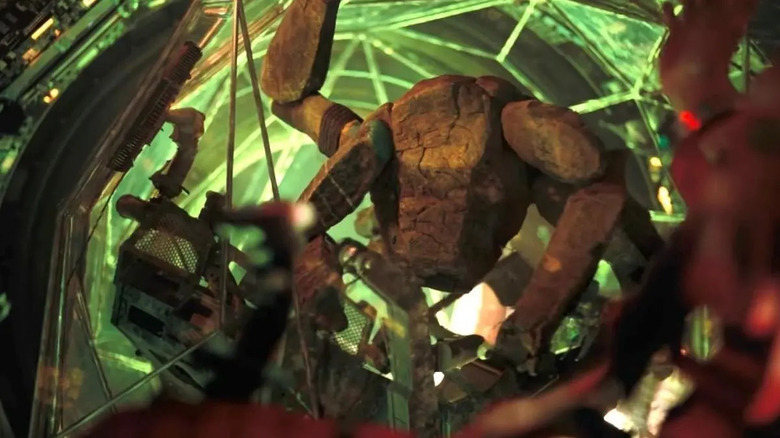
The voice that the film finally settles on is a plain-spoken male voice played by actor and Rocky puppeteer James Ortiz. The deadpan, computerized delivery of Rocky's voice makes the creature seem weirdly more human, as we're listening to his words more than his passions. As the film goes on, Ortiz begins inserting more emotion into his line readings, making Rocky more and more relatable as time passes. It's an impressive feat, seeing as Rocky is, as mentioned, a rock tarantula.
It seems that the scene wherein Dr. Grace listened to potential voices was partly improvised. Both James Ortiz and Ryan Gosling were given earpieces, and various actors recited Rocky's dialogue into their ears, with both actors giving genuine, unscripted reactions. As Lord said:
"Most of it was on set. We gave Ryan an earwig and James one. And then we had different people on set come up at the microphone and didn't tell Ryan who it was going to be. His kids were on set, so they started doing silly voices."
Gosling's two daughters, sadly, do not appear in "Project Hail Mary," although it would have been cute to witness the actor responding, in character, to his kids doing funny alien voices. There are a few other voices one might recognize in "Project Hail Mary," but I will leave those for the reader to discover. The film is in theaters now, and it's definitely worth a trek to the theater. It's one of the better sci-fi films in recent memory.
"Project Hail Mary" is based on the novel by Andy Weir, but it's the first Lord/Miller adaptation that isn't expressly kid-friendly ("Cloudy with a Chance of Meatballs," "The LEGO Movie") or riffing on ideas of nostalgia and pop knowledge ("Spider-Man: Into the Spider-Verse," "21 Jump Street").