

Steven Spielberg Thought One '80s Action Classic Was Dangerous For Society
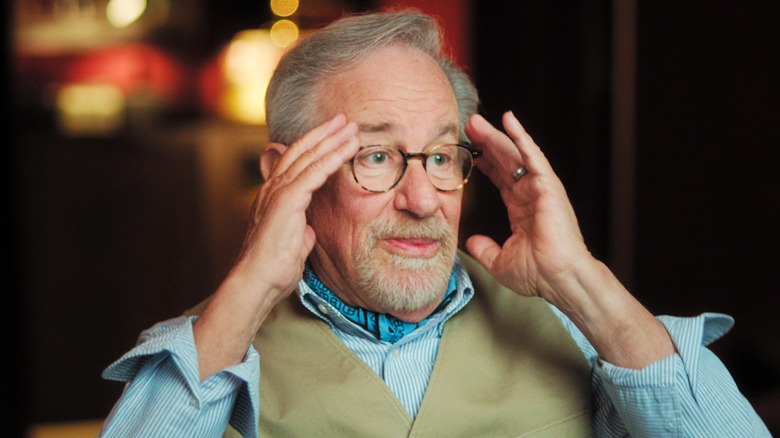
To this day, Steven Spielberg regrets the negative effect "Jaws" had on sharks. His seminal 1975 thriller is often blamed for propelling the decline of the global shark population, though just how much "Jaws" is actually at fault remains unclear. As far as the director is concerned, however, he has blood on his hands. But it's not just the real-world impact of his own movies that Spielberg worries about. In the mid-'80s, the filmmaker expressed concern over Sylvester Stallone's second outing as John J. Rambo in the exquisitely-titled "Rambo: First Blood Part II."
Sly first debuted as the ex-Green Beret war vet in 1982's "First Blood." Still the best "Rambo" movie ever made, the film was an adaptation of David Morrell's 1972 novel of the same name, which featured a heavy critique of the Vietnam War. Much of that made it into Ted Kotcheff's film adaptation, which followed Rambo as he returned from war and arrived in the small town of Hope, Washington, to a hostile reception. There, he immediately draws the ire of local sheriff William Teasle (Brian Dennehy), who has Rambo arrested, triggering his Post Traumatic Stress Disorder and sending him on the run.
While "First Blood" did feature the kind of action tropes that quickly became clichés in the years after the film's debut, it also maintained the book's social commentary, clearly depicting Rambo as a tortured vet who didn't even kill anyone throughout the film's runtime. When "First Blood Part II" arrived, however, things were different, and Spielberg clearly wasn't too sure about this new direction, describing the sequel as "potentially a very dangerous movie" that "changes history in a frightening way."
Before First Blood Part II, Rambo was anti-war
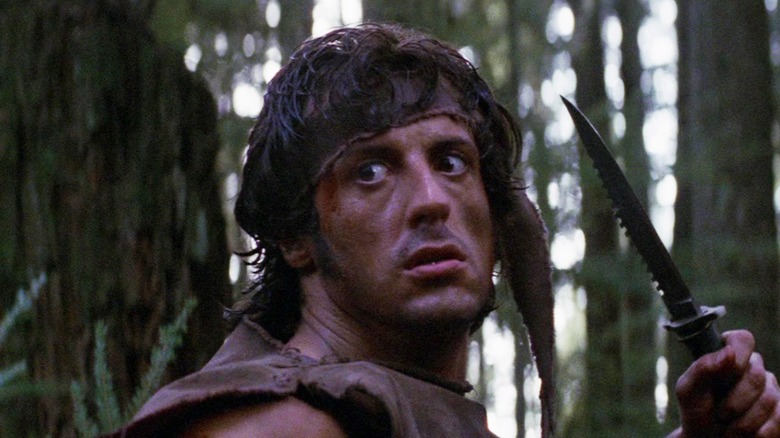
The "First Blood" story was based on harrowing true stories about war veterans, and that carried over to the film, which saw Sylvester Stallone's hero breaking down in the closing moments. But in 1985, John J. Rambo returned, rehabilitated and out for blood. "First Blood Part II" saw Rambo released from prison and sent on a mission to track down missing prisoners of war in Vietnam. He was under strict orders not to rescue any of the prisoners, but wasted no time in contravening those orders. Once he did so, however, he found himself abandoned by the U.S. Government and forced to outwit the Vietnamese and their Soviet backers solo — and by outwit, I mean single-handedly decimate.
While he didn't kill a single soul in "First Blood" (an accidental death notwithstanding), Rambo dispatches a full 75 bad guys in "Part II." That alone should give you an idea of how different the sequel was. But its politics were also much more simplistic. Whereas the first film had a clear anti-war bent, the second installment seemed to enjoy the very horrors of war that the original abhorred. Director George P. Cosmatos' bombastic sequel saw Rambo blowing stuff up and killing a bunch of foreign enemies using the real-life POW/MIA dispute as an excuse. At the end of "Rambo: First Blood Part II," after laying waste to his foes and freeing the prisoners, Rambo tells Trautman, "I want what they want, and every other guy who came over here and spilled his guts and gave everything he had wants. For our country to love us as much as we love it. That's what I want!"
For Steven Spielberg, this was all a bit too much to take.
Steven Spielberg thought Rambo: First Blood Part II was fun but dangerous
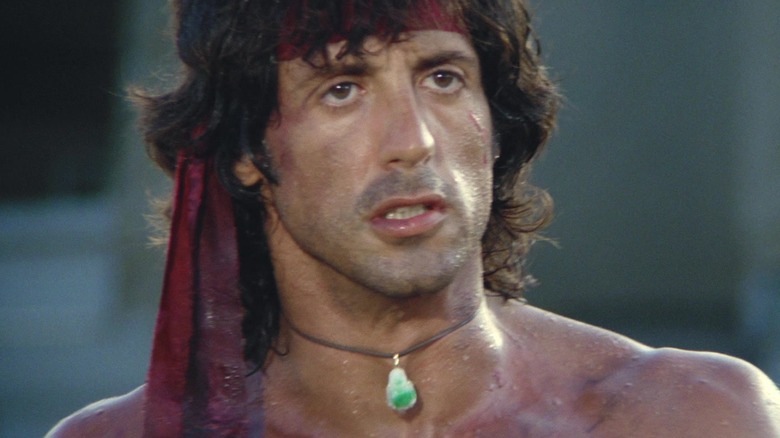
Even Sylvester Stallone says his best action movie is "First Blood," and it seems Steven Spielberg would agree. With "Rambo: First Blood Part II," the titular hero was no longer a walking anti-war symbol. Instead, most of his actions in the film were a pure celebration of violence — and Rambo wanted nothing but praise for it. That, for Spielberg, was dangerous.
In a 1985 Rolling Stone interview (via DavidBreskin.com), Spielberg was asked what he thought of "First Blood Part II." The director said he "love[d] 'Rambo,'" before going on to criticize it as dangerous. "It's a this-is-the-way-it-should-have-been motion picture," he said. "Which is very, very frightening. It changes history in a frightening way."
Spielberg didn't elaborate on what he meant, but based on the storyline of "First Blood Part II," it's obvious he was put off by the jingoistic, morally questionable politics on display in Stallone's $25 million bloodbath. The final plea for unwavering gratitude for veterans followed 96 minutes of non-stop violence that saw the Viet Cong flattened by Stallone's one-man army. Apart from anything else, then, this attempt at emulating Rambo's emotional outburst from the first film was flat out ridiculous, coming as it did at the tail end of a massacre.
Still, like the audiences who propelled the film to $300.4 million at the box office, Spielberg still had to admit "First Blood Part II" was "a helluva well-made picture." He continued, "It winds you up inside, and when it lets you go, you spin around like a top, and the darn thing is just so much fun to watch. Even bleeding-heart liberals walk out trying desperately to deny that they were entertained. I was entertained and angered at the same time."