

How Scientifically Accurate Is Battlestar Galactica?
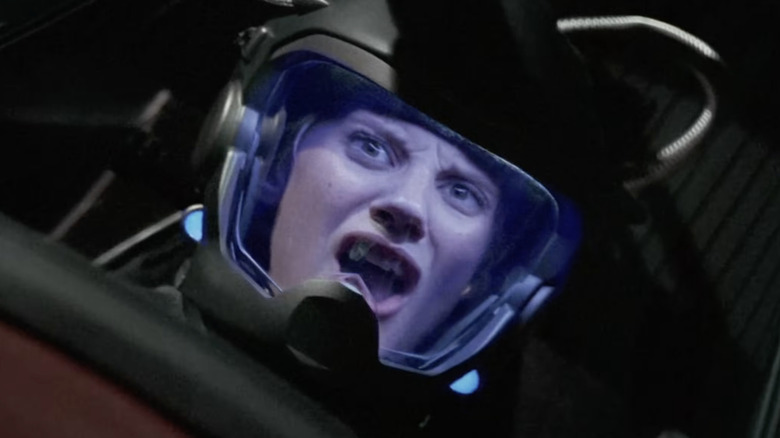
If a story has faster-than-light starships and chrome-plated robots, that's usually a sign it's thrown scientific accuracy out the airlock. Even so, the 2000s "Battlestar Galactica" reimagining was made as a more "grounded" space opera that put character and politics first. In the series' bible, "Battlestar" co-creator Ronald D. Moore wrote that:
"Our show is built on the idea that a science fiction series can employ ground-breaking special effects, dynamic cinematography, realistic situations, believable characters, and explore contemporary social and political issues without sacrificing dramatic tension or excitement."
To add to that tone, the show steered away from some sci-fi stereotypes to create a more tactile and familiar world for its audience. There were no aliens in "Battlestar Galactica," and its characters used modern tools like guns (no lasers), pens and paper, etc.
Moore got his start in TV writing on "Star Trek: The Next Generation," and he wanted "Battlestar Galactica" to avoid the parts of "Star Trek" that frustrated him. One of them? Technobabble or stringing scientific terms together in dialogue to give plot devices the air of realism. There should be less time discussing phony science jargon and more "emotional fallout," Moore wrote in the "Galactica" bible.
Thus, "Battlestar" rarely (though not never) got bogged down in explaining the specifics of how technology works, be it the Battlestar's ability to "jump" across space or the android Cylons' resurrection via downloading their minds into new bodies. When weaselly scientist Gaius Baltar (James Callis) does start speaking in technobable, it's a sign he's trying to befuddle someone.
In the book "The Science of Battlestar Galactica" (by Patrick Di Justo and "Galactica" science consultant Dr. Kevin Grazier), Moore was quoted as saying, "We always tried to make drama work with science on 'BSG,' but when push came to shove, drama wins."
Battlestar Galactica puts drama before science
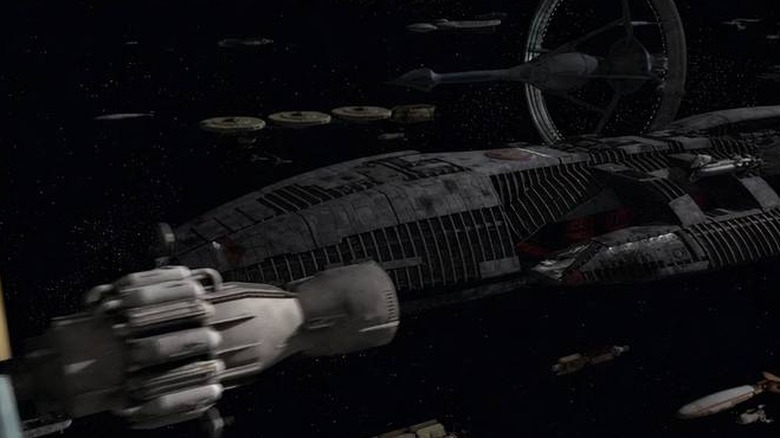
A key example of drama coming first is in the "Battlestar Galactica" episode "Exodus." To rescue some people on the colony New Caprica, Galactica jumps into the planet's upper atmosphere to release its Viper squadrons to attack the Cylons. Galactica is in free fall and burning up, but it jumps away before it crashes to the surface.
Kevin Grazier recalled this scene at the Hollyweird Science Panel during Comic-Con@Home 2021. Speaking as a planetary physicist, he admitted it was "one of the worst science moments we had." The Galactica itself would break up in New Caprica's atmosphere, as would the Vipers when they tried to launch. Why did Grazier sign off on it? "'Owing to the extreme coolness of this, go for it, because I want to see that.' And do you know how many complaints we got online? Zero."
A bigger example is how "Battlestar" depicts sound in space. In real-life, sound doesn't travel in a vacuum. Most sci-fi franchises, from "Star Wars" to "Star Trek," ignore this and use sound effects for space battle scenes. By comparison, the beloved space Western series "Firefly" (which also tried to avoid "Star Trek" clichés) has space completely and scientifically-accurately muted. "Battlestar" goes somewhere in the middle; sound effects in space are muffled, but there's still some dramatized sound.
One part of space physics the show does get right though (per astronomer Greg Brown and New Scientist) is the Vipers' propulsion. The Vipers have small air-release valves to make turns or flips, because they have no other force to push them in a vacuum. As Brown notes, space operas often feature vehicles meant to be fighter jets in space (think X-Wings in "Star Wars"), yet they don't account for the lack of air. "Battlestar" does.
Battlestar Galactica only explains its science as needed
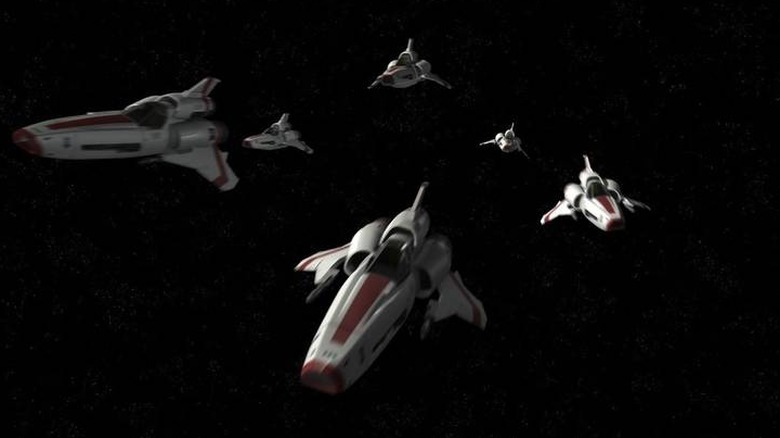
In a 2009 interview with New Scientist, Dr. Kevin Fong (a space medicine expert) argued it was unrealistic that the Galactica had manned fighter crafts like the Vipers at all:
"You would think that, if they had that much technology, they would probably be able to get the things to fly themselves much more efficiently."
This criticism actually does have an explanation, though! In the series' bible, Ronald D. Moore wrote that humanity largely did away with computer networking technology after the creation of the Cylons to prevent Cylon infiltration of their defense systems. Hence, no unmanned drones. That's an explanation that makes sense on its face (the Cylons are basically living computers) and doesn't require much technical detail. Unlike, for instance, going through the trouble of explaining how the Galactica and other ships generate their artificial gravity.
As Fong noted to New Scientist, this allows "Battlestar Galactica" to bypass some issues real astronauts face in a zero gravity environment (such as muscles, including the heart, atrophying). Patrick Di Justo, speaking to Wired in 2010, argued that "Galactica" not explaining other scientific details — like how the ship's faster-than-light travel system works or how Cylon infiltrators pass medical checks — left the door open for him and Kevin Grazier to try and answer those questions in "The Science of Battlestar Galactica."
The most medically accurate part of "Battlestar Galactica" is, per Fong, "the psychology." He specifically cited the episode "33," where Galactica has to jump every 33 minutes to avoid Cylon ambushes, as correctly depicting exhaustion. Considering the show's focus on character and drama, accurate psychology is high praise.