

Pixar's Hoppers Took Inspiration From A Studio Ghibli Movie For One Specific Aspect [Exclusive]
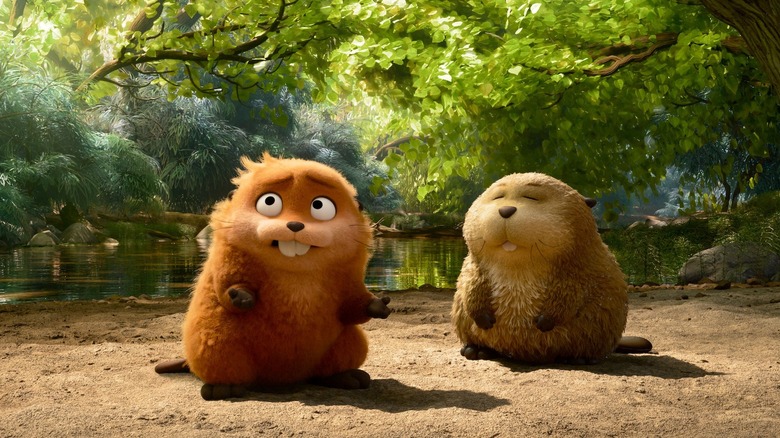
Daniel Chong's new animated film "Hoppers" follows the adventures of a teenage conservationist named Mabel (Piper Curda) as she fights City Hall to preserve a local glade. The glade is personally important to her — she used to spend time with her grandmother there — and it is under threat because City Hall (represented by Jon Hamm) wishes to bulldoze it and build a highway. The mayor says he can legally do this, as all the animals have all left the glade. Mabel figures if she can find a beaver and convince it to build a dam, it will revive the miniature biome and prevent construction from taking place.
Luckily, Mabel happens to be friends with one Dr. Sam Fairfax (Kathy Najimy), who has developed an "Avatar"-like technology that allows humans to project their consciousnesses into ultra-realistic animal robots. Through a series of plot complications, Mabel finds herself in the body of a robotic beaver and has to move among the animals, trying to convince other beavers to return to the glade.
As a robot, Mabel can communicate with animals, and both she and the audience can hear beavers, bears, lizards, birds, and even insects speaking in clear English. When the film cuts to a human perspective, however, the humans only hear the animals chittering and squawking. To visually indicate what perspective we're seeing, Daniel Chong gave the animals large, expressive cartoon eyes when they're talking to one another. Humans see them as having small, inexpressive "dot" eyes.
/Film's own Bill Bria recently spoke with Chong, and the director said the visual perspective indicator was a design choice, yes, and one that he borrowed from a lesser-known film from Studio Ghibli. Particularly, Chong said he was borrowing the human/animal duality from Isao Takahata's 1994 film "Pom Poko."
Daniel Chong took inspiration for Hoppers from Isao Takahata's Pom Poko
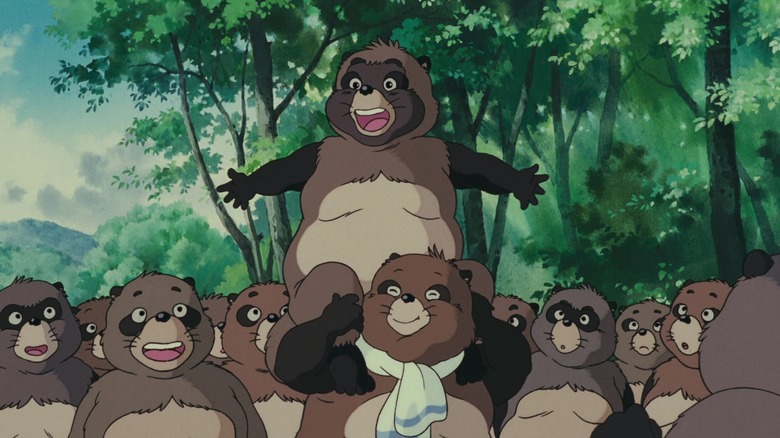
"Pom Poko" is a delightful, laidback movie about a clan of Japanese raccoon dogs — or tanuki — whose environment is threatened by the encroaching construction of a housing development. The tanuki, as they are typically depicted in Japanese folklore, are impish, horny shapeshifters, typically more concerned with creature comforts than threats from outside. Eventually, the tanuki rebel. They hone their transformation skills and conduct acts of espionage. "Pom Poko" is a bit of a tough sell in the United States, as the animators were careful to animate all the male tanuki's testicles. That's not a detail usually seen in American animated films for kids.
When the "Pom Poko" tanuki are talking to one another, they are anthropomorphic, standing upright and speaking in human language. When humans see them, they look more realistic, like wild animals. This conceit was mentioned by Daniel Chong in his interview with /Film when discussing "Hoppers." Bill Bria asked him about the way the animals see one another vs. the way humans see them, and Chong answered:
"I think I kind of knew it right away that we needed something like that. What we call it internally with ourselves was it's a two world kind of rule where there's like the human point of view and there's an animal point of view. So we always knew we wanted that. And I think we took a lot of cues from 'Pom Poko,' the movie from Studio Ghibli, which does something similar. [O]bviously the plot's very different, but the idea that you could showcase two different versions of the animals, and yet the audience understands we're talking about the same animal."
It's pretty clear in both movies, and you can see it for yourself as "Hoppers" is playing in theaters everywhere.