

Paradise's Writer Explains How The Hulu Show Is Pretty Much A Western
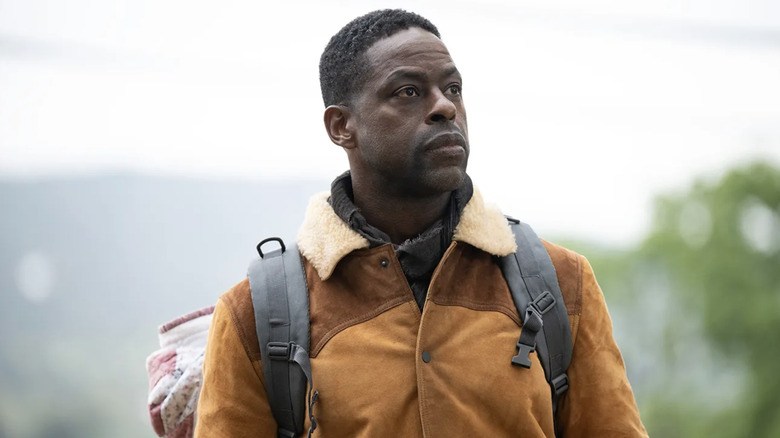
Few filmmaking tricks are as simple yet clever as the Texas Switch, in which an actor slyly swaps spots with their stunt double while the camera keeps rolling. So, you'll appreciate my meaning when I say that creator Dan Fogelman executes a perfect genre Texas Switch in the premiere for his Hulu series "Paradise." To be sure, the episode never so much as cracks a smile as it presents itself as a by-the-book political thriller about the mysterious murder of one fictional U.S. President Cal Bradford (James Marsden). It's only in its closing moments that the premiere reveals what its lead, Sterling K. Brown's strapping Secret Service Agent Xavier Collins, is all too painfully aware of: that everything we just saw took place in a giant underground bunker in the wake of some as yet unexplained apocalyptic event.
"Paradise" only keeps on mutating from there. Like Fogelman's long-lived NBC hit "This is Us," it's a series filled with soapy drama and flashbacks that prompt us to re-examine what we previously thought we knew about specific characters and incidents. At the same time, season 1 occasionally plays like a serious version of the Fogelman-produced whodunnit TV comedy "Only Murders in the Building," and that's before the more emotional if clumsy "Paradise" season 2 evolves the show into a story involving survivors traversing a post-apocalyptic landscape while moneyed forces conspire to reshape the world as they deem fit. So, basically, the "Fallout" TV series, but with fewer exploding heads.
Speaking with The Hollywood Reporter, however, executive producer and writer John Hoberg made the case for "Paradise" being a Western at its core, given how it's constantly testing its hero, Xavier, to determine if he'll abandon his principles on his adventure. But, really, "Paradise" is a Western in more ways than that.
Paradise is a classic Western set in a post-apocalyptic world

This fake town under a mountain ain't big enough for the both of us. Okay, that line doesn't quite roll off the tongue, but it does get to the heart of the Western-y conflict between Xavier and Samantha "Sinatra" Redmond (Julianne Nicholson), the crafty tech mogul who funded the construction of "Paradise" and pulls the strings on its puppet politicians. Take away the "end of the world" aspect, and their war to determine how order and justice will be meted out in the show's version of the new frontier could have just as easily come out of a classic Western film.
Xavier's struggle is similarly the guiding light that keeps "Paradise" on course as it navigates genres. As John Hoberg put it:
"The weird thing is that the genre I have in my head for this show is a Western. Xavier is a Western hero. He is that person with an uncompromising goal. He has a set of values he won't compromise. So, even if the genre is shifting one way or another, the anchor to the entire show is him. We're testing him. Every episode, we're going to test him on his moral and personal codes to see if he is going to crack. So, even if the show blends into different things, he holds it together."
For that matter, Sterling K. Brown even plays Xavier like he's an archetypal white hat (read: noble) cowboy who alternates from being brave to tender and aw-shucks humble as the occasion merits. It's why we, as viewers, can't help but cheer him on through thick and thin ... and more than the occasional, equal parts charming and cringe-inducing, slowed-down dramatic cover of an older pop song.
"Paradise" is streaming on Hulu.