

You're Not A Mel Brooks Fan If You Haven't Seen This '70s Satirical Comedy
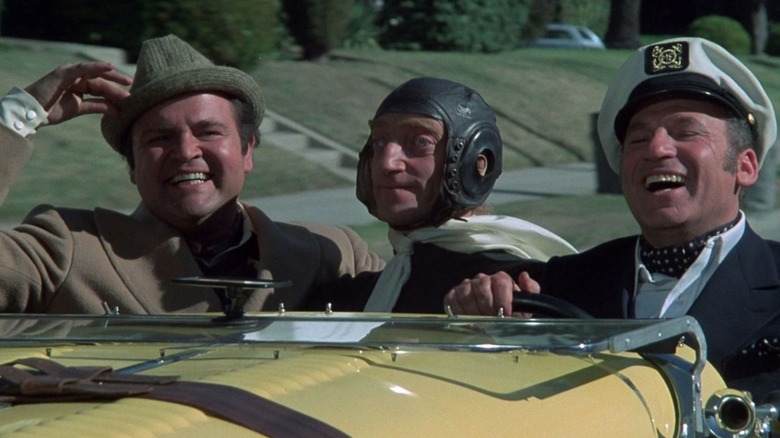
Mel Brooks' 1976 comedy "Silent Movie" is one of the lesser-seen in the comedian's catalogue. As a writer/director, Brooks exploded onto the cinema scene in 1967 with "The Producers," one of the funniest films of all time, and one that won Best Screenplay at the Academy Awards. He followed that with 1970's "The Twelve Chairs," a picaresque adventure based on a Soviet novel. That film was beloved by critics and inspired Roger Ebert to write a four-star review. 1974, as all comedy fans know, was a banner year for Brooks, as he wrote and directed both "Young Frankenstein" and "Blazing Saddles," two of his best and most popular movies. John Wayne was almost in "Blazing Saddles." Those films are still widely enjoyed to this day.
"Silent Movie" came next, and it was perhaps a little too oblique for mainstream audiences. It is, as the title denotes, a silent movie. There is no spoken dialogue (one notable word notwithstanding), and the film sports old-fashioned silent movie intertitles. The story is also an appealing metanarrative about its own existence. Mel Brooks plays Mel Funn, a film director whose career is flagging. His buddies Dom and Marty (Dom DeLuise and Marty Feldman) convince him that making a silent movie would be a great career boost. Mel agrees; silent movies are still a legit art form. They're just out of fashion.
Naturally, Mel has trouble selling a silent movie to the studio head (Sid Caesar). The studio head says that he'll only make a silent movie if Mel can sign some of the biggest movie stars available. The rest of the film involves Mel Fun/Brooks approaching giant movie stars (all playing themselves), asking if they'll be in the movie. The movie they're technically already in.
Silent Movie starred some of the biggest actors of the day
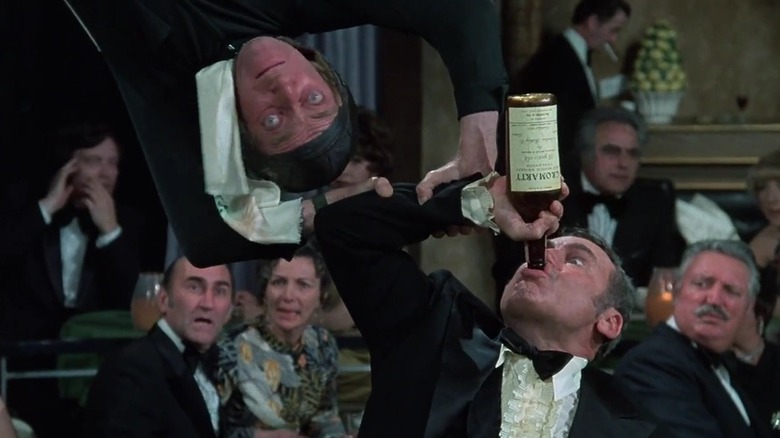
Mel Brooks was always fond of breaking the fourth wall, but "Silent Movie" doesn't have any walls. It's like a cartoon version of François Truffaut's "Day for Night," constantly commenting on its own existence. Each time a celebrity appears, the laughs come from their own winking awareness of their own place in the movie. Naturally, when Mel confronts each of the actors, wacky, Buster Keaton-like shenanigans ensue. As if the medium of silent films warps reality around it to create a more acceptable visual language. The big stars in question, incidentally, are Burt Reynolds, Liza Minnelli, Paul Newman, James Caan, and celebrated mime Marcel Marceau.
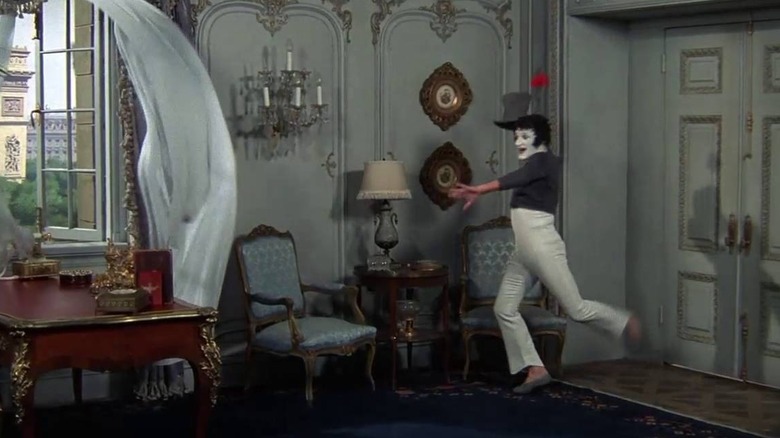
Marceau gets the most memorable moment in the movie. Mel calls him on the telephone, and Marceau answers in full face paint and a mime outfit. He makes a big mimetic production of answering the telephone, demonstrating how perfect mime is for silent movies. When asked if he'll be in the film, Marceau says "No" out loud, providing the movie its only word of dialogue. It's a very cute joke.
To make sure the metanarrative strikes even harder, one of the "big stars" Mel tries to secure is Anne Bancroft, Mel Brooks' own wife, playing herself. The studio head was, as mentioned, played by Sid Caesar, reminding the audience that Brooks got his start writing sketches and scripts for Caesar's 1950 program "Your Show of Shows."
"Silent Movie" was a hit when it came out, making over $36 million on its $4 million budget. It was nominated for four Golden Globes, and critics were largely very positive. And yet, in the 2020s, it appears to be one of the lesser-seen of Brooks' films.
Silent Movie is underrated
Some critics very much liked "Silent Movie." Like "The Twelve Chairs," Roger Ebert gave "Silent Movie" four stars, openly stating that the movie made him laugh heartily. Rather daringly, Ebert said that he thought "Silent Movie" was even funnier than "Young Frankenstein." As he wrote:
"[Mel Brooks is] an anarchist; his movies inhabit a universe in which everything is possible and the outrageous is probable, and Silent Movie, where Brooks has taken a considerably stylistic risk and pulled it off triumphantly, made me laugh a lot. On the Brooks-Laff-O-Meter, I laughed more than in 'Young Frankenstein' and about as much as in 'Blazing Saddles,' although not, I confess, as much as in 'The Producers.'"
Ebert doesn't focus too much on the meta-commentary and merely states that "Silent Movie" was a success because it's funny.
If Letterboxd is any kind of serious gauge, "Silent Movie" is the least-watched of Brooks' films. It has about 23,000 comments, whereas Brooks' other films like "Blazing Saddles" and 1987's "Spaceballs" have over 300,000 and over 468,000, respectively. Sadly, the movie is not available on streaming, but there are plenty of Blu-rays out there for purchase.
Brooks followed "Silent Movie" with an equally ambitious, high-concept meta-comedy called "High Anxiety," a spoof of Alfred Hitchcock movies. That film is only funny if you know a lot about Hitchcock and can spy which shots Brooks is cribbing from. He only directed two movies in the 1980s — "History of the World, Part I" and "Spaceballs" — but also began producing other important dark auteur movies like David Lynch's "The Elephant Man," Freddie Francis' "The Doctor and the Devils," and David Cronenberg's "The Fly." There is nothing he cannot do.