

Roger Ebert Explained Why Mel Brooks' Alfred Hitchcock Spoof Didn't Really Work
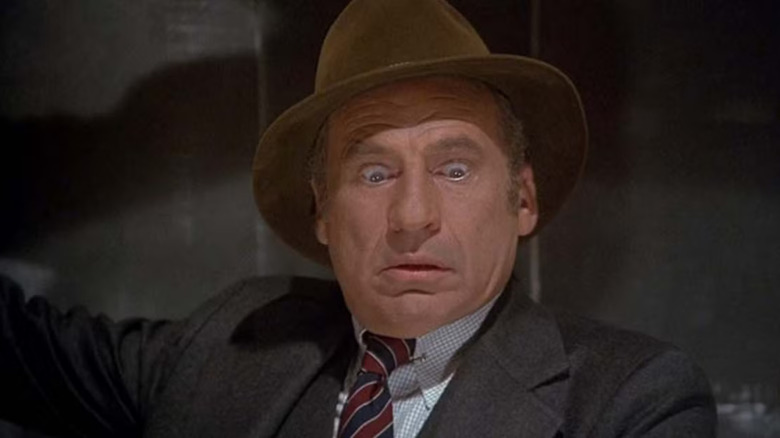
The Mel Brooks directed 1977 comedy "High Anxiety" only really works if you are intimately familiar with the various films of Alfred Hitchcock. Its title is an allusion to "Vertigo," for one, and the movie's asylum setting is a clear nod to "Spellbound." Even Brooks' on-screen character, Dr. Thorndyke, seems like a wink to Raymond Burr's "Rear Window" character, Lars Thorwald, with nearly every visual gag in the film being a riff on something Hitchcock did in one of his movies.
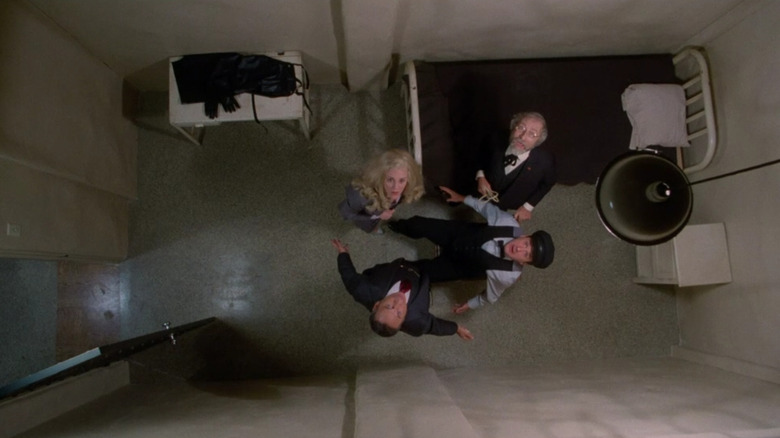
Sometimes, the jokes are obvious, like a bird attack scene (a clear homage to Hitchcock's "The Birds") in which the birds merely poop on people. Sometimes, however, one needs to have sharper eyes. For example, there's a scene where Harvey Korman and Cloris Leachman's characters are filmed sitting at a coffee table from a low angle, itself likely a reference to Hitchcock's "Rope." (Notably, Leachman's character herself appears to have been inspired by Mrs. Danvers from "Rebecca.") Similarly, another scene has Madeline Kahn's character entering a hotel room in a way that echoes a moment from "The 39 Steps."
That being said, 1977 was an odd time to make a full-bore Hitchcock spoof, as his movies weren't as popular then as they'd been 15 or 20 years earlier. What's more, in his "High Anxiety" review, Robert Ebert argued that lampooning the filmmaker felt like a churlish exercise overall. While Hitchcock was known as a master of suspense, his movies also had a lot of dry humor and self-awareness. Hitchcock liked to wink to his audiences quite directly, often by putting himself on screen in cameo roles.
Basically, Ebert felt that one can't really effectively satirize something that's already kind of poking fun at itself. Brooks' "High Anxiety" was, to Ebert, like putting a hat on a hat.
Roger Ebert felt that Hitchcock movies are too tongue-in-cheek to be spoofed
Roger Ebert began his review with his thesis:
"One of the problems with Mel Brooks's 'High Anxiety' is that it picks a tricky target: It's a spoof of the work of Alfred Hitchcock, but Hitchcock's films are often funny themselves. And satire works best when its target is self-important. It's easy for the National Lampoon to take on the Reader's Digest. But can you imagine a satire of the National Lampoon?"
Ebert added that Mel Brooks didn't possess the same kind of wit as Alfred Hitchcock and that trying to exaggerate something that's already subtly exaggerated amounts to little more than stylistic overkill. Ebert ended his review by writing that Brooks needed to pick his satirical targets better. There's a reason why his 1974 films "Young Frankenstein" and "Blazing Saddles" worked as well as they did; it's appropriate to satirize the self-seriousness of a classic horror movie or the earnestness (and baked-in racism) of a classic American Western film. Because Hitchcock was "a director of such sophistication" (Ebert's words), a spoof of his work can't help but feel oblique. "Half the audience won't even get the in-jokes the other half is laughing at," he observed.
Then again, as the "Blazing Saddles" poster puts it, never give a saga an even break. What Ebert failed to acknowledge is that anything that reaches a certain level of popularity in the mass consciousness immediately becomes game for satire. Hitchcock is a fine target for spoofery, and the filmmaker's notorious sense of humor isn't as widely acknowledged as his style. It remains true, however, that one has to have deep-cut knowledge of Hitchcock to understand "High Anxiety." It's a little too insular for its own good.
For film students, though, it's hilarious.
Roger Ebert was a stickler about parody
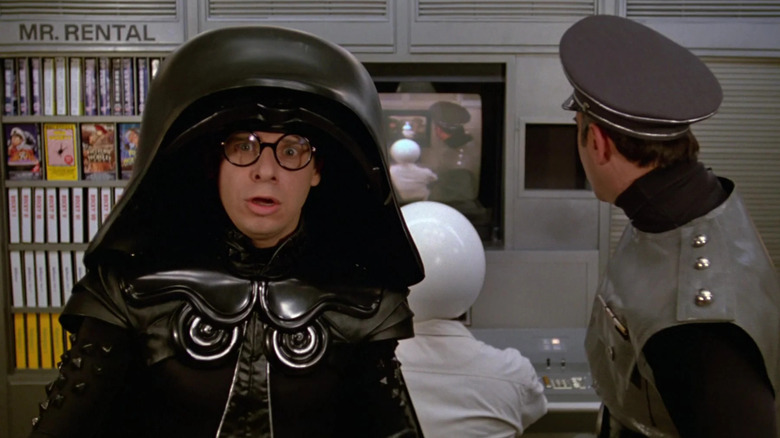
It's worth noting, though, that Roger Ebert may simply have been on a different wavelength than Mel Brooks. After all, he gave "High Anxiety" two-and-a-half stars, which was also the rating he awarded to Brooks' 1987 comedy "Spaceballs." The latter, of course, is primarily a "Star Wars" spoof, yet it arrived at a point when there hadn't been a new "Star Wars" film in four years. As such, Ebert argued that its satire felt dated and aimless at the time, echoing his criticism of "High Anxiety" from roughly a decade earlier. "Maybe the reason 'Spaceballs' isn't better," as he put it, "is that he [Brooks] was deliberately aiming low, going for the no-brainer satire. What does he really think about 'Star Wars,' or anything else, for that matter?"
Admittedly, "Spaceballs" wasn't exactly timely when it first came out, but it's still hilarious, and its takedowns of "Star Wars" merchandising are spot on. And again, anything that has reached a certain level of popularity is worthy of spoofery. Indeed, it's practically a moral obligation to criticize and take down anything that has grabbed onto the popular consciousness. Ebert wanted an elegant commentary on why something is being satirized, whereas Brooks, who's more puckish in his attitude, merely wanted to subvert the dominant paradigm.
Mind you, Ebert loved some of Brooks' films, but he lambasted others. His review of 1981's "History of the World: Part I" was pretty acidic, yet he, like so many others (George Harrison among them), loved "The Producers," and he even wrote a Great Movies essay about it.
At the end of the day, though, comedy is subjective. Laugh at what tickles you.