

Roger Ebert Adored This Criminally Underrated Time Travel Movie From The '70s
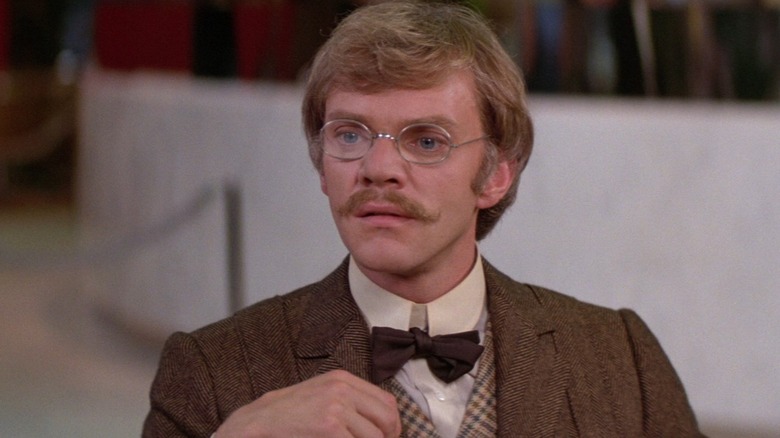
Based on the novel by Karl Alexander, Nicholas Meyer's 1979 time travel romance "Time After Time" features a rather clever premise. According to the film, author H.G. Wells didn't just write the novel "The Time Machine" in 1895, but actually invented a real time machine to go with it. The film opens with Wells, played by Malcolm McDowell, showing off his new invention to a group of dinner guests. During the tour of his lab, the London police arrive, claiming to have evidence that the notorious serial killer known as Jack the Ripper might be among Wells' guests. It's him! It's John Leslie Stevenson (David Warner)!
Stevenson immediately hijacks Wells' time machine and takes it into the future. Thanks to a plot contrivance, the machine reappears in his lab, sans Stevenson, allowing Wells to travel into the future in pursuit. He arrives in San Francisco in 1979 and finds the future to be strange and daunting. He had predicted that the future would be a utopia, not the greed-driven, crime-riddled hellhole he witnesses.
Wells begins feeling his way through 1979, getting usable currency and tasting the local cuisine. Most notably, he meets a charming bank employee named Amy (Mary Steenburgen), and they begin a cautious romance. When Wells finally tracks down Jack the Ripper, the killer admits that he feels right at home. In the 1890s, he was a monster. In 1979, he was just one depraved soul among many.
Roger Ebert gave "Time After Time" a very glowing review on "Sneak Previews," saying that McDowell and Steenburgen had a very sweet chemistry together, and that the film's light, almost-comedic tone was immensely appealing. This was before Siskel & Ebert started using "thumbs up" reviews, but he did give it a "Yes."
Roger Ebert loved the light tone of Nicholas Meyer's Time After Time
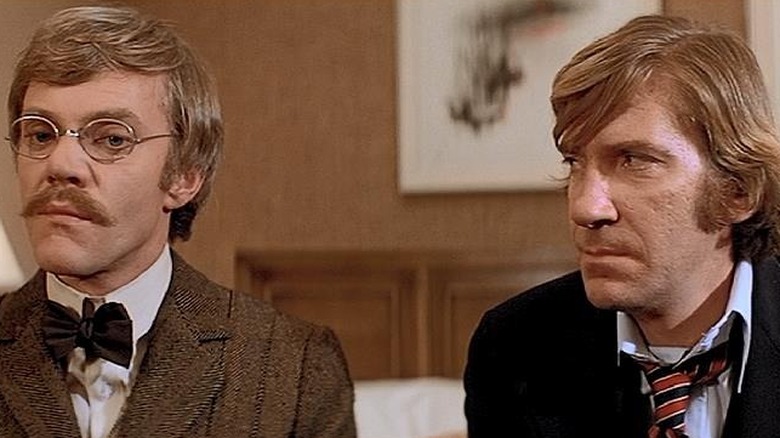
The Jack the Ripper plot is appealing and clever, and plays into writer/director Nicholas Meyer's penchant for clever detective stories. Meyer also wrote the Sherlock Holmes novels "The Seven-Per-Cent Solution" (1972) and "The West End Horror" (1976), so he knew his detective literature quite well. After "Time After Time," Meyer also famously wrote and directed "Star Trek II: The Wrath of Khan" and "Star Trek VI: The Undiscovered Country," the latter of which also heavily involved a criminal investigation. That film posited that Spock may be related to Sherlock Holmes. "Time After Time" was Meyer firing on all cylinders, indulging in his literary instincts.
Roger Ebert, however, chose to focus on the film's tone and its romance, rather than its literary or detective elements. He said:
"They both have a really nice quality there. The whole movie, in fact, has a delicate way of quietly kidding serious material [...] 'Time After Time' could have been one of those clumsy satires that make a lot of simple points time after time, but it's not. It's light-footed and quick-thinking, and it treats its material just seriously enough to make us care. And then it kids its characters just enough to seem playful. Amidst all the science-fiction apparatus and Jack the Ripper attack on the women of San Francisco, the awkward love affair between Malcolm McDowell and Mary Steenburgen is just plain sweet and charming."
Gene Siskel agreed, saying that "Time After Time" had an old-fashioned feeling, calling it "Classic Hollywood." At the end of the show, Meyer's film got two "Yeses." This was, to repeat, before Siskel & Ebert adopted their famed "thumbs-up/thumbs-down" scale.
Most critics liked Time After Time
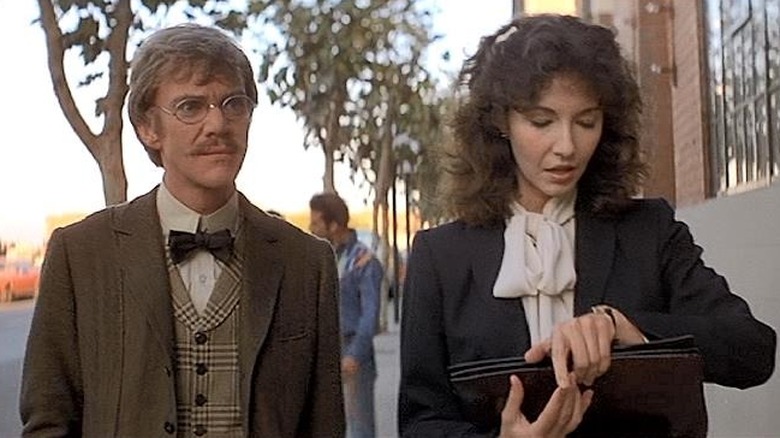
"Time After Time" was well-received all around. It currently has an 88% approval rating on Rotten Tomatoes, based on 32 reviews. Robert Osborne, writing for the Hollywood Reporter, wrote that "Such a scrambling of fact, fiction and imagination in itself deserves back-patting, and, for the most part, the rendering is as delightful as the basic idea. [This] Picture marks the directorial debut of scripter Meyer, and only occasionally does he let things drop into second gear." Osborne also loved the chemistry between Malcom McDowell and Mary Steenburgen, finding it awkward and sweet.
Anecdotally, anytime I encounter someone I can recommend "Time After Time" to, they tend to like it. Ebert and Osborne may have been taken by the film's romance and comedy elements, while I was more intrigued by the Jack the Ripper story. In 1888, Jack the Ripper killed five women, and he was never caught, making him one of the most notorious murderers in history. But compare his body count to John Wayne Gacy, who was proven to have killed 33 people from 1972 to 1978, and his crimes suddenly seem that much more tame. Ted Bundy was connected to 20 murders, but may have killed up to 100. If Jack the Ripper suddenly appeared in San Francisco in 1979, he would be, as he describes himself in "Time After Time," an "amateur."
Plus, it's just fun to think that author H.G. Wells was a time-traveling adventurer who trekked through the decades to capture dangerous criminals. It would make a good TV series. There's a pulp adventure notion to the film's premise that is irresistible. The fact that "Time After Time" also boasts a fun romance is a bonus. /Film called it one of the best of all time travel movies.