

David Bowie Wasn't Impressed By A '90s Movie That Was Partially Based On His Life
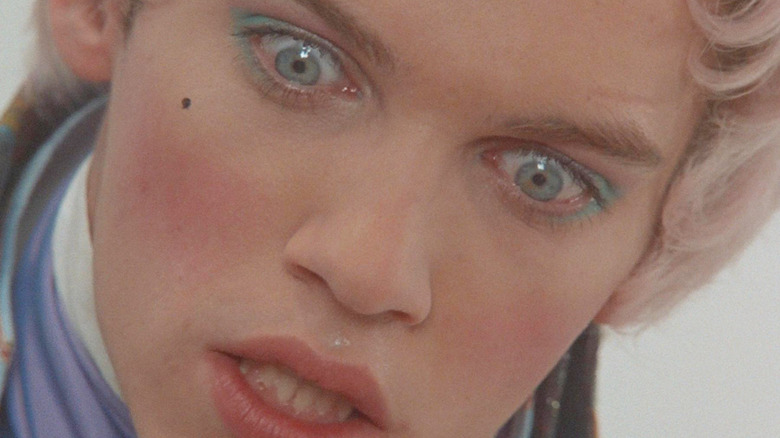
Writer/director Todd Haynes' 1998 glam rock odyssey "Velvet Goldmine" isn't really about David Bowie, but it also kind of is. Jonathan Rhys Meyers stars as Brian Slade, a fictional queer pop icon whom rock historians will be able to recognize is a compilation of Bowie, Bryan Ferry from Roxy Music, Marc Bolan from T. Rex, and gay rocker Jobriath. Brian Slade also assumes a wild, bedazzled stage persona at one point in the movie, calling himself "Maxwell Demon," which is a clear reference to Bowie's "Ziggy Stardust" persona. It certainly also helps that Brian Slade, well, just looks like David Bowie.
Meanwhile, Ewan McGregor co-stars as Curt Wild, a fictional rock star who is clearly an amalgam of Iggy Pop, Mick Jagger, and elements of Lou Reed. "Velvet Goldmine" is one of McGregor's best movies, but it isn't so much a biopic as it is a widespread exploration of the daring music, open queerness, wild aesthetics, and quick burnout of the British glam rock scene of the 1970s (but especially the queerness). It even touches on the rumored affair that Bowie had with Mick Jagger, but using their cleverly fictionalized avatars. Pretty much everyone could see what was going on with Haynes' film when it first came out.
That included Bowie himself. In a 1999 interview with Big Issue Magazine (which was handily printed online in 2020), Bowie took a bit of a swipe at "Velvet Goldmine." He felt that Haynes' film, while a small production made for only $9 million, was trying to jumpstart a new wave of retro-glam fashion that it would be able to cash in on. The only parts of the movie he really liked were the queer scenes. Bowie could say from experience just how openly queer the '70s glam scene was.
David Bowie only liked the queer aspects of Velvet Goldmine
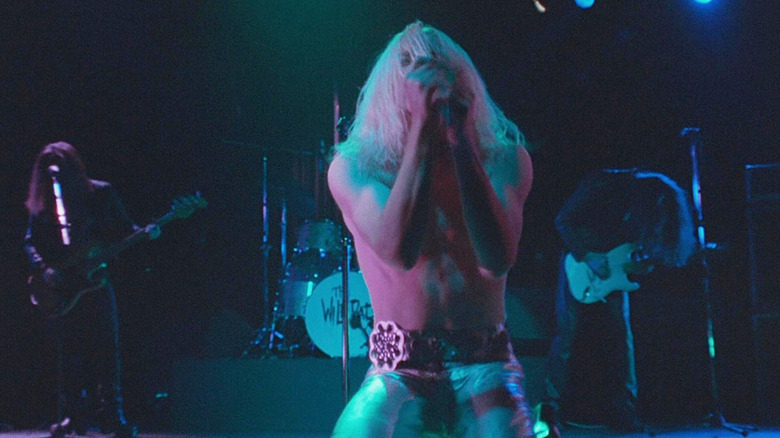
It's important to recall that hit movies, back in the 1990s, did have a tendency to bend the entire popular consciousness toward specific musical trends. At the very least, they could boost the record sales of certain genres and/or careers. One could see the swing explosion that popped up on either side of "Swingers," the surf-rock airplay that resulted from "Pulp Fiction," or the rebirth of Queen after "Wayne's World." It seems David Bowie felt that "Velvet Goldmine" was trying to do something similar with 1970s British glam rock. Sadly, the movie wasn't a huge success (it only made $4.3 million at the box office), so the glam explosion never came.
Bowie commented on that to Big Issue Magazine, as well as what "Velvet Goldmine" could have done to be more historically accurate:
"I felt that was a synthetic recycling on the back of the belief that 'Velvet Goldmine' would be a smash movie and be able to sell all those spin-off books and records. When I saw the film, I thought the best thing about it was the gay scenes. They were the only successful part of the film, frankly. It didn't understand how innocent everyone was then about what they were getting into. [...] Also, there was a lot more shopping; trawling round Liberty's looking for fabric. It was hysterical."
It's true: "Velvet Goldmine" has a lot of fashion shows and wild costumes but not many shopping-for-fabric scenes. There is plenty of queer sexuality on display, though, so it seems to have gotten at least one detail 100% correct. It just didn't do much else to impress Bowie.
Bowie was a film fan, incidentally. He even tried to buy the rights to Fritz Lang's "Metropolis."