

Mark Hamill's Underrated Sci-Fi Anime Adaptation Deserves Another Look
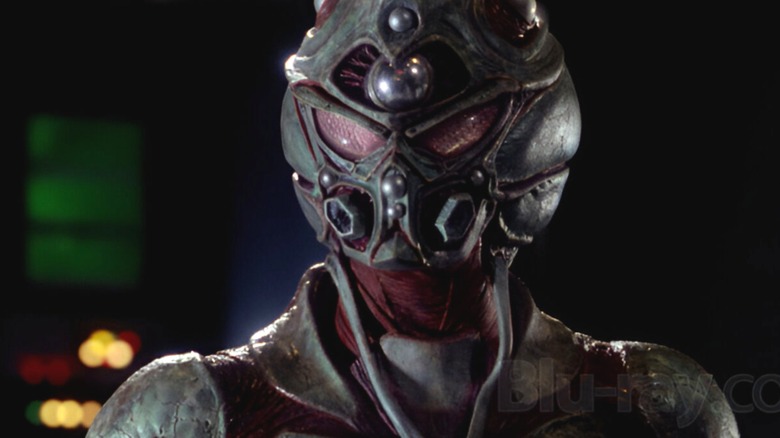
You might or might not have heard about "Big-Booster Armor Guyver," Yoshiki Takaya's manga series about the titular techno-organic device. The story begins inside the Cronos Corporation, where someone escapes with three Guyver units until he is cornered by soldiers. He detonates a bomb, causing the stolen Guyver units to scatter. One of these units ends up near two high school students; the second is retrieved by Cronos, while the third merges with Agito Makishima, the adopted son of a high-ranking Cronos official.
A short animation titled "Guyver: Out of Control" was released in 1986, followed by a 12-episode OVA in 1989 — "The Guyver: Bio-Booster Armor" — based on the first four manga volumes. There's also a 26-episode anime that ran between 2005 and 2006 (dubbed "Guyver: The Bioboosted Armor"), but the 1989 version is the most hard-hitting (and gruesome) out of the three.
The fights are the obvious draw here, but "Guyver" also boasts beautiful bio-armor, which takes on a fluid quality during violent clashes with enemies. Remember the two high school kids who stumble upon the first Guyver unit? One of them, Shō Fukamachi, becomes our protagonist, and he undergoes a painful fusion process with his Guyver I unit. This is an intriguing premise for sure, considering the implications of human DNA being altered on a fundamental level.
While the "Guyver" franchise isn't as influential or popular as the long-running "Gundam" anime series, it prompted a 1991 live-action adaptation with Mark Hamill and Vivian Wu. This is a rare instance of an anime-based Hollywood live-action project during a time when anime wasn't as mainstream as it is now. Although Screaming Mad George and Steve Wang's "The Guyver" isn't a good adaptation by any stretch of the imagination, it is a fun exploration of Takaya's world.
The Mark Hamill-starring Guyver live-action has impressive costuming
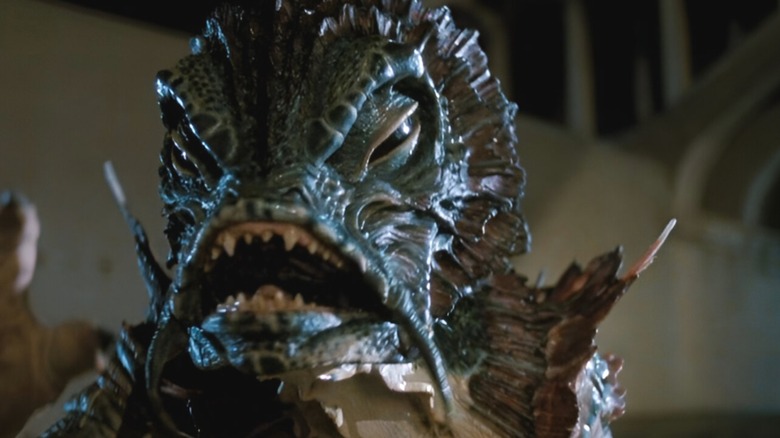
Hamill's talents as an actor obviously extend beyond roles that are not Luke Skywalker. His incredible voice work in "Batman: The Animated Series" is just one example, considering how Hamill turned a quick cameo into a long-standing career as the Joker. In "The Guyver," he plays CIA agent Max Reed, who oversees the aftermath of the theft incident involving the Guyver units, which are found by a young man named Sean Barker (Jack Armstrong, who is supposed to be our Shō Fukamachi). Hamill's presence helps the shoddy recreation of Takaya's story feel somewhat believable, but the Guyver costume designs do most of the heavy-lifting in terms of selling the premise. This works in favor of Armstrong's Sean, who is mostly inside the cool-looking suit, apparently wrestling with the dilemma that comes with great power and responsibility.
While the costuming is memorable enough, "The Guyver" overindulges in flashy excess without being self-aware about its campy overtones. Only David Gale, who plays Chronos president Fulton Balcus, delivers an appropriately over-the-top performance that veers into parody, but a surprising Jeffrey Combs cameo is a close second. What George and Wang excel at is special effects, channeled into the impressive fusion transformations, monster design, and the handful of fights that take place throughout.
The fight choreography isn't the best either, lacking the brutal edge of the manga (and its many adaptations). The issues that lie with transposing a Japanese premise into an American one are on display here, as the film's tokusatsu (Japanese term for live-action stories that heavily use practical special effects) inspirations end up getting lost in translation.
In essence, "The Guyver" evokes a slightly grown-up version of "Power Rangers," which is enjoyable in itself if you completely ignore its manga roots.