

Robert De Niro's Underseen '80s Horror Movie Got A Near-Perfect Score From Roger Ebert
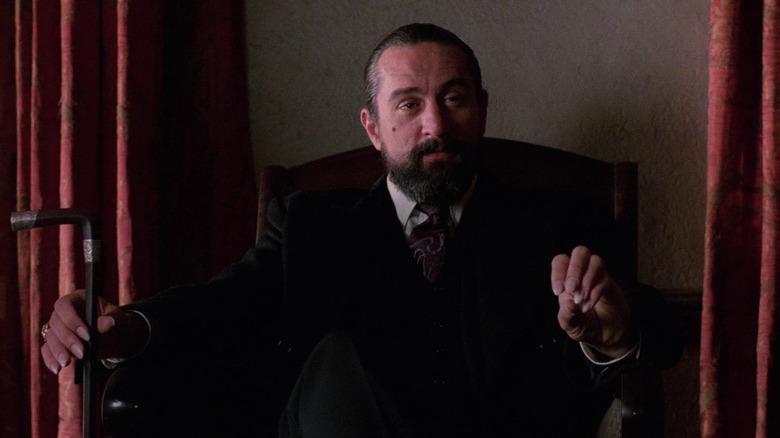
Alan Parker's 1987 film "Angel Heart" is simultaneously gorgeous and salacious. Michael Seresin's steady, professorial photography is some of the best you'll ever see in a horror movie, and the film is further classed up by the presence of Robert De Niro as a mysterious benefactor named Lou Cyphre. "Angel Heart" was released at a time when adult sexuality was being explored more openly in American cinemas. "Body Heat" pushed sexual boundaries in 1981, and horror films turned sensuality into artistry in films like "Cat People" and "The Hunger." Brian De Palma's "Body Double" hit theaters in 1984, and Richard Marquand's "Jagged Edge" came out in 1985.
The real barn-burner, though, was Adrian Lyne's 1986 film "9½ Weeks," starring Kim Basinger and Mickey Rourke. That film was explicitly about the way two adults came to explore their passions and sexual proclivities over the course of the titular time span. Rourke had already appeared in "Body Heat," and his "9½ Weeks" role cemented him as a sexy star of sensual cinema. He was a perfect fit for "Angel Heart," a twisted and dark detective story about the Devil and the identity of a missing lounge singer, set in the 1950s. "Angel Heart" was notable for its violent ideas and its raw, over-the-line sexuality; Rourke's private detective character has a fling with a teenager played by Lisa Bonet.
The film was mildly notorious when it was released, and initially received an X rating from the MPAA. Alan Parker had to cut ten seconds of the Rourke/Bonet sex scene in order to get a more distributor-friendly R rating. It was a lot of B.S.
Roger Ebert, however, gave "Angel Heart" three-and-a-half stars, describing it as "sensuous and depraved" (meant positively). He liked the film's extremity.
Angel Heart is a great, grimy movie
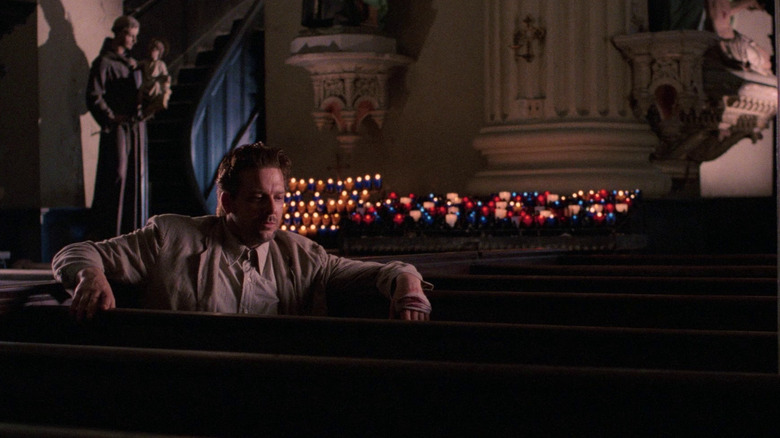
The plot of "Angel Heart" is confusing and twisted, and its tone is grimy, sweaty, and coated with last night's bloodstains. Rourke plays a private detective named Harry Angel who is hired by Lou Cyphre to track down a missing lounge singer named Johnny Favorite (you gotta love those names). Lou Cyphre has slicked-back hair, long pointed nails, and a Mephistophelean twinkle in his eye. No points for putting together that "Lou Cyphre" sounds like "Lucifer."
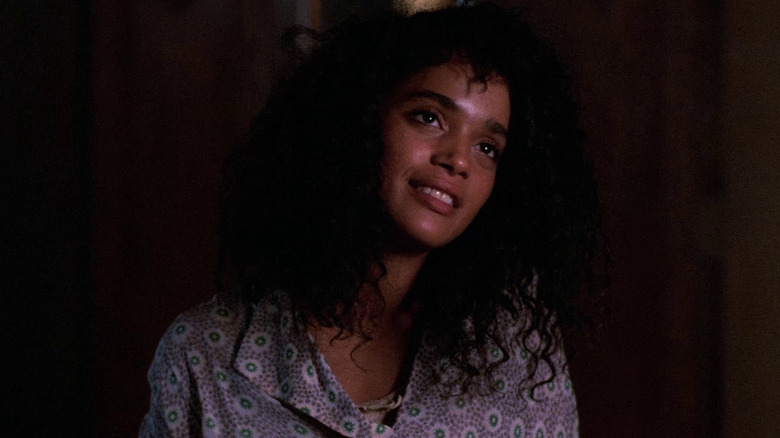
Harry's investigation takes him to a muggy Louisiana town called Algiers, outside of New Orleans. There, he talks to Margaret (Charlotte Rampling), the wife of the missing man, as well as her father, Ethan (Stocker Fontelieu). He also tracks down the missing man's daughter (by another woman), a mysterious teen named Epiphany Proudfoot (Bonet). Harry and Epiphany begin to develop an eerie romantic regard.
The notorious sex scene in "Angel Heart" involved Harry and Epiphany having sex as a leaky roof drips water on them. In the midst of their coitus, the water turns — in a nightmarish sense– into blood, and the pair continue their erotic encounter while coated in the stuff.
Regarding this scene, Ebert was defensive. He noted that De Niro's performance early in the movie was an indicator of things to come, writing:
"The scene is consistent with the whole film, which is sensuous and depraved. The De Niro character sets the tone, with his sharp, pointed fingernails and his elegant black suits. De Niro must have had fun preparing for the character: He uses a neatly trimmed black beard, slicked-back hair and tricks of lighting and makeup to make himself look uncannily like Martin Scorsese, his favorite director. Given what we eventually discover about the character, it's a wicked homage."
Have you figured out the twist yet?
Angel Heart was in keeping with director Alan Parker's style
Roger Ebert also had a colorful way of describing Mickey Rourke, writing:
"Rourke occupies the center of the film like a violent unmade bed. No other actor, with the possible exception of France's Gerald Depardieu, has made such a career out of being a slob. He looks unshaven, unwashed, hung over and desperate, and that's at the beginning of the film, before things start to go wrong. By the end, he is a man whose nerves are screaming for help."
(Alan Parker, incidentally, hated working with Mickey Rourke.)
The final twists of "Angel Heart" are plentiful, and only make sense after you've thought about them for a while. During the investigation sequences, the film only follows the logic of a nightmare, with people turning up dead left and right. Ebert pointed out that director Alan Parker was used to this kind of aesthetic excess, having made films like "Midnight Express." His aesthetic was even on display in the musical drama "Fame" in 1980. In 1982, Parker made what might be his best film, "Pink Floyd: The Wall," a surreal musical epic extrapolated from the eponymous concept album.
Parker's follow-up to "Angel Heart" was the 1988 racism crime drama "Mississippi Burning" with Gene Hackman and Willem Dafoe. It seems that any stigma surrounding "Angel Heart" had burned off in less than a year, as "Mississippi Burning" was an Oscar darling, nominated for seven Academy Awards, including Best Picture.
All told, Parker's movies have been nominated for a collective 27 Oscars, winning six. "Angel Heart" may not have been an awards darling, but it is well remembered by the people who have seen it (/Film called it one of the best supernatural thrillers ever.) It can currently be watched on Kanopy.