

I've Read Every Manga In The Tokyo Ghoul Series. Here's What The 2014 Anime Adaptation Gets Wrong
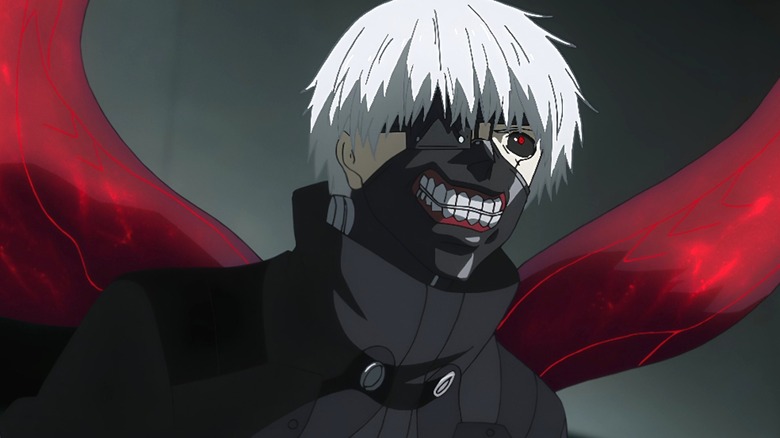
It's impossible to escape the allure of Sui Ishida's "Tokyo Ghoul." The overwhelming popularity of this dark fantasy saga compels every manga/anime enthusiast to check it out, given its status as a bona fide genre classic. Ishida's seinen manga series was serialized between 2011 and 2014, while a two-season anime adaptation by Studio Pierrot aired from 2014 onward. With no prior knowledge of Ishida's manga, I watched both seasons of the anime back in 2015 and arrived at the conclusion that it was riddled with flaws. While the first season felt serviceable enough with a promising horror premise and robust creative direction, season 2, titled "Root A," came off as confusing, unconvincing, and terribly paced.
Dissatisfied, I cracked open the first volume of Ishida's manga series and immediately became hooked. After finishing all 14 volumes of "Tokyo Ghoul" and the first five volumes of the then-ongoing (and now finished) "Tokyo Ghoul: re," I came to the following conclusion: Ishida's dark, uncompromising world boasts an edge and complexity that the anime severely lacks, to the point that this lack of depth feels insulting. Ishida's love for thematic symbolism, which bursts out of almost every panel, gets a surface-level interpretation in the adaptation, which barely takes risks on a narrative scale.
Also, Ishida's gorgeous art style (which leverages monochrome to play with light and shadow, and create sustained atmospheric dread) is translated into a vibrant, but bland aesthetic that detracts heavily from the manga's moody tone.
Stylistic distinctions aside, Pierrot established a sound foundation with season 1, building an intriguing world with tense sociopolitical overtones. Our protagonist, Kaneki Ken, is also fleshed out adequately at first, inspiring radical empathy (and later, awe). But alas, "Root A" destabilizes this foundation and steers the series towards egregious storytelling impulses.
The Tokyo Ghoul anime is a major step down from Sui Ishida's acclaimed manga
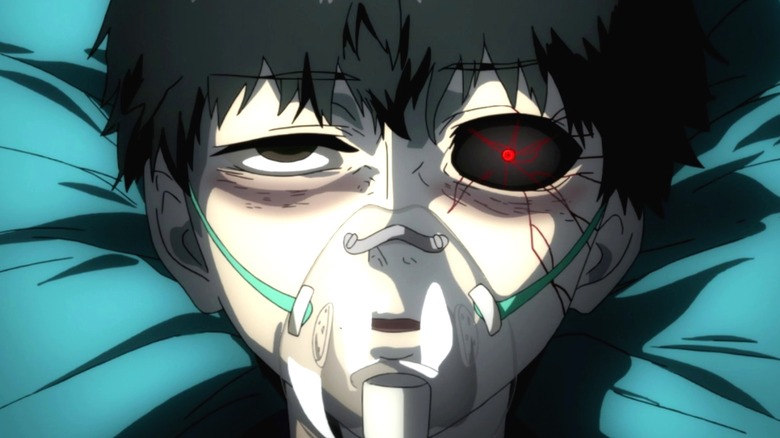
"Tokyo Ghoul" opens with the soft-spoken Kaneki going on a date with Rize, where she reveals herself as a ghoul, violently attacking him until a pole kills her. Kaneki wakes up in the hospital, where he learns that his damaged organs were swapped out with Rize's to save his life. This brands Kaneki as a half-ghoul — an identity that neither humans nor ghouls want to side with. There's a middle ground for Kaneki in the form of the Anteiku — an organization that rehabilitates ghouls and ethically feeds on humans — but will his inner turmoil consume him before he can fight for what's right?
This question is central to Ishida's manga, which also draws a parallel between ghoul persecution and the systemic oppression of the marginalized. Kaneki's characterization hinges on his dual states of being (human and ghoul), and how such duality manifests during traumatizing situations. Kaneki's post-Aogiri self is nothing like his base personality, as he undergoes unimaginable torture and gives into brutality. The manga underscores this turning point with a horrific choice presented to Kaneki, but the anime drastically changes the context. This is but one example of shoddy interpretation, as season 2 completely breaks away from canon and follows storylines that lack logical cohesion or emotional impact.
Reading the manga after watching season 2 is a heady experience, as I wasn't prepared for the intricacy of Ishida's writing, and the obsessive attention paid to environmental storytelling. Kinetic fights between humans and ghoul ooze visceral intensity (enough to inspire a Hollywood "rock and roll" action movie), while quieter moments are soaked in pathos. None of this is present in "Root A" and its attempts to revamp a story that never warranted such flippant reinterpretation.
Ishida's surreal art style is noticeably absent from 2014's Tokyo Ghoul adaptation
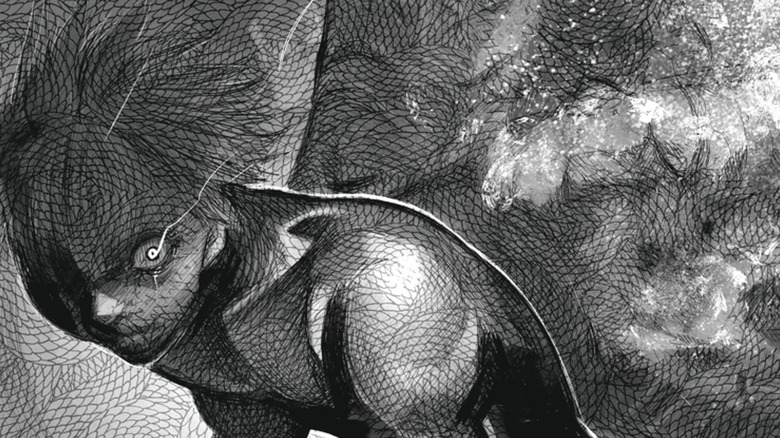
Ishida's art style infuses stunning watercolor-like palettes for manga covers, while his panels alternate between softer and harsher strokes to convey the beauty and horror of existence. Ishida's art is so distinctive that its absence feels immediate: Think an adaptation of "JoJo's Bizarre Adventure" without Hirohiko Araki's exaggeratedly evocative art. While animation studios often polish their own visual identity, Ishida's beautiful (and strangely eerie) panels are foundational to "Tokyo Ghoul" and everything it stands for. Moving away from it to embrace an uninteresting style feels counterintuitive, but it is exactly what Pierrot does with both "Tokyo Ghoul" and "Tokyo Ghoul: re."
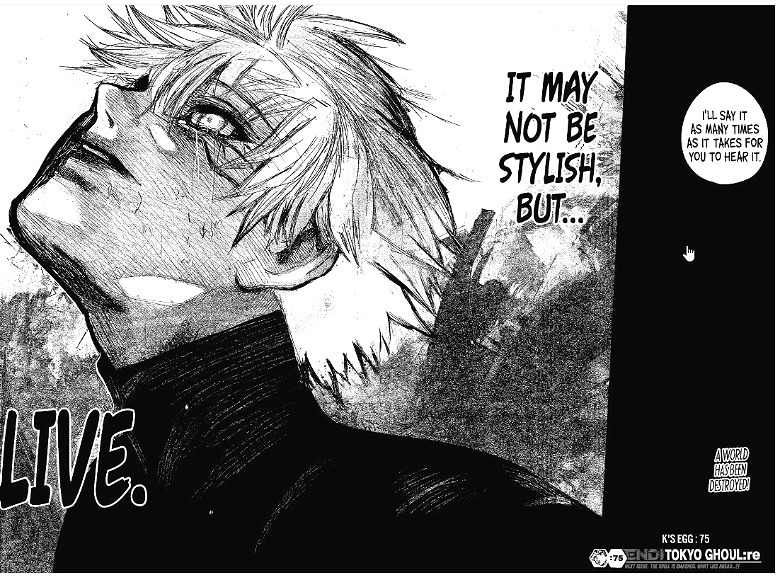
Speaking of the sequel manga "Tokyo Ghoul: re," I happened to read it during a particularly difficult time in my life. The sequel's brilliance undoubtedly lies in its layered symbolism and Ishida's instinctive urge to splice literary references into every aspect of the narrative. The story moved me enough to cling to hope again, especially when I reached this stunning double-page panel in Chapter 75, where Kaneki rejects the escapism associated with death to embrace survival, no matter how unglamorous it may be:
 Shueisha/Viz Media
Kaneki's vulnerability in this panel is brought out by Ishida's softer lines, which morph into oppressive, void-like shadows in scenes where he gives into violence or is broken by trauma. This approach to horror is significantly different than in a disturbing horror series like Junji Ito's "Uzumaki," which sports a layered, macabre bent to anatomy. Both Pierro anime adaptations do not indulge in Ishida's surreal vision, thus glossing over line the mangaka toes between restrained horror and full-blown chaos.
A competent "Tokyo Ghoul" anime has been long overdue, and I hope it'll be as deliciously complex as Ishida's game-changing manga.