

Roger Ebert Called This Notorious John Wayne Movie 'Cruel And Dishonest'
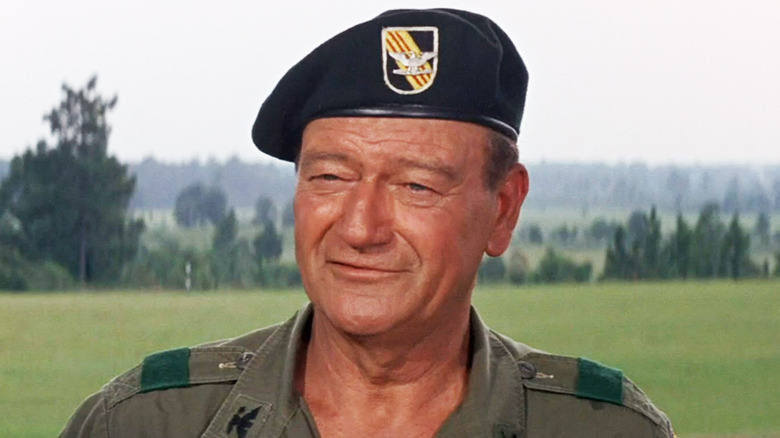
In 1968, John Wayne made one of his worst movies with "The Green Berets." This jingoistic piece of propaganda preceded the Duke's one and only Oscar win, which in turn preceded somewhat of a resurgence for the screen legend prior to his 1979 death. As such, "The Green Berets" was a nadir in Wayne's career that almost cost him that career altogether. It didn't help that Roger Ebert hated the film so much he declined to even give it a star rating.
The worst John Wayne movies are a mix of his early "Poverty Row" Westerns, made on minuscule budgets, and films that unfortunately embodied his questionable-at-best political convictions. Those convictions were rigid and simplistic which was echoed in his black-and-white-hat Westerns that preceded the revisionist movement heralded by the likes of Clint Eastwood and Sergio Leone. It was when that very movement came to the fore that Wayne quickly became somewhat of an anachronism.
Hollywood was no longer only making straightforward, good guys vs. bad guys stories and that didn't sit well with a man who had made his name with those very films. Wayne hated controversial Western "The Wild Bunch," for instance, for its violent and cynical depiction of the Old West. But director Sam Peckinpah had felt compelled to jolt viewers out of their desensitization to screen violence largely due to the Vietnam War, which had ensured images of bloodshed were routine in the late-'60s. Wayne was having none of it. Not only did the Duke voice his distaste for "The Wild Bunch," they year prior he made a movie celebrating the United States' efforts in Indo China. By that point, however, nobody was buying it, least of all Roger Ebert
With The Green Berets, John Wayne tried to drum up support for the Vietnam War
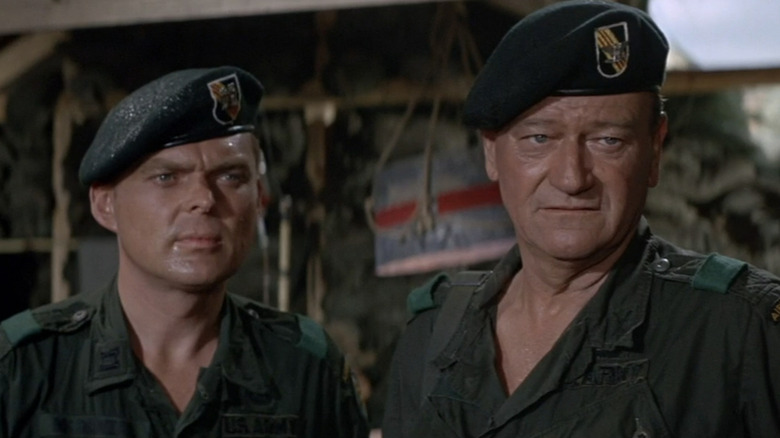
John Wayne wasn't exactly at the height of his career in 1968. Amid the counter-culture of the era he was little more than a relic, and seemingly refused to update his image or the films in which he starred, most of which retained the same simplistic ideals of the features he'd made throughout the 1940s and 50s. So what did he do? Well, eventually he acquiesced and played a much more flawed and even comedic character in "True Grit," which became the blueprint for the rest of Wayne's career and earned him an Oscar. Before that though, he had one more go at reminding everyone how out of step he was.
The Duke co-directed "The Green Berets" with ex-U.S. Navy Lieutenant Ray Kellogg, and based his pro-war propaganda piece on the Robin Moore novel of the same name. The actor/director also went a step further by writing to then President Lyndon B. Johnson for support, thereby ensuring the government shaped what became one of Wayne's most controversial films. An avowed Republican giving the government more control over anything seems counter-intuitive but that gets to the heart of how misguided "The Green Berets" actually was.
The film sees Wayne play Colonel Mike Kirby, who leads a top-secret mission to kidnap a Viet Cong commander. Tagging along for the ride is anti-war reporter George Beckworth (David Janssen) and even if you haven't seen the movie you can see where this is going. Surprise, surprise, Beckworth learns just how important it is for America to be embroiled in a bloodbath on the other side of the world after the titular team saves a war orphan's life. Like most people, Roger Ebert found the whole thing nauseating.
Roger Ebert labelled The Green Berets offensive propaganda
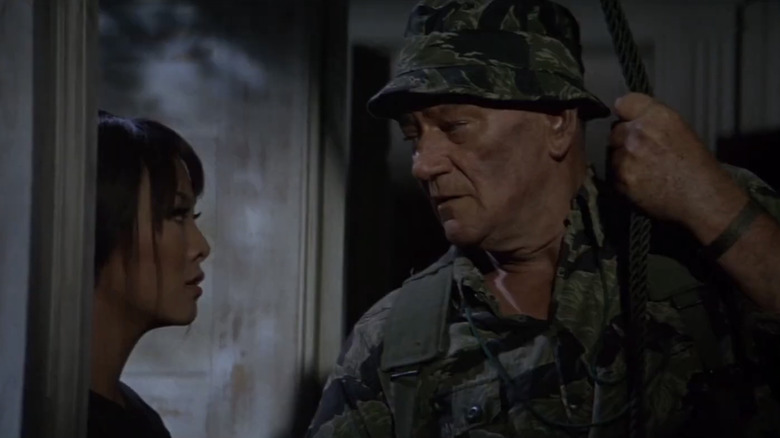
Roger Ebert hated a lot of films, and would hand down a sole half-star for the really bad ones. But he reserved a simple "thumbs down" for the truly wretched, and "The Green Berets" earned that unfortunate honor. "'The Green Berets' simply will not do as a film about the war in Vietnam," Ebert began his review. "It is offensive not only to those who oppose American policy but even to those who support it." As far as the critic saw it, John Wayne had applied his facile black-hat-vs.-white-hat Western ethos to a very real conflict with very real consequences. This was, in Ebert's estimation, "a movie depicting Vietnam in terms of cowboys and Indians" that was "cruel and dishonest and unworthy of the thousands who have died there."
There was an undeniable element of hubris at play with "The Green Berets." Wayne seemed to presuppose his own cultural influence, as if he still commanded the public attention like he did in his prime. Surely, watching the Duke lead a band of soldiers to the front lines of the Vietnam war would immediately sway public opinion? It didn't. In fact, "The Green Berets" had the opposite effect, and Ebert's review became emblematic of the backlash.
The critic labelled Wayne's film "propaganda," which was accurate given the U.S. government's heavy involvement. What's more, in making this "virus" of a film, to use Ebert's words, Wayne had laid bare the myopic, even naive ideology that still supported the war in the late-60s. The "stock characters," endless "clichés," and "semi-anonymous enemy" all merely advertised the mindless jingoism that animated not only "The Green Berets" but the pro-war movement for which it stood as a shameful totem.