

Stanley Kubrick's Bizarre Demand Kept Steven Spielberg Up At Night During Their Sci-Fi Project
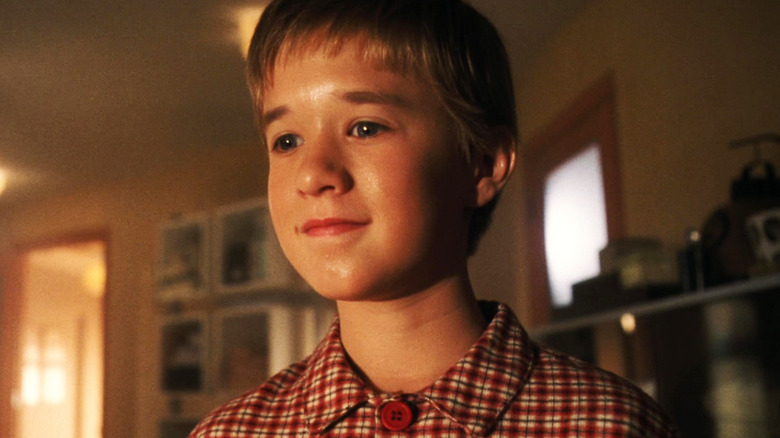
When Steven Spielberg accepted Stanley Kubrick's offer to direct what became "A.I. Artificial Intelligence," he didn't realize what he was signing up for. Not only would Kubrick pass away before the film's completion, he would also mandate that Spielberg keep a fax machine in his bedroom through which he'd communicate his ideas and concepts. Unsurprisingly, this caused some drama in the Spielberg house.
Though his films were monumental, Stanley Kubrick didn't actually make all that many. As his wife, Christiane, said during a British Film Institute interview following the director's death, "He didn't make very many films. He thought very long and hard and really worried and looked at billions of stories and rejected many and was quite sad that he couldn't make more." Of course, that meant that when the director passed away in 1999 he left behind multiple unrealized projects. In fact, Kubrick wrote three movies that were never released to the public.
But there was one project that Kubrick managed to get over the finish line from beyond the grave: "A.I. Artificial Intelligence." An adaptation of British author Brian Aldiss' story "Supertoys Last All Summer Long," the movie follows android David (Haley Joel Osment) who's programmed to love but finds himself cast out by humans and forced to find his own place in the world. The idea had been kicking around in Kubrick's mind since 1973 when he agreed to adapt the story for the big screen. But the director became distracted by all the other stories he wanted to tell, with Kubrick even using a less-than-honest trick to free up his schedule and make "The Shining" instead of "Supertoys." He remained distracted up until his death, and the Kubrickian version of the story never actually materialized. At least, the version with him as director never materialized.
Stanley Kubrick demanded Steven Spielberg keep a fax machine in his bedroom
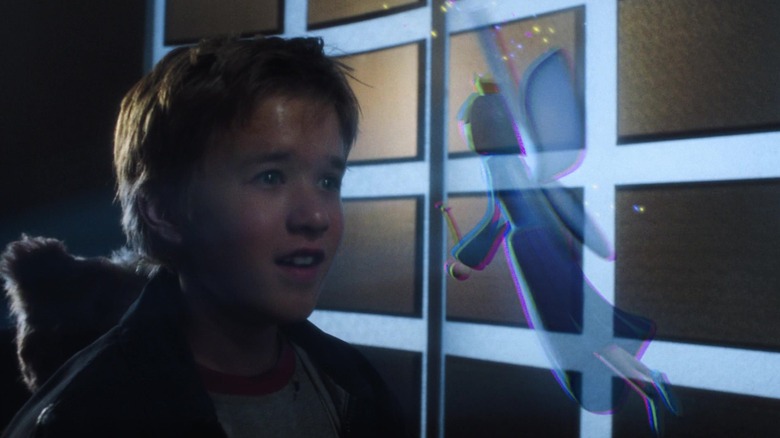
"A.I. Artificial Intelligence" emerged in 2001 with Spielberg as its director. Spielberg had been handed directing duties in the mid-'90s after Stanley Kubrick decided to produce. That made for an interesting pairing. A filmmaker famous for his cold, even sepulchral slow-burns matched with a director whose films were a celebration of the latent child-like wonder dwelling within baby boomers the world over. But Kubrick and Spielberg went way back. They met in 1980 on the set of "The Shining," a film that Spielberg didn't like at first but which became one of his favorites.
It was also the very film Kubrick used to get out of making his "Supertoys" adaptation. As such, when Kubrick eventually handed directorial responsibilities to Spielberg for that same adaptation, there was a strange kind of symmetry involved. Little did the latter know, however, that this honor would come with significant pressure even before Kubrick passed away and left him with all the responsibility.
In a 2018 AMC interview with James Cameron, Spielberg revealed that Kubrick demanded he keep a fax machine in his bedroom. The director recalled his old friend telling him it was necessary because, "I'll be sending you a lot of notes and pictures and ideas and it's got to go in your bedroom." Needless to say Spielberg was taken aback. "I said, 'Why?'" he continued, adding:
"He said, 'Because what if somebody comes in and reads—' I said, 'Who's gonna come in and read in the middle of the night?' He said, 'What if a kid comes in or somebody comes in and reads what I've written you? It's got to go in a private place. You have to ensure me it's going in your bedroom.'"
Steven Spielberg's wife threw Stanley Kubrick's fax machine out of the house
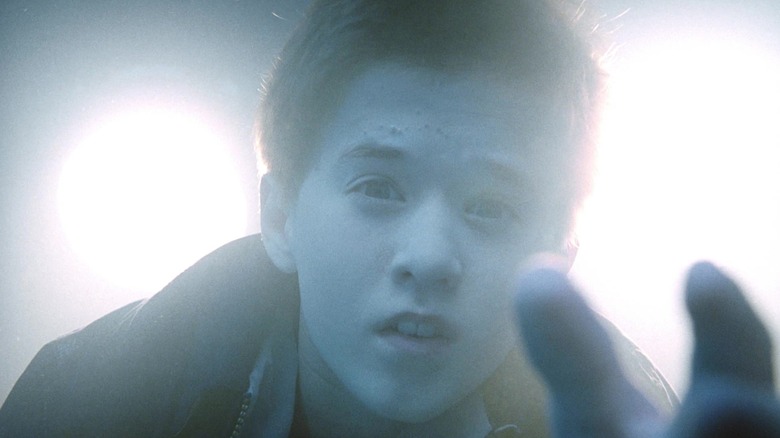
Though his distaste for air travel has been overblown, Stanley Kubrick had all sorts of odd idiosyncrasies. His final film, "Eyes Wide Shut," took Kubrick's exhausting methods even further than "The Shining," with the director insisting on recreating New York streets on an English backlot down to the measurements between newspaper vending machines. Despite having shared a relationship with the enigmatic filmmaker since the early 1980s, however, Spielberg was entirely unprepared for his fax machine mandate.
In his AMC discussion with James Cameron, the director recalled his response to Kubrick's request. "Do you know how loud a fax machine is? It's 10 times the volume of a regular house line, right?" Still, he relented only to find that the machine would fire up in the early hours of the morning as Kubrick faxed over his latest epiphanies from his UK residence. "It lasted two nights," said Spielberg, "and Kate Capshaw – my wife – threw the fax machine out of the bedroom. So, but other than that it was a fruitful collaboration."
Despite the fax machine's unceremonious removal, ultimately Spielberg's divisive ending for "A.I. Artificial Intelligence fulfilled Kubrick's original vision. In that sense, he obviously maintained a commitment to realizing Kubrick's ideas, sent, though they were, in the dead of night. When "A.I." finally arrived in 2001, it was met with mixed reviews as critics grappled with the incongruous mix of styles. That was inevitable, though perhaps not for the reasons you might expect. As it turns out, much of the warm "fuzziness" that pervaded parts of "A.I." came not from Spielberg but Kubrick himself, who was seemingly intent upon telling an uncharacteristically happy story.