

Starfleet Academy Borrows Some Unexpected Tech From Star Trek: The Animated Series
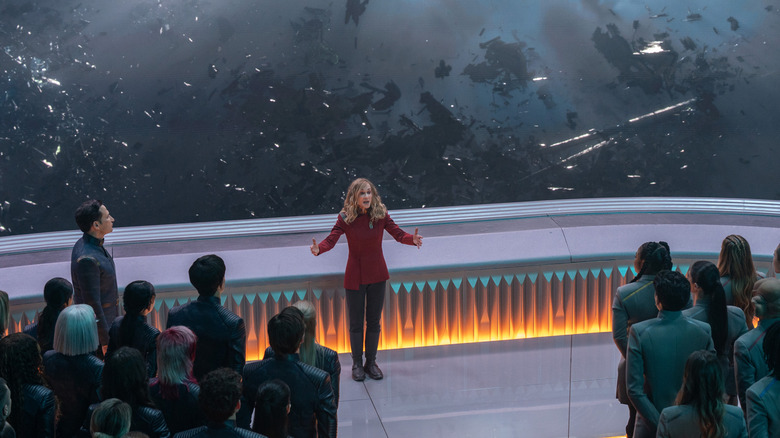
It took until the sixth episode of "Star Trek: Starfleet Academy" – titled "Come, Let's Away" — for death to re-enter the picture. The premise of the series, recall, is one of reconstruction. The series is set in the 32nd century, at a time when the galaxy is still recovering from a massive cataclysm called The Burn. Most known "Star Trek" worlds lost their ability to travel through space, and became standoffish and isolationist as a result. Starfleet Academy has reopened for the first time in over a century, and it aims to bring those isolationist worlds out of hiding, and into a new societal paradigm wherein students learn to become Starfleet officers together and launch a new era of peace.
But pacifism is a tricky thing to pursue in the world of "Starfleet Academy." Violence is still lurking in the cosmos. Trekkies were recently introduced to the Furies, a species of angry, monster-like pirates that seem hellbent on theft, salvage, and destruction. "Come, Let's Away" follows a group of cadets as they embark on a special off-site training mission to a derelict vessel called the U.S.S. Miyazaki. Their mission, a mere training exercise, is to reactivate the Miyazaki in one hour. Naturally, in the middle of the exercise, the Furies attack.
Before the cadets beam over to the Miyazaki, however, some sharp-eyed Trekkies might have noticed a tiny technological detail that will make their hearts sing. The cadets, because they are beaming into essentially a vacuum, require air. They activate shimmering personal life support systems that cover their bodies like a second skin.
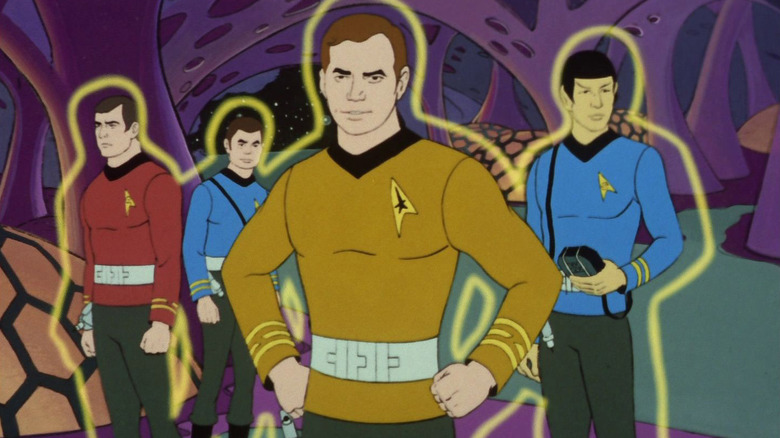
These shimmering Academy-issue life-support fields may very well be a reference to the yellow, glowing personal force force fields that the crew of the U.S.S. Enterprise wore in "Star Trek: The Animated Series."
Personal force fields are back on Star Trek
The forgotten spin-off "Star Trek: The Animated Series," as Trekkies can tell you, ran for two seasons in 1973 and 1974, and it's considered only semi-canonical by many Trek fans. It's also an underrated program whose animated medium allowed the writers and showrunners to explore more outlandish sci-fi concepts than they couldn't have in live-action in 1973. There is a three-armed alien on the bridge of the Enterprise, for instance. There is an episode about humanoid plant monsters and a fifty-foot Spock clone. Stuff like that.
The makers of TAS were also able to explore cooler ships and landscapes, as exemplified in the very first episode of the series, "Beyond the Farthest Star." In that episode, the Enterprise encounters a derelict vessel that has been stranded for untold millennia. It's a strange vehicle that looks like multiple seed pods strung together, rather than a more traditional spaceship. To explore this vessel, Kirk (William Shatner) and crew put on high-tech belts that project yellow force fields around their bodies. The fields serve as energy-based spacesuits that allow them to breathe comfortably.
Savvy animation fans might intuit that the yellow force fields were invented mostly for practical production reasons. It would be easier and cheaper to add the yellow "haze" effect to existing animation assets than it would be to design and animate bulkier, practical spacesuits. Also, the force fields would allow viewers to see Kirk and co. in their traditional gold/red/blue Starfleet uniforms, ensuring a certain degree of brand consistency.
In-canon, well, the force fields are just cool. Sadly, because of the nature of the animated effect, personal force fields didn't become a regular part of "Star Trek" after "The Animated Series."
The tech on Starfleet Academy has finally caught up with Star Trek: The Animated Series
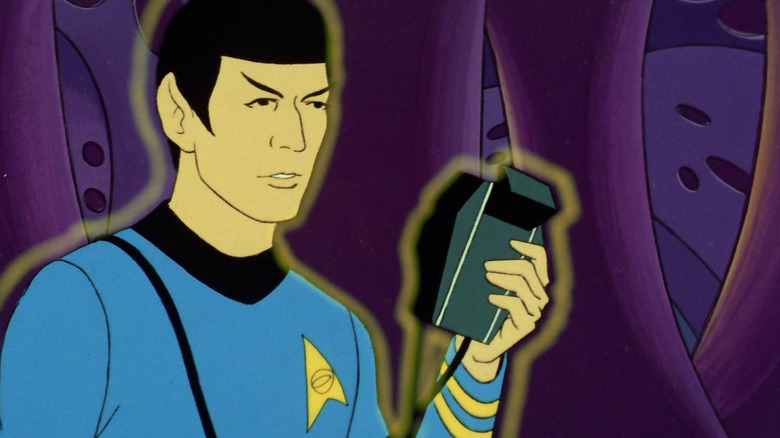
"Starfleet Academy," then, seems to be the first time that Starfleet personnel have been issued personal force fields since their introduction in "Star Trek: The Animated Series." Trekkies will hasten to point out that there have been personal force fields throughout "Star Trek," of course. "Star Trek"'s most evil villain Kivas Fajo wore a personal force field on his belt. Worf constructed a force field from a communicator in "A Fistful of Datas." They were also sometimes mentioned (but rarely seen) during the Dominion War episodes of "Star Trek: Deep Space Nine."
It's possible that personal force fields were largely ignored in live-action "Star Trek" because producing a "shimmer" effect would have been cost-prohibitive for the showrunners. Of course, by the time we got to "Starfleet Academy," CGI was common, and budgets were higher, allowing a "shimmer" effect to be more easily visualized. Also, because "Starfleet Academy" takes place some 920 years after the events of the original "Star Trek," it's reasonable to assume that technology had advanced.
Transporters are faster now, and also personalized via communication badges; there's no longer a need for officers to gather in Transporter Room 3 before beaming down. Also, at this point in Trek history, the badges can project interactive holograms, a conceit introduced in "Star Trek: Discovery."
So it seems that the "Star Trek" franchise finally, organically, caught up with its own technology. "The Animated Series" invented a tech that eventually became canon. See also: holodecks.