

Another Version Of Gambit's Death In X-Men '97 Featured A Very Different Sacrifice
We may receive a commission on purchases made from links.
"X-Men '97" was a shock to the system and arguably the most surprising Marvel project since another X-Men project, "Logan." Though Stan Lee was not a big fan of the original 1990s "X-Men: The Animated Series," the original show remains a bold, at times groundbreaking (especially regarding representation in superhero media) cartoon. When it came time to do a legacy sequel to that show, there was reason to be skeptical. It could easily have been just a nostalgia play full of cameos and little else. Thankfully, we were all wrong.
"X-Men '97" wasn't just a great shot of nostalgia, but it pushed forward every idea and theme of the original. Nowhere is this more evident than in the fifth episode, titled "Remember It."
In a single episode, "X-Men '97" combined soap opera elements, multiple affairs, every cameo imaginable, grief, politics, and mass murder. The episode adapted one of the darkest Marvel storylines ever with the Genosha genocide, delivering Marvel's answer to the Red Wedding from "Game of Thrones" when a party to celebrate the mutant nation of Genosha joining the United Nations is spoiled by a Sentinel attack that results in a tragic massacre.
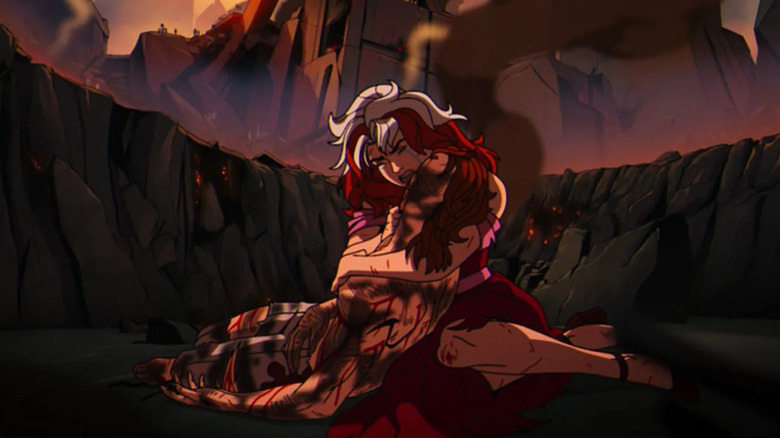
Among the many dead is Remy LeBeau aka Gambit (A. J. LoCascio), who sacrifices himself to save Rogue (Lenore Zann) from a Sentinel. It's a heartbreaking moment, one of the darkest moments in an "X-Men" adaptation, and it could have played out differently.
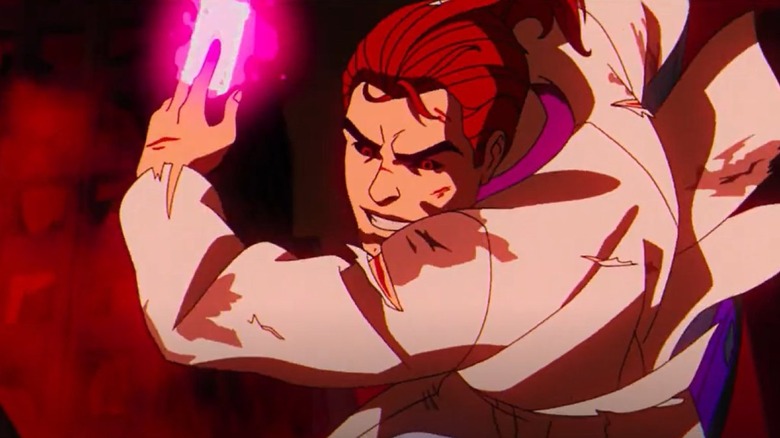
In the "X-Men '97: The Art and Making of the Animated Series," supervising producer Jake Castorena said that an alternate version of Gambit destroying the Master Mold showed a different version of his abilities. "Gambit was going to land on Master Mold's head, barefoot and with no weapons," Castorena said. "He was going to charge Master Mold with his bare feet and hands."
The name's Gambit. Remember it
The idea of having Gambit energize the Master Mold barefoot and with nothing on his hands was meant to show that he can use his powers with more than just his fingers. He can make a connection with his skin to energize his target. "I just wanted to give Gambit that moment, leaning into 'Oh, you don't kill me. I kill me? I wanted to show him taking agency of it," Castonera added.
To bring Gambit's powers to life in his moment of truth, the FX team at "X-Men '97" looked to the works of Jack Kirby, using white-hot outlines on what Gambit touches, with his pink-colored kinetic energy layered behind them. "Using the Kirby crackle in our design any time we need a specific FX to feel particularly powerful is really helpful in amping up a design to feel like the energy is overflowing," said FX lead designer and FX supervisor Chris Graf. "Gambit is incredibly strong, and we wanted that to be extremely apparent in his battle with Master Mold."
Gambit's sacrifice is a highlight not just of "X-Men '97," but of Marvel adaptations overall. Just before his sacrifice, Gambit was the one to rescue the Morlocks from the Sentinel attack. This is a rather moving reversal from the comics' "Mutant Massacre" arc, when Gambit was a traitor who helped start the Morlock massacre. Not to mention, Xavier's last words to Gambit in the original series, "How often must the scoundrel prove himself the hero, before he believes it himself?" hit even harder, considering he died to save the woman he loved but had just let go mere hours earlier.