

How Many People Live On Star Trek: The Next Generation's USS Enterprise?
We may receive a commission on purchases made from links.
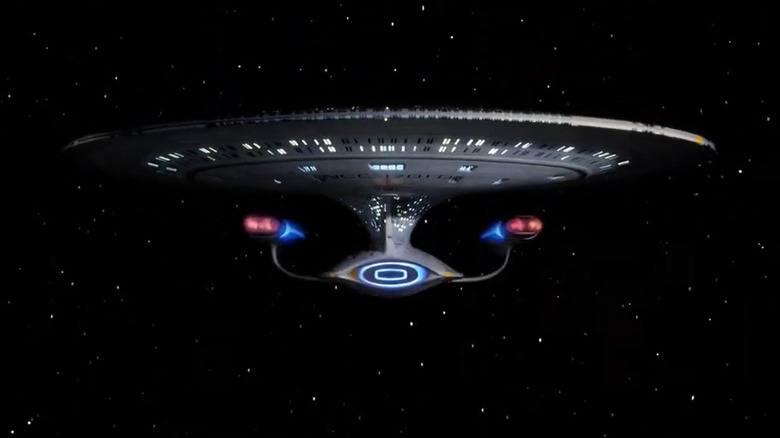
In the history of science fiction, few ships can rival the U.S.S. Enterprise. While there have been many versions of the Enterprise throughout "Star Trek" history, the ship is instantly recognizable, even by those who aren't necessarily big fans of the franchise. The whole premise of "Star Trek," very basically, involves exploring space on long missions. That requires a lot of people and, therefore, a lot of space. So, just how many people live on the Enterprise? In the case of the version of the ship featured on the much-beloved "Star Trek: The Next Generation," a lot.
In the book "Star Trek: The Next Generation 365," it's revealed that the writers' guide for the series contained a wealth of information about the Enterprise itself — more specifically, the Enterprise NCC 1701-D, which is the fifth ship in Starfleet history to carry that name. The guide explained that it was roughly twice the length of the original, with eight times as much interior space. That meant more people could live in it ... more than 1,000, to be exact. To quote "The Next Generation 365" directly:
"The starship is designed to be home (home in a very literal sense) to 1,012 persons. Gone is the metallic sterility of the original ship, the reason being that the last century or so has seen a form of technological progress which 24th-century poets call 'Technology Unchained' — which means that technical improvement has gone beyond developing things which are smaller, or faster, or more powerful, and is now very much centered on improving the quality of life."
Real-life scientists believe that the Enterprise design is accurate for warp speed travel, interestingly enough. That's all the more impressive when you consider that the vessel houses more people than a large apartment building.
The Enterprise was built for more than just the main crew

Even though "Star Trek: The Next Generation" was put on hold for years, it completely revived the franchise upon its arrival in 1987. The show remains a favorite amongst fans to this day, and this writer's guide has offered a small window into the painstaking thought process that went into the series' creative, with the Enterprise at the center of it all. The ship was well thought out beyond the bridge where the main crew spent much of their time.
While viewers didn't get well acquainted with all 1,000-ish people on the ship during the show's seven season run, they were part of the backdrop. The writer's guide further explained that in the time that had passed between "Star Trek: The Original Series" and "Next Generation," longer missions demanded more space to make room for crew members' families. Per "The Next Generation 365":
"As humanity probes deeper and deeper into space with 10-year or longer missions becoming the norm, Starfleet has been encouraging crew members to share the space exploration adventure with their families. Previous experiences in space exploration have underscored the lesson that people need people for mental and physical health."
While the "Next Generation" writers room was apparently full of bad blood early on, nobody could argue that the show's creatives weren't considerate about what they put on the page and ultimately brought to life on screen. Another fun fact? The series' version of the Enterprise was estimated to be exactly the size of the Paramount Studios lot, which is demonstrated by an illustration in "The Next Generation 365." It's a unique example of the saying "life imitates art."
You can grab "Star Trek: The Next Generation — The Complete Series" on Blu-ray or DVD from Amazon.