

The Biggest Sci-Fi Movie Of 1996 Caused A Country To Panic Over An Alien Invasion

"Independence Day" was a major hit when it was released back in 1996, part of which was down to the innovative marketing campaign that accompanied its arrival. At one point, however, that marketing campaign caused a brief panic. In an echo of what occurred after Orson Welles' 1938 "War of the Worlds" broadcast, trailers for the film made to look like breaking news convinced Spanish viewers that an actual alien invasion had begun.
On October 30, 1938 Orson Welles announced the invasion of Earth by extra-terrestrial creatures. That is, he and his Mercury Theatre repertory company broadcast their radio adaptation of H.G. Wells' 1898 novel "War of the Worlds." It began with fictionalized news flashes that convinced many listeners Martians had actually arrived on our home planet. At least, that's what newspapers reported the next day, though how widespread the actual "panic" was remains disputed.
Since then, there have been several similar events that actually did prompt genuine concern, like when an '80s TV movie about atom bombs terrified the public into believing nuclear annihilation was imminent. Flash forward almost 60 years from Welles' broadcast, and a similar event occurred when 20th Century Fox, as it was known prior to the Disney Fox merger that was completed in 2019, released Roland Emmerich's "Independence Day." This time, however, it was Spanish audiences who became convinced that aliens had made contact.
Spanish trailers for Independence Day has viewers thinking aliens had landed
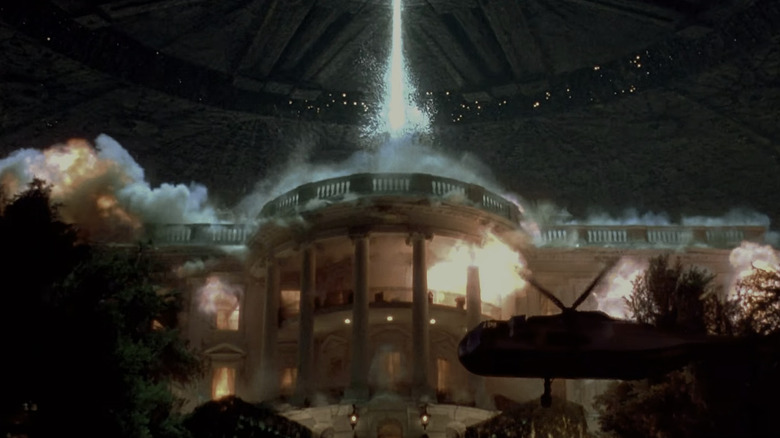
"Independence Day" wasn't just the biggest film of 1996, it ushered in a new wave of sci-fi blockbusters and disaster movies. It also helped launch star Will Smith's career, contained a legendary speech from Bull Pullman that changed the title of the movie, and arrived on the back of one of the best marketing campaigns ever for a movie up to that point. Over in Spain, however, fake news broadcasts designed to promote "Independence Day" worked a little too well.
A report from the September 10, 1996 Daily Gazette details how hundreds of Spanish audience members called into TV and radio stations after watching what appeared to be a news announcer interrupt programming with a report of aliens invading Earth. Broadcast on the Telecinco network, these "reports" were essentially commercials for "Independence Day" made using scenes from the movie that depicted a White House press conference and frenzied New Yorkers running through the streets. Though every one of the supposed news flashes came with the word "advertisement" emblazoned along the bottom of the screen, that didn't stop people from panicking.
One of the things that made "Independence Day" so successful was the fact that its visual effects were better than pretty much anything that came before. This was a time when CGI was still a fairly novel thing (can you imagine?) and Roland Emmerich's film pushed things further with the scope of its VFX shots (yes, you can thank and blame "Independence Day" for destruction in Marvel and DC movies). As such, it's not entirely unbelievable that people might have been fooled into thinking that aliens had descended based on clips from the film.
Unlike Orson Welles' War of the Worlds, Independence Day actually caused a panic
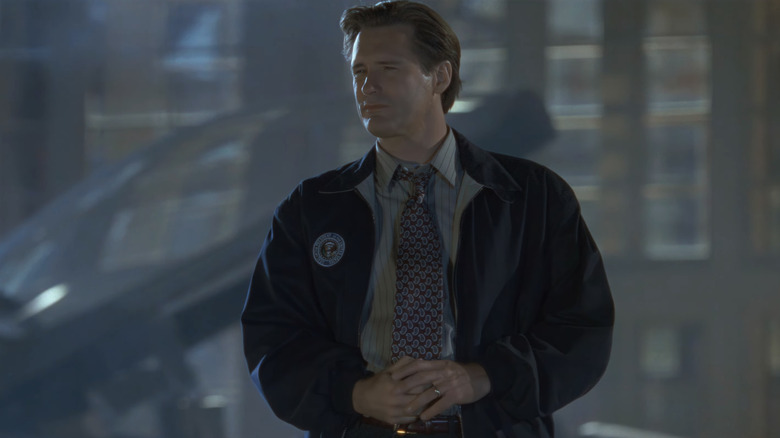
The "Independence Day" marketing clearly worked, with the movie making $817 million on a $75 million budget. What's more, it actually prompted a panic by emulating Orson Welles' "War of the Worlds" broadcast from six decades prior, whereas that original broadcast didn't actually fool as many people as you might have heard.
So much of what occurred on October 30, 1938 and in the following days is disputed. In a 1960 court deposition (via Smithsonian Magazine), Welles claimed to have "conceived the idea of doing a radio broadcast in such a manner that a crisis would actually seem to be happening." But in a press conference the day after the broadcast, he'd claimed the opposite. Then, as detailed in a 2013 Slate piece, the actual extent of the so-called "panic" appears to have been exaggerated, with newspapers sensationalizing the effect of Welles' broadcast in order to strike a blow against radio, then a threat to print media's advertising revenue.
Still, it's not as if there's absolutely no reason to believe at least some listeners were taken aback. In the aftermath of the broadcast, for instance, Federal Communications Commission chairman Frank McNinch did establish an agreement with radio networks to never use a newsflash format for a work of fiction again. That might have been propelled more by the sensationalized newspaper reports than anything else, but either way, "The War of the Worlds" radio drama caused a significant stir, even if nobody was actually convinced aliens had arrived. With its movie marketing stunt that went a little too far, however, "Independence Day" managed to do what Welles seemingly couldn't and actually convinced people Earth was under attack from extraterrestrials.