

David Lynch Directed Only One Western, And It's Absolutely Fascinating
The French newspaper Le Figaro was founded way back in 1826, making it the oldest newspaper in France. It took the paper until 1978, however, to launch its own supplemental magazine, handily called Le Figaro Magazine. The outlet would go on to court controversy for its right-wing views and anti-immigration stance, and the fact that members of its editorial board belonged to a GRECE, a hard-right ethno-nationalist think-tank, at least prior to 1980.
Nevertheless, to celebrate its 10th anniversary in 1988, Le Figaro commissioned an ambitious and strange cultural arts experiment dubbed "The French as Seen by..." The magazine invited several filmmakers to make short films about the culture clash between France and their native countries. These shorts included "Pèlerinage à Agen" from Italy's Luigi Comencini, "Proust Contre la Déchéance" from Poland's Andrzej Wajda (director of "Ashes and Diamonds" and many other works), "Les Gaulois" from Germany's venerable Werner Herzog (director of gonzo movies like "Aguirre, The Wrath of God"), and "Le Dernier Mot" from France's own film school staple, Jean-Luc Godard.
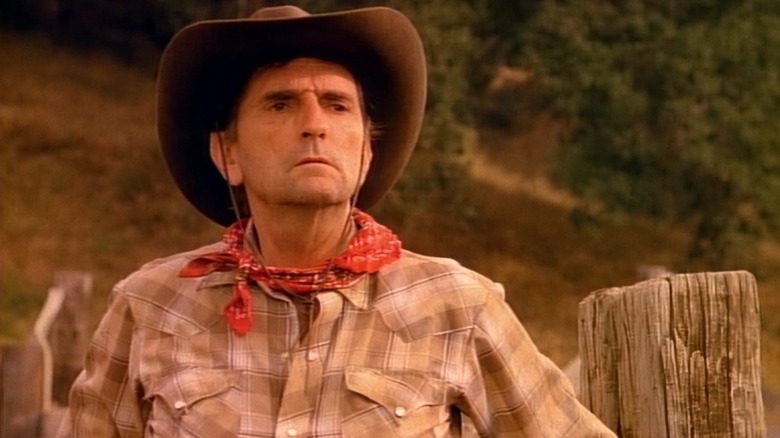
Lastly, the project's U.S. representative was David Lynch, who wrote and directed the 26-minute film "The Cowboy and the Frenchman" starring Harry Dean Stanton as the Cowboy and Frederic Golchan as the Frenchman. The short is striking in that it can be considered Lynch's only Western, but it may also stand as one of the famed director's only straight-up comedies. Like much of Lynch's work, however, it is refreshingly off-center. The short also stars notable American character actors Jack Nance (the star of "Eraserhead"), Tracey Walter, and Michael Horse, who would go on to appear in Lynch's TV show "Twin Peaks."
The Cowboy and the Frenchman is David Lynch's only Western
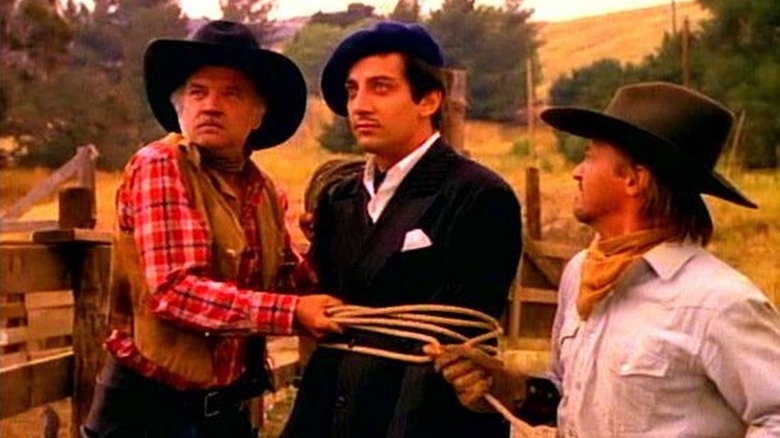
"The Cowboy and the Frenchman" is a pretty simple short. Slim (Harry Dean Stanton) is standing around his ranch in the Wild West when two of his ranch hands (Jack Nance and Tracey Walter) lasso a strange creature in the nearby trees. The strange creature is Pierre (Frederic Golchan). After some shouting and miscommunication, the cowboys discover that Pierre doesn't speak English. Slim is also hard of hearing, so there's a lot of shouting. They discover that Pierre was running away from a local Native American named Broken Feather (Michael Horse).
Pierre, however, carries a basket full of French treasures. He has a bottle of wine, a baguette, Gauloise cigarettes, mussels, a ripe hunk of Camembert cheese, a plate of pomme frites, and models of the Eiffel Tower. He also has some escargot on his person. Somewhere in there, Slim finally figures out that Pierre might be from France. They have no problems with a French feller, however, and they decide to have a party. Beers are consumed, a Statue of Liberty is presented, everyone sings "Home on the Range" before exclaiming "Viva la France!"
While the name of the overarching project for "The Cowboy and the Frenchman" was "The French as Seen by...," Lynch seems to be commenting more on Americans than on the French. To the American cowboys in Lynch's film, the French are seen as a bundle of cliches, weird men in black berets who eat elongated loaves of bread and travel around with models of the Eiffel Tower. The cowboys are, as many Americans might be, largely ignorant of international affairs.
The Cowboy and the Frenchman is weirdly optimistic for David Lynch
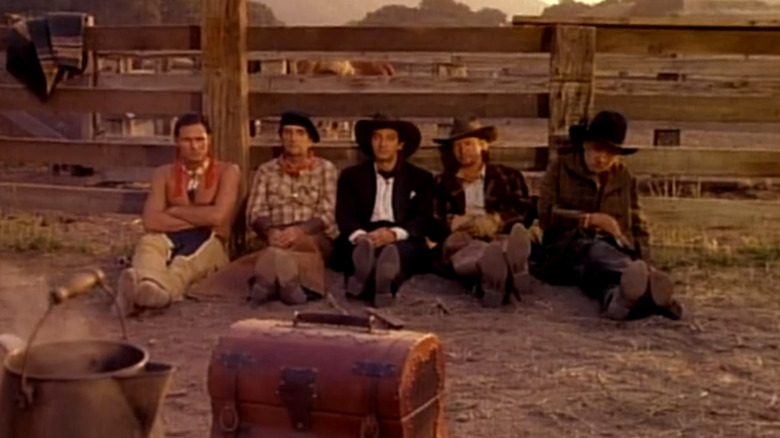
Counter to Lynch's usual cinematic interests, there is no darkness lurking at the heart of the matter. There is no alienation or inner American rot. Unlike in "Blue Velvet," there are no bugs lurking just below the surface of the nation's placid suburban front. Indeed, Slim seems genuinely excited to meet a French man, once he finally figures out that he's French. The cowboys are all ignorant, shouting hayseeds, but they would love to hunker down and have some beers with an amiable new friend. There is no animosity whatsoever. It's a pleasant-feeling short. Lynch's comedic timing is a little strange — no surprise — be he is never anything less than affable in "The Cowboy and the Frenchman," a surprise from the man who would go on to make "Lost Highway."
"The Cowboy and the Frenchman" came during a massive upswing in Lynch's career. He had become a critical darling for 1986's "Blue Velvet." In 1990, he would release "Wild at Heart," and become a TV phenom that same year with the debut of "Twin Peaks." Personally, Lynch was dating "Blue Velvet" star Isabella Rossellini. It's no wonder Lynch was in the mood to make something so uncharacteristically optimistic; he was in a great place in his life.
Lynch arguably only made one other comedy project in his career: the very, very short-lived sitcom "On the Air" which was canceled after three episodes. Given the obscurity of "The Cowboy and the Frenchman" and of "On the Air," it seems that audiences didn't like Lynch when he was lighthearted.