

Netflix's KPop Demon Hunters Was Inspired By A Monster Movie Masterpiece You Have To Watch
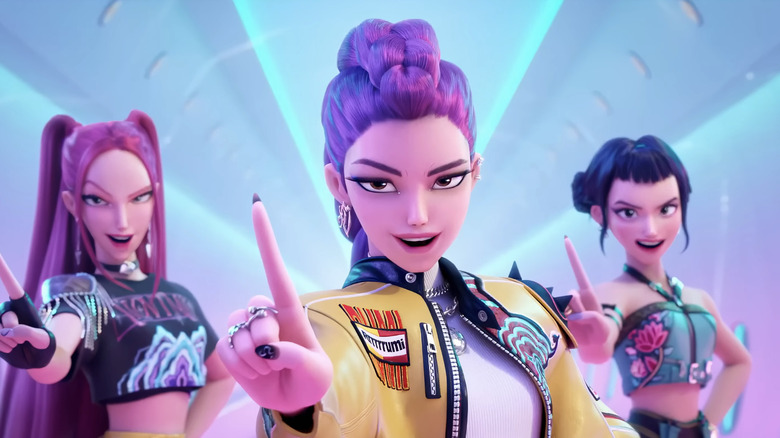
"KPop Demon Hunters" mixed all manner of influences to create its intoxicating style and tone. But while many fans will no doubt be familiar with the K-pop influences and even perhaps the K-drama references, they might not be as aware of how celebrated auteur Bong Joon Ho inspired the hugely-successful Netflix animated movie. In particular, the director's 2006 monster movie "The Host."
Even if you haven't seen it, there's little to no chance you haven't encountered "KPop Demon Hunters" in some form. The Netflix movie has permeated culture in a way that few movies ever will, becoming a cultural phenomenon that is very hard to escape, even if you might want to. Part of what made "KPop Demon Hunters" the defining movie of 2025 was the way in which co-writers and directors Maggie Kang and Chris Appelhans blended an impressive array of inspirations to create something both new and exciting but also relatable and timely.
Those inspirations included the obvious, like K-pop itself, as well as Korean dramas and folklore. But it seems the Korean influences didn't stop there, as Kang — who was born in Seoul but grew up in Toronto — has spoken about how Director Bong's films have had a major impact on her work. That's not surprising given that we're talking about a hugely influential modern-day auteur who himself hails from Korea. But rather than Director Bong's Oscar-winning, record-breaking 2019 drama "Parasite," it seems Kang was specifically inspired by "The Host" when crafting "KPop Demon Hunters."
The Host's tonal mashup influenced KPop Demon Hunters
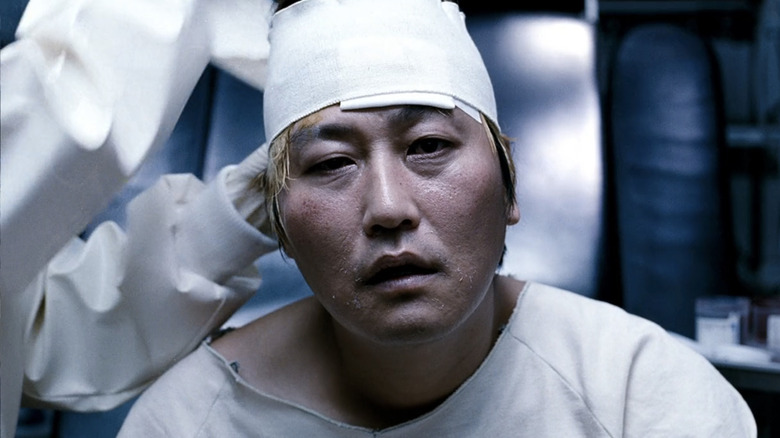
Bong Joon Ho is known for melding disparate tones. The director spoke to /Film about walking that tonal highwire with "Parasite" back in 2019, but that was far from his first time pulling off such a trick. That's something Maggie Kang is acutely aware of. In 2025, the "KPop Demon Hunters" director introduced a screening of "The Host" at Busan International Film Festival (via Screen Daily), speaking about Director Bong's influence. "He's a huge inspiration for me," she said. "I wanted to mimic his style, in a way, in ['KPop Demon Hunters']. I was really inspired by the way he juggled many different tones in ['The Host']. I actually didn't know that you could do that in a movie. It was the first time I had seen it."
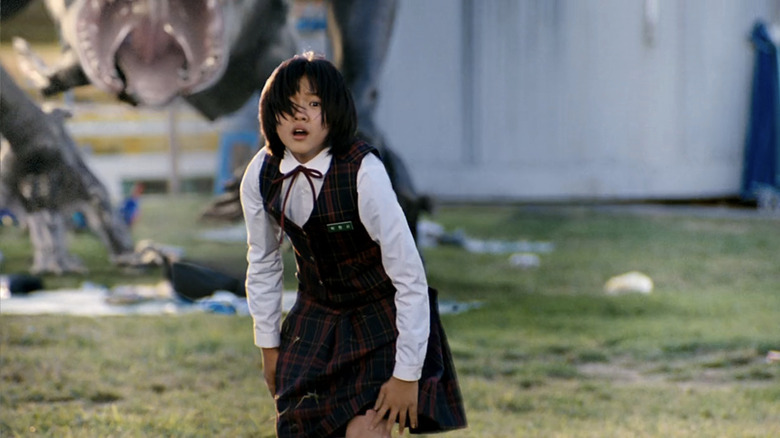
Before Director Bong made his English-language debut with 2013's "Snowpiercer," he made four features in his native Korea, beginning with 2000's "Barking Dogs Never Bite." Crime thriller "Memories of Murder" came next, then "The Host." This monster movie sees Song Kang-ho's food stand vendor, Park Gang-du, and his family hunting down a creature from Seoul's Han River after it kidnaps his daughter. The creature is the result of the American military dumping chemicals into the river, which Director Bong based on a real 2000 incident whereby a U.S. military employee released formaldehyde into a drain that led to the Han River. As far as we know, no hideous beasts emerged as a result, but in Director Bong's film, that's exactly what happens.
After grossing $89.4 million, "The Host" became the highest-grossing South Korean film ever made — a record later usurped by "Parasite." It was also a critical hit and holds a 93% critic score based on 155 reviews on Rotten Tomatoes.
Without The Host, KPop Demon Hunters wouldn't be the same
"KPop Demon Hunters" was influenced by everything from Marvel movies to Korean folklore. Mashing that all together might have resulted in something completely overwhelming and incoherent, but there's absolutely no arguing with the result. "KPop Demon Hunters" became so popular that it forced Netflix to do something it had avoided by making merchandise for the film and even giving it a theatrical release, where it became a box office smash.
"The Host" isn't necessarily what you might think of when you think of a "KPop Demon Hunters" influence, but that's partly why fans of the Netflix film should give it a go. As Geoff Pevere of the Toronto Star put it in his review, the film excels by "shifting tones from the horrific to the slapstick and back again," with Pevere commending Bong Joon Ho for making a movie "that's comprised almost equally of family sitcom, political indictment, high-urban paranoia and maximum-geek, monster-movie delight."
Clearly, that willingness to combine styles, genres, and tones was what made such an impact on Maggie Kang, adding yet another major influence to the tapestry of references that gave life to "KPop Demon Hunters." Had Netflix not been so willing to back a movie so steeped in Korean history and culture, however, we might never have seen this unlikely progeny of "The Host" come to light. As Kang said during her Busan International Film Festival speech, "[Netflix was] very encouraging for me to create a movie that was very culturally Korean. They know, above anyone else, the value of Korean content and how widely it was viewed globally. The desire for an animated film to be Korean is something they really wanted to do."