

How Star Trek: First Contact's True Sequel Involved Marvel's X-Men
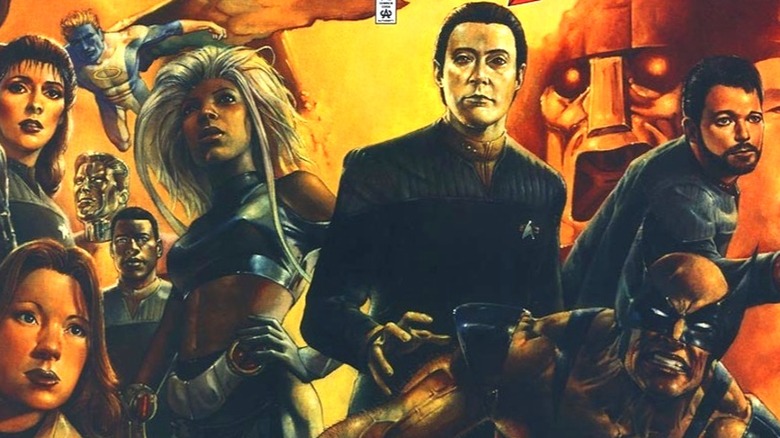
If you think about it, a crossover between the X-Men and "Star Trek" kind of makes sense. Kind of. Both were invented in the 1960s, and both used sci-fi and fantasy tropes to address social problems of the day. When Stan Lee invented them in 1963, Marvel's X-Men were a symbol for victims of prejudice. They were superheroes, but society at large hated the X-Men because of their mutant powers. They were considered second-class citizens. X-Men enthusiasts like to draw parallels between the X-Men's leader, Professor X, and Dr. Martin Luther King Jr. In this parallel, the Professor's ideological nemesis, Magneto, might stand in for Malcolm X.
Gene Roddenberry's original "Star Trek" debuted in 1966, and took place in a future where Earth had been unified and prejudice was at an end. Captain Kirk (William Shatner) admonished crewmates who expressed intolerance. But the galaxy at large, Kirk found, was still struggling with notions of bigotry, and the crew of the U.S.S. Enterprise remained stalwart in their confrontation of such notions. When Roddenberry created "Star Trek: The Next Generation" in 1987, he shifted his utopian ideals into overdrive, making Starfleet even more peaceful and egalitarian than before.
So when the crew of the Enterprise met the X-Men in a 1996 Marvel Comic called "Star TreX," it snapped together pretty neatly. It's nerdy AF, of course, and exists only to placate the very basest fanboy instincts, but conceptually, it kind of makes sense.
"Star TreX" was so successful, it warranted a 1998 sequel wherein the X-Men fast-forwarded to the events of "Star Trek: The Next Generation." Specifically, the X-Men turned up on the U.S.S. Enterprise-E, almost immediately after the events of the 1996 film "Star Trek: First Contact." The comic was aptly named "Second Contact."
The X-Men and Captain Picard met each other in Second Contact
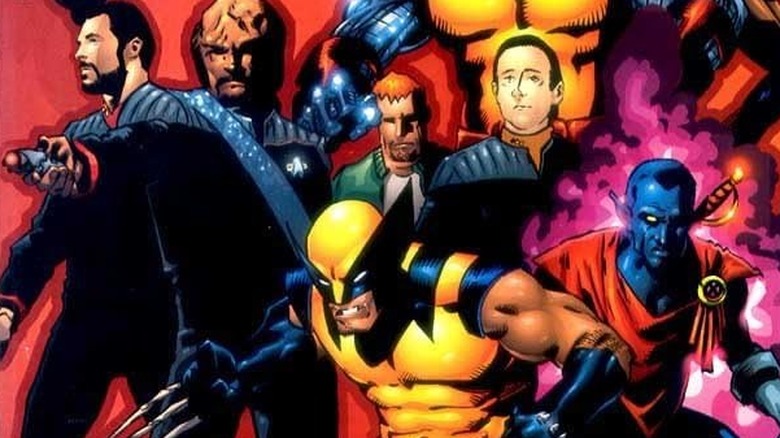
Since both the X-Men and "Star Trek" had dabbled in parallel universe stories, it seemed logical that they would eventually cross universes. In "Star TreX," an X-Men villain named Proteus, able to twist all of reality to his whims, sensed that a godlike being from "Star Trek" would make for a good compatriot. The godlike being was Gary Mitchell (Gary Lockwood), a character who appeared in the episode "Where No Man Has Gone Before" (September 22, 1966). Gary and Proteus brought the universes of the X-Men and "Star Trek" together, allowing Wolverine to meet Kirk, etc. Once the X-Men and the Enterprise defeated Gary and Proteus, the universes were separated once again.
But that wasn't the end of it.
Trekkies will recall that the movie "Star Trek: First Contact" (which originally had much grander plans) was a time-travel story unto itself, one that saw the U.S.S. Enterprise-E thrown back in time to the year 2063. At the end of the film, the Enterprise returned to its own present via a time hole, and everything seemed to be okay. Audiences, however, never saw the Enterprise arrive back in its own time, allowing the writers of "Second Contact" room for a little story loophole.
The comic depicts an adventure that occurred during the return trip, when the Enterprise was unexpectedly diverted through time by the Marvel Comics villain, Kang the Conqueror. The ship ended up in the Marvel universe. Wolverine recognized the uniforms from the previous "Trek"/X-Men comic and asked Picard if he was one of "Kirk's People." (This will make Trekkies' head explode.) The X-Men and the crew of the Enterprise-E must team up to stop Kang's plan to blend and erase all known timelines from existence.
There was a third chapter in the X-Men/Star Trek saga
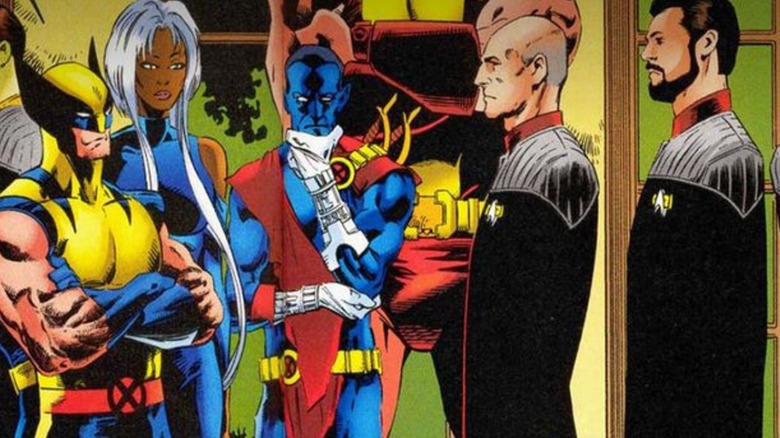
After the conflict was resolved in "Second Contact," the Enterprise-E was finally returned to its timeline, just in time for the 1998 movie "Star Trek: Insurrection" (which was released only seven months after "Second Contact" was published).
But, again, that wasn't the end of it.
Immediately after the events of "Second Contact," and the same month it hit comic store shelves, Pocket Books published Michael Jan Friedman's novel "Planet X," the third and final installation in the X-Men/"Star Trek" crossover saga. Being a novel, "Planet X" could afford to have a more intricate story than its two comic book prequels. On a distant planet in the "Star Trek" universe, the populace is spontaneously developing superpowers, very much like the X-Men. As a response, the X-Men are pulled into the "Star Trek" universe, and the characters can interact once again.
Worf and Wolverine train together on the holodeck. Dr. Crusher notices an uncanny resemblance between Captain Picard and Professor X. ("Planet X" came out two years before Patrick Stewart was cast as Professor X in a live-action X-Men movie, so the jokes about their resemblance was an early form of fan casting.)
Having read both comics and the novel, I can say without hesitation that they are all as dumb as they sound. It's not so much an intriguing idea as a "what if" conversation that got out of hand. But it is a hoot, and all the involved writers were careful to make the X-Men universe and the "Star Trek" universe interlock effectively. Only the most rabid fans need seek it out.