

Fallout Season 2's Biggest Problem Was Never An Issue With Season 1 For One Key Reason
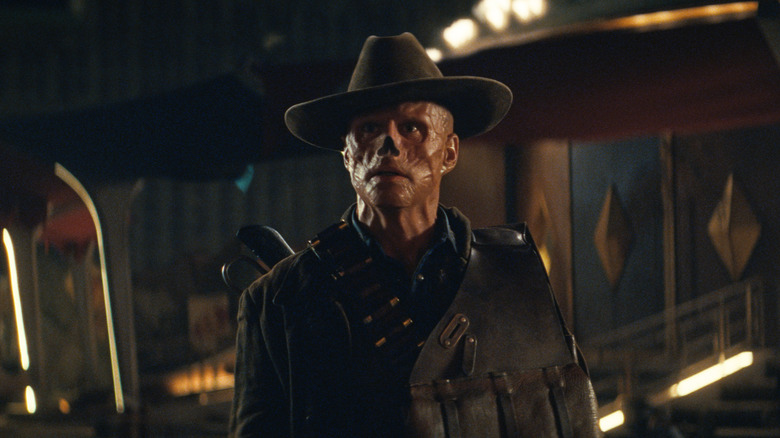
"Fallout" remains a brilliant video game adaptation in its second season. It's a show that understands you don't always have to directly adapt the plot of a specific video game for television. Instead, sometimes you can just focus on the world. The best thing "Fallout" does is translate the look and feel you get when you first boot up the original games and step into a new and unique universe. It uses that sandbox to tell new stories that only tangentially relate to the games' plot.
The show's impeccable production design also does a lot of heavy lifting in bringing the post-apocalyptic, retrofuturistic setting of "Fallout" to life. Like the games, the series pays careful attention to details and uses background visuals to help propel its narrative forward. Every set and prop tells a unique story and adds to the lore of this universe, as well as its unique feel. Its use of practical effects like the Power Armor and even the Deathclaw puppets gives the show a tactile and lived-in feel. And while the series doesn't directly adapt a particular story from the "Fallout" games, it does touch heavily on their lore. Throughout the first season, and continuing in season 2, we learn a lot about how the shadowy organizations that caused the world to "end" in this franchise.
Unfortunately, viewers don't seem to be responding to "Fallout" season 2 the way they should, considering how great it is. According to The Hollywood Reporter, the ratings for season 2 are lower than those for season 1. There are many reasons for this, but perhaps the biggest problem is season 2's release schedule. Indeed, where season 1 dropped all at once, season 2 has taken the more traditional approach of unveiling a new episode weekly, and it's hurting its story.
The problem with Fallout season 2's weekly release schedule
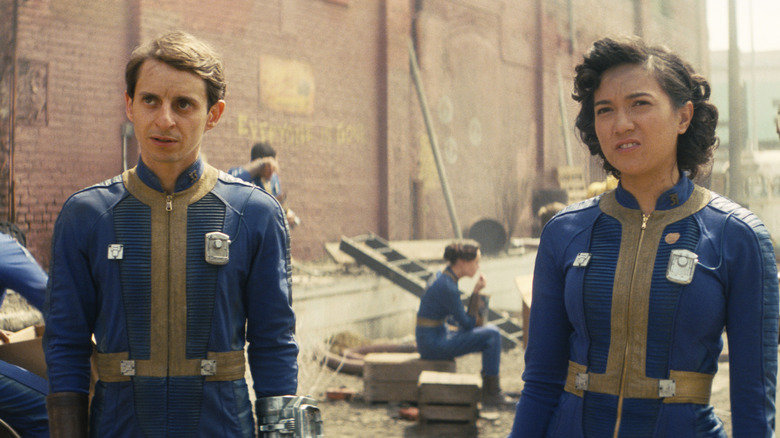
"Fallout" has a lot of storylines happening at the same time. Because of this, its overarching plot tends to move forward at a slow pace from one episode to the next. Considering how the subplot involving the show's protagonist, Lucy (Ella Purnell), and her drug addiction advances only a bit at a time. Not just that, but the show isn't always cohesive in the way it breaks up its story threads. A character will appear in one episode, have their storyline come to a halt, and not return until a seemingly random point a week or two later. Compare that to a show like "Game of Thrones," which knew how to split up its subplots and connect them from episode to episode, be it thematically or narratively.
Week in and week out, "Fallout" can only give so much attention to each of its many plot threads. Because of this, it rarely offers a satisfying conclusion to any one episode. Instead, the show feels like it was written specifically to be binge-watched. Otherwise, the plot seems to move at a snail's pace, with the lore getting far more time in the spotlight. That's fine if you're mainly interested in the series' world-building, but it negatively impacts the way you experience the larger story in "Fallout" while watching it weekly.
Again, that's a sharp contrast to "Fallout" season 1, which unveiled all of its episodes at once. That season also focused more on its individual character storylines than in backstory and lore. Because of this, it might've actually benefitted from a weekly release format. Perhaps the solution is to drop multiple episodes each week (à la "Andor"). We'll see if that happens with season 3.
"Fallout" is streaming on Prime Video.