

Cyclops Gave X-Men '97 Animators One Of Their Biggest Challenges In The First Episode
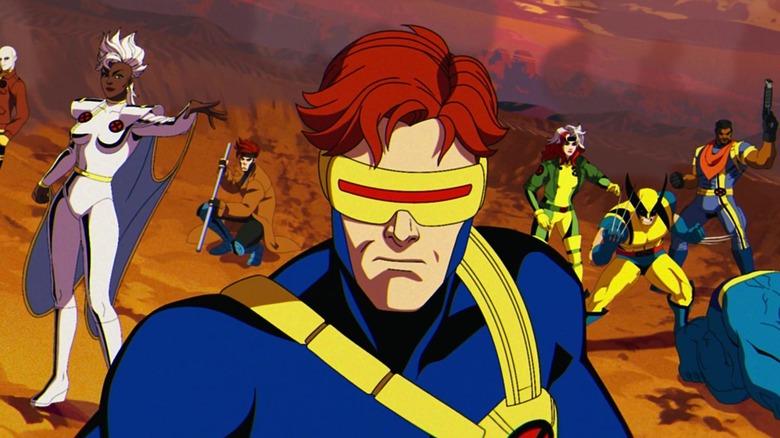
We may receive a commission on purchases made from links.
Fans of the X-Men will be able to tell you all about the curious physics of Cyclops' optic blasts. Although they look like bright red lasers, Cyclops' blasts are actually a focused beam of concussive force. They don't burn things, but they can punch a hole through a wall. The X-Man could, with the right control, merely knock over a foe, but he could also blast open a mountain. Cyclops' optic blasts are constantly pouring forth from his eyes, and can only be blocked by his eyelids or by a lens made of the fictional ruby-quartz mineral. All of Cyclops' glasses and visors are equipped with this mineral.
In terms of his personality, Cyclops is a lot less complicated. He is one of the leaders of the X-Men, usually taking command when the mutant army goes into combat. He is resolute, vaguely noble, and generally heroic. Sadly, "has good leadership skills" isn't much of a personality in the comic book world. Back in the 1990s, some X-Men fans would mock Cyclops for being something of a stuffed shirt. He was a boring character who lacked the edge of Wolverine, or the cool powers of Storm. He was too stable, too boring.
The makers of the 2024 revival series "X-Men '97," however, wanted to undo any stigma or mockery that had previously been attached to Cyclops (voiced by Ray Chase) by transforming him into something of a badass. As seen in the first episode of "X-Men '97," Cyclops uses his powers as a way to slow his descent after falling from a plane. FX Lead Designer and FX Supervisor Chris Graf spoke about the challenges of animating that scene in James Fields' new book "X-Men '97: The Art and Making of the Animated Series."
The animators had to find a way to make Cyclops look like a badass
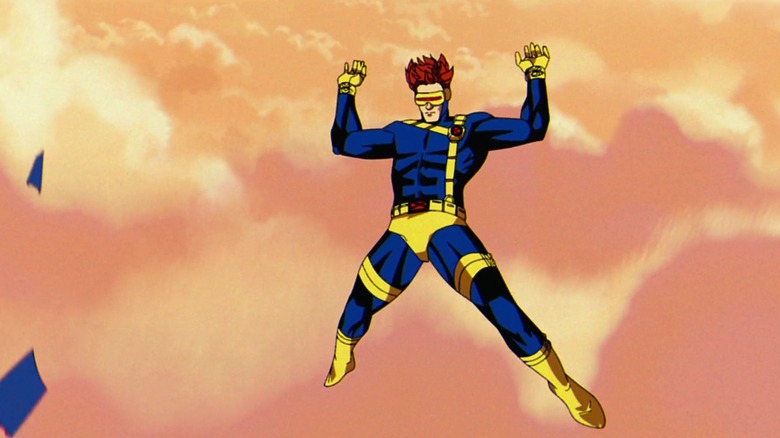
Indeed, the "superhero landing" that Cyclops performs is pretty cool. He and the other X-Men leap from their plane, ready to land in the middle of the action. Some of the X-Men can fly, and aid the ones that cannot down to the ground. Cyclops, however, needs no aid. He falls freely, without a parachute, unflappably prepped for a light landing. He blasts his optic beams directly at the sandy desert ground, essentially using them as rocket engine, halting his descent. Cyclops even lands with a cool superhero pose.
The sequence was cool and all, but to make the moment more appropriately epic — and to make Cyclops look cool — Chris Graf admitted he and his animators had to add in a lot of effects and movement. That moment ensured the show's viewers that, yes, Cyclops was a powerful badass that is worthy of following into combat. As Graf described the sequence:
"I did roughly twelve design stages for that shot to sell each moment that a new FX element was introduced. This scene was important to show how powerful and capable Cyclops actually is, and it was also extremely important to our showrunner and directors that Cyclops finally got his long-overdue cinematic moment to really sell his strength as team leader. [...] With all the different layers of sand, wind, dust, optic blast, and shockwaves, it ended up taking roughly eighty hours from start to finish-to-animate the six-second scene."
Graf ended up animating the sequence himself. It proved that Cyclops, as some fans have said, is an underrated X-Men character.
The desert sequence displayed that Cyclops was both powerful and in control
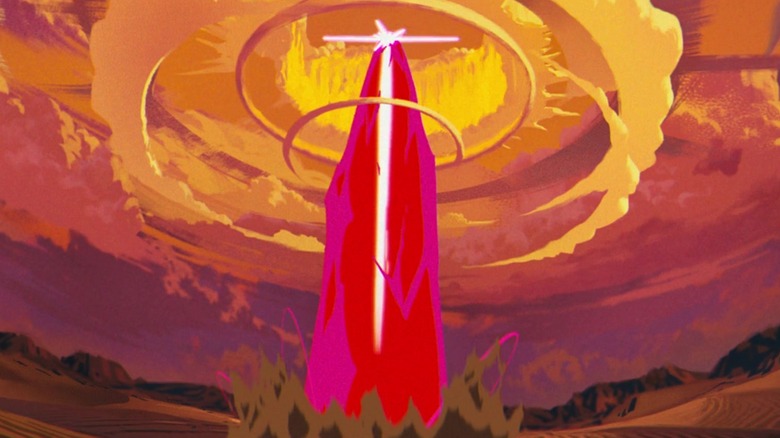
To reiterate, the desert landing sequence wasn't just meant to look cool, but to establish what kind of character Cyclops is and, just as importantly, what he's capable of. Too often, superhero comics take their characters for granted, giving them only vague limits to their powers — if they're even defined at all. To this day, I couldn't tell you what Thor does, for instance. Cyclops, we learned from "X-Men '97," can fight gravity itself. Graf continued:
"It was very important in design to make sure we got the idea across that his optic blast is concussive-and not a laser made of heat-and that he can also adjust the power level needed when fighting different types of characters. Being able to reduce his power levels to use them in a fight against common thugs or turn them up when he's fighting three-story-high Sentinels was a level of precise control we wanted to make sure the leader of the X-Men had."
To be fair, this kind of control wasn't ever demonstrated in "X-Men: The Animated Series," the 1992 show that "X-Men '97" is extrapolated from. The showrunners made sure to pay attention to detail more this time around. It wasn't necessary to remain so authentic to the 1992 show that they only included vague descriptions of powers or, worse yet, cheap and rushed animation techniques. The original "X-Men" showrunners didn't know anything about mutants. The new showrunners do.
The second 10-episode season of "X-Men '97" is due to debut on Disney+ in 2026.