

Steven Spielberg Directed Christian Bale's First Major Movie For Personal Reasons

Cinema academics tend to describe 1985's "The Color Purple" and 1987's "Empire of the Sun" as the movies that finally made Steven Spielberg grow up. These were the pictures that saw him step away from the fantastical creatures and genre thrills of his earlier work to tell fully grounded human stories for the first time. It's a reductive way to look at his art as a director, but it's not wholly invalid, either.
Of the pair, though, it's "Empire of the Sun" that feels more personal. "The Color Purple" is sensitive in the way it adapts Alice Walker's regularly banned book, and it's obvious that Spielberg sympathizes with the queer Black woman at its center, but he also struggles to get a grip on how to best handle her experiences. However, that's not at all the case with "Empire of the Sun," a film in which a preteen Christian Bale, in his first major movie role, plays a boy who's forced to grow up way too quickly. A child of divorce himself, Spielberg understandably gravitated to this motif throughout his career on his way to helming the cinematic therapy session that is "The Fabelmans."
Speaking to The New York Times in 1988, he didn't deny that this was what drew him to "Empire of the Sun" as well. Still, as much as he appreciated that it was a story about a child, what really attracted him was "the idea that this was a death of innocence, not an attenuation of childhood, which, by my own admission and everybody's impression of me, is what my life has been." Therein, perhaps, lies the paradox of Spielberg: As much as he was criticized for needing to grow up as an artist when he was younger, his personal life was a different story.
Empire of the Sun remains one of Spielberg's most personal works
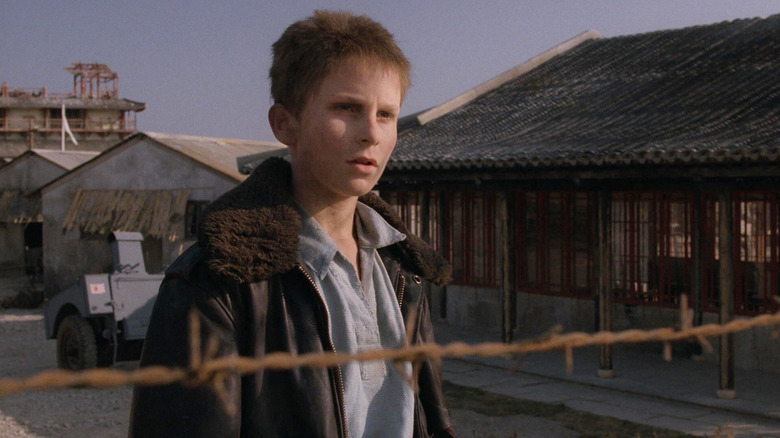
Based on J.G. Ballard's partly autobiographical 1984 novel, "Empire of the Sun" follows Jamie Graham (Christian Bale). The son of two affluent, white British expats living in the Shanghai International Settlement during WWII, Jamie is separated from his parents when Japan takes control of the area and, in time, becomes a prisoner of war in a Japanese internment camp. As was similarly the case when Steven Spielberg directed the true-ish story inspired "Catch Me If You Can" 15 years after "Empire," it's not exactly hard to see why this tale about a family being broken up and the traumatic effect it has on their son spoke to the filmmaker.
That, coupled with his general interest in WWII, was why Spielberg wanted to direct "Empire of the Sun" even back when his filmmaking hero, David Lean, was circling it. ”My parents got a divorce when I was 14, 15. [...] The breaking up of the mother and father is extremely traumatic from 4 up. All of us are still suffering the repercussions of a divorce that had to happen," as he told TNYT. He also admitted this is part of the reason why he's "not good with change," and it took him a minute to stop focusing on making films that "appeal to audiences between the ages of 6 and 15."
Occasionally, Spielberg's crowd-pleasing sensibilities rear their head in "Empire of the Sun" and clash with the story's grim subject matter and otherwise serious tone, but it's much less of an issue here than in "The Color Purple." Relating to the story the way he did, you get the feeling that the filmmaker was simply more comfortable letting this movie's haunting imagery and sadder moments speak for themselves.