

Why Luc Besson's Dracula Made Two Major Changes To Bram Stoker's Story
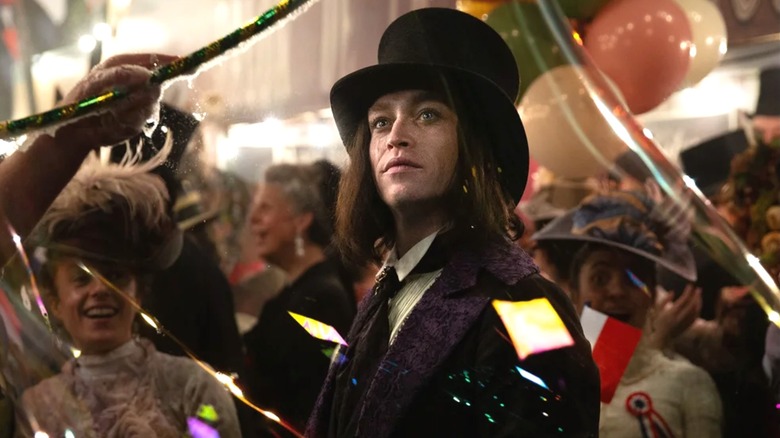
Vampires have been in for quite some time, as stories about the undead make for layered metaphors. The overwhelming popularity of "Sinners" and "Nosferatu" points toward the untapped potential of the vampire mythos, which can still accommodate varied interpretations. Love has been an essential component of gothic horror in prominent vampire stories, including "Bram Stoker's Dracula," Francis Ford Coppola's hypnotic, audacious 1992 adaptation of the titular classic. Coppola's Dracula (brought to life by the brilliant Gary Oldman) is both sympathetic and repulsive, driven primarily by his centuries-spanning love for one woman. A similar approach has been adapted by Luc Besson ("The Fifth Element"), whose "Dracula" leans more towards period romance than a horror tale steeped in moral corruption or xenophobia.
Per SFX Magazine's January 2026 issue, Besson made two key changes in "Dracula" to differentiate his adaptation from Bram Stoker's 1897 source material. For starters, this story doesn't accommodate Abraham Van Helsing, the iconic polymath/vampire hunter who aids Jonathan Harker and his allies in vanquishing Dracula in the novel. Speaking to SFX, Besson explained that he wished to invert traditional assumptions about science and religion by introducing a new character (played by Christoph Waltz, who simply goes by "Priest") who fulfills Van Helsing's function:
"I was not trying to portray Van Helsing, so why call him Van Helsing? [...] What was interesting is that you have science and religion. Religion is supposed to be a proposition. Science is something we know. I really wanted to reverse that. The priest is very sure of himself and basically knows everything when science is lost. I wanted to play that exchange of knowledge."
Apart from this character inversion, Besson also did away with Dracula's three Brides, as he wanted to underline the idea of an immortal creature loving one person across centuries.
Besson's reimagining of Dracula feels extravagant, yet thematically empty
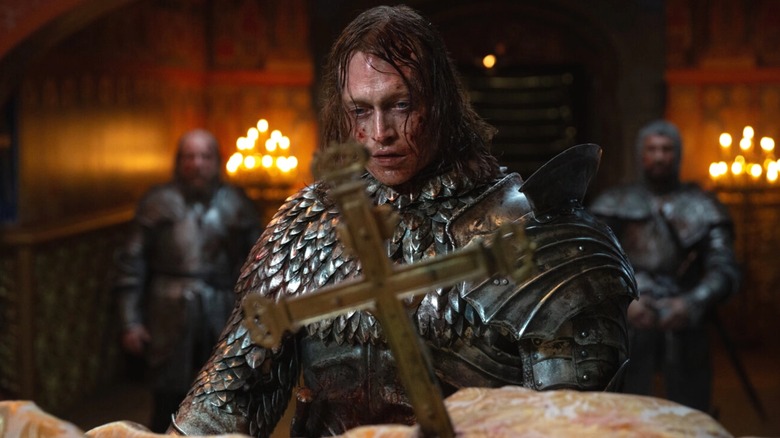
In Bram Stoker's "Dracula," the Brides of Dracula function as subversions of traditional femininity during the Victorian era, as they embody sexual freedom and perverse morality. They're physical manifestations of the temptations inherent in vampirism, which is in stark contrast to the repressed nature of Victorian society as a whole. Luc Besson overlooks this key facet and views the Brides as an obstacle to his grand love story. "In the book, he [Dracula] has like three nymphs, which is very disturbing to me, because my love story is really unique — he loves one woman and no one else," Besson exclaims, diluting the narrative agency of the Brides in the process.
Just like Francis Ford Coppola's film, Besson's "Dracula" opens with Prince Vladimir (Caleb Landry Jones) and Elisabeta (Zoë Bleu) in the 15th century, who are cruelly torn apart by fate after the Ottoman Empire's invasion. Besson switches things up a bit to avoid the narrative beats in Coppola's version, but in the end, he patiently waits for centuries to reunite with Elisabeta's reincarnation. While this sounds like an awe-inspiring saga of passionate love, Besson's version fundamentally misunderstands Stoker's story, even within the confines of a romantic remagining devoid of horror.
For example, the omission of Van Helsing exemplifies the adaptation's thematic emptiness. Waltz's Priest cannot fulfill the function of Helsing's intended role, as the latter is a man of science who has great respect for unexplained mysteries, which is exactly why he's the perfect vampire hunter. By positioning a religious figure against a supernatural force like Dracula, Besson foregoes the complexity that a character like Helsing brought to the original tale.
"Dracula" releases in theaters on February 6, 2026.