

What Are Photonics? Star Trek: Starfleet Academy's Holographic Characters Explained
In the world of "Star Trek," the idea that a humanoid hologram could possess consciousness dates back to the 1988 "Star Trek: The Next Generation" episode "Elementary, Dear Data." There, Geordi (LeVar Burton) is shown playing a Sherlock Holmes game with Data (Brent Spiner) on the holodeck, only for the pair to discover that Data's android brain is too advanced for the pre-written detective stories in the ship's database; in other words, he can solve the cases too easily. As such, Geordi asked the ship's computer to create a nemesis for them to match wits with. The computer then proceeded to create Professor Moriarty (Daniel Davis), an ultra-intelligent hologram that, over the course of the episode, revealed that he had self-awareness and a consciousness of his own (making him a nemesis worthy of Data).
Since that episode, "Star Trek" has returned, time and again, to the idea that holograms can be imbued with life. They are, in "Star Trek" parlance, "photonics," meaning they are life forms made of photons. The computers are so advanced on "Star Trek," they can manifest artificial consciousness by accident. This was most deeply explored on "Star Trek: Voyager," in which the U.S.S. Voyager's crew was required to leave their Emergency Medical Hologram (Robert Picardo) running 24/7 after their flesh-and-blood medical staff died in an accident. The Doctor eventually developed a consciousness and personality of his own.
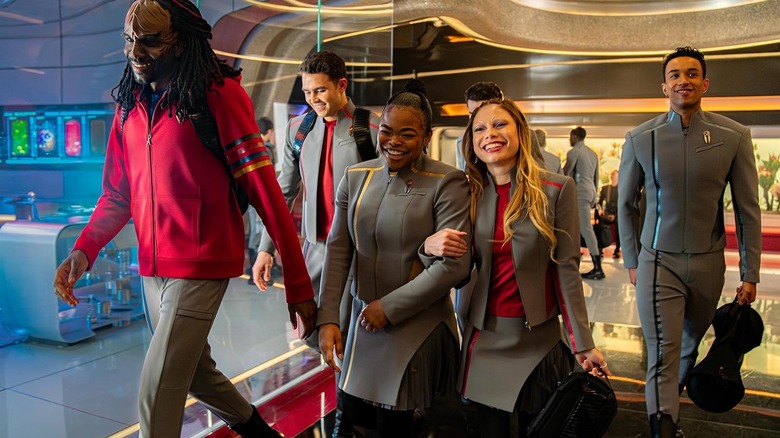
Because he's only made of light and force-fields, the Doctor doesn't age. This, in turn, allowed Picardo to reprise the Doctor for "Star Trek: Starfleet Academy," a series set eight centuries after the events of "Voyager." But as it happens, the Doctor's not the only photonic on the show. One of his students, Series Acclimation Mil or Sam (Kerrice Brooks) is a Kasqian, which is a kind of hologram.
The rise of photonic life forms and the fight for their rights in the Star Trek universe
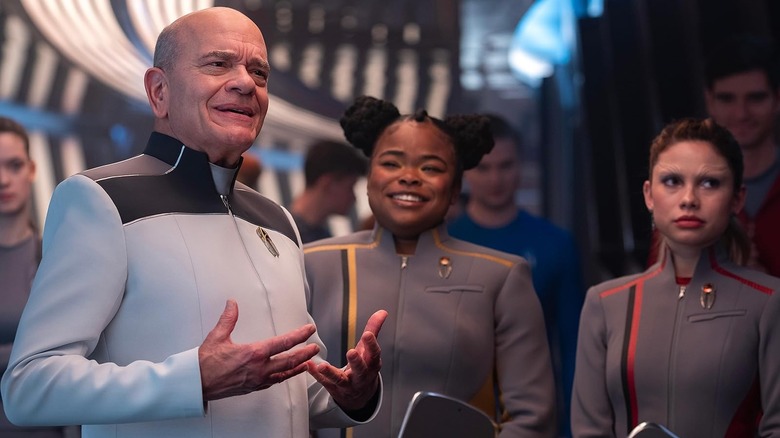
On "Star Trek: The Next Generation," holograms were confined to the holodeck, as it was the only place on Starfleet's ships where hologram emitters had been equipped. Later on "Voyager," the titular spacecraft's sickbay were additionally equipped with the same types of emitters, allowing a holographic doctor to walk anywhere he wanted in the office. Complex force fields also made holograms physically tangible. Over the course of the series, the Doctor eventually revealed he had more than a consciousness; he even had his own personal interests and dreams. Thus, being unable to explore a ship beyond the sickbay made the character restless. Eventually, Starfleet's engineers found a way to transfer his program over to the holodeck, so he could at least get a change of scenery.
In the 1996 "Voyager" episode "Future's End, Part II," however, a rogue time machine gave the Doctor access to a special mobile emitter, a technology that wouldn't be invented for another 500 years. The mobile emitter allowed the Doctor to walk anywhere he pleased, his hologram being projected from a small floating widget on his arm.
This newfound freedom allowed everyone to see the Doctor as an autonomous individual with rights and not just a living hologram. But if the Doctor had rights, and holograms required equal protection under the law, this sparked a tricky ethical debate back at Starfleet headquarters. It seems that Starfleet had already invented hundreds of holographic laborers to do dangerous manual work, like mine for dilithium. Since it was assumed that holograms weren't sentient, this didn't seem to pose an ethical problem. The Doctor, on the other hand, felt these laborers had been enslaved and petitioned for their autonomy, winning his case.
How Kasqians fit into Star Trek: Starfleet Academy
The issue of hologram rights was settled in the 2001 "Voyager" episode "Author, Author." By then, of course, there had been multiple "Star Trek" stories about the ethics of relying on humanoid holograms. For example, in the 2000 "Voyager" episode "Body and Soul," the titular ship met a species that invented holographic soldiers to fight their wars, only to face a hologram rebellion when the photonics revolted. Also, Moriarty from "Next Generation" returned, and he complained about being stored in a computer memory bank. The characters on "Star Trek: Deep Space Nine" even recklessly and deliberately created Vic Fontaine (James Darren), a sentient holographic 1960s Las Vegas lounge singer. Living holograms, then, were very, very common by the time "Voyager" had ended. And that's to say nothing of the Emergency Command Hologram (Kate Mulgrew) on "Star Trek: Prodigy," a character that has an arc similar to that of the Doctor.
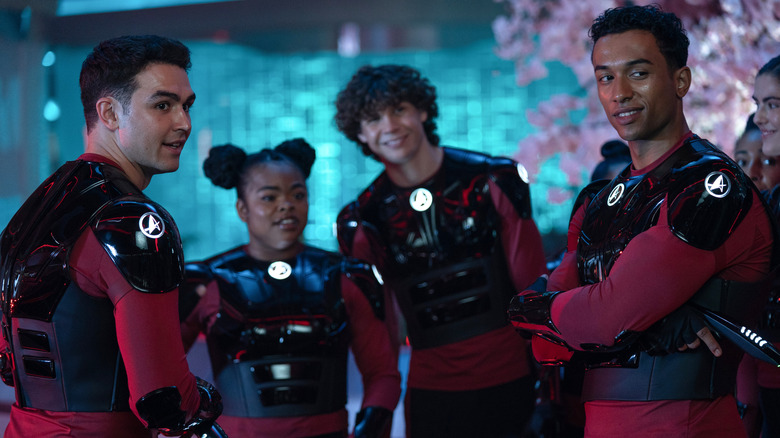
Now, "Star Trek: Starfleet Academy" — which takes place in the 32nd century — has introduced Sam, a character who appears to be about 17, but is, in fact, only a few months old. She even has to check on her program's manifest to learn about her own personal interests. Sam is a hologram that was activated by the Kasqians on the planet Kasq, specifically to study as a student at Starfleet Academy "with the sole purpose of reintegrating with organic life forms," as she explains in the series' pilot. Kasq, as she also notes, is a colony of holograms, although they go by "photonics." A lot can happen by the 32nd century, and it seems that a colony of photonics has been around long enough to become isolationists. Sam is their new envoy.
"Star Trek: Starfleet Academy" is streaming on Paramount+.