

X-Men: The Animated Series Used Jubilee For A Very Important Reason

In the very first episode of "X-Men: The Animated Series," called "Night of the Sentinels, Part I" (October 31, 1992), audiences were introduced to the character of Jubilee (Alyson Court), a fashionable but dejected teenager who had recently discovered she could accidentally manifest firework-like explosions out of thin air. As was common in "X-Men" stories, Jubilee was terrified by her new powers, and her foster parents begin debating their daughter's future. Mutants are pilloried and attacked in the world of "X-Men," you see, and they are objects of extreme prejudice and bigotry. Jubilee's foster parents, fearful of the government, sell her out, handing her name over to a fascistic Mutant Registration which aims to capture and control mutants.
Jubilee flees home, and laments her own fate. To make matters worse, she's soon attacked by a 50-foot robot called a Sentinel, the primary policing force of the Mutant Registration bureau. Jubilee is eventually rescued by the X-Men, a team of freelance mutant crimefighters and revolutionaries who operate secretly out of a high-end private school in upstate New York. There are about a dozen X-Men, and Jubilee is introduced to them all.
But why was Jubilee needed in this story? Surely, the kiddie audience could have been dropped into the middle of the X-Men and know what's going on, right? Not necessarily. According to a 2024 interview with Inverse, the makers of "X-Men: The Animated Series" said they wanted to introduce the X-Men with more deft storytelling. Jubilee, a teenager character, was confused and overwhelmed by the existence of X-Men, and thus used as an audience surrogate. If Jubilee was astonished, the X-Men would seem, well, astonishing to us too. She was our way in. It likely also helped to have directors who knew nothing about mutants.
Jubilee was the audience surrogate for X-Men: The Animated Series
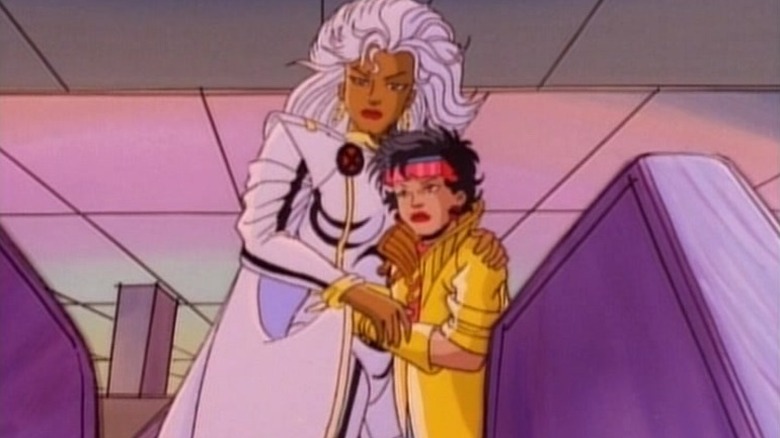
The head writer of "X-Men: The Animated Series" was Mark Edward Edens, and in the Inverse article, he spoke about how he and his fellow writers came up with the team we see on screen. By 1992, there were probably over 100 "official" X-Men teammates, so the showrunners had to come up with a "core" cast of characters to focus on. They ended up going with some of the most popular characters of the time: Storm, Cyclops, Jean Grey, Beast, Gambit, Rogue, Wolverine, and Professor X. There was an all-new character named Morph as well, although he dies in the second episode.
And then, of course, there was Jubilee, the fireworks teen. About Jubilee, Edens admitted that she was included for practical storytelling reasons, saying:
"Maybe the most original decision we made was to add Jubilee to the lineup. She was chosen very consciously as the stand-in for the audience. Most people hadn't heard of the X-Men, so we needed someone who, like the audience, didn't know who the X-Men were."
In that pilot, Jubilee was taken aside by the X-Men and everything was explained to her, and, by extension, and newbies in the audience. After the pilot, Jubilee became a part of the ensemble, and each episode focused on a different subset of characters. There were many, many Wolverine-heavy episodes, several Storm episodes, a few Cyclops/Jean Grey episodes (they were an item), and plenty of episodes of the whole team gathering to kick butt and fight prejudice.
The Jubilee voice actress had to be reminded that X-Men was a serious drama

Jubilee actress Alyson Court was also interviewed by Inverse, and she recalled recording for "X-Men" decades earlier. She was given some very pointed direction, she recalled, that dictated the tone of the series for her. Court is an experience voice performer who had recently landed a high-profile gig playing the lead role in a TV adaptation of Tim Burton's "Beetlejuice," so she was used to playing her roles somewhat fantastically and whimsically. Although "X-Men" was about dangerous robots and mutants with superpowers, Court was instructed by Sidney Iwanter, an executive at Fox Kids, to take the role more seriously. In Court's words:
"Someone else had originally been cast as Jubilee, a lot of us were recasts. I remember when we were recording the pilot, we lived at that studio for two weeks. They were so specific about what they wanted. I'd just finished playing Lydia in the 'Beetlejuice' cartoon and, every time I did a line, Sidney Iwanter would say, 'This isn't a childish Saturday morning cartoon! This is serious. Jubilee is being persecuted for being different. Do it again.' Sidney really put me through the wringer and it was great. He pushed me and we became good friends as a result."
Court did not return to the role of Jubilee for the nostalgia-heavy revival series "X-Men '97," as it had finally been acknowledged that Jubliee was an Asian-American character being played by a white actress. Court tastefully stepped aside, and was replaced by Holly Chau. Court instead played a new character called Abscissa in a few episodes. /Film wrote about the return of the original voice of Jubilee and how it was perfect, so check that out if you missed it at the time.