

Steven Spielberg's Most Underrated Sci-Fi Movie Almost Starred An Actual Robot
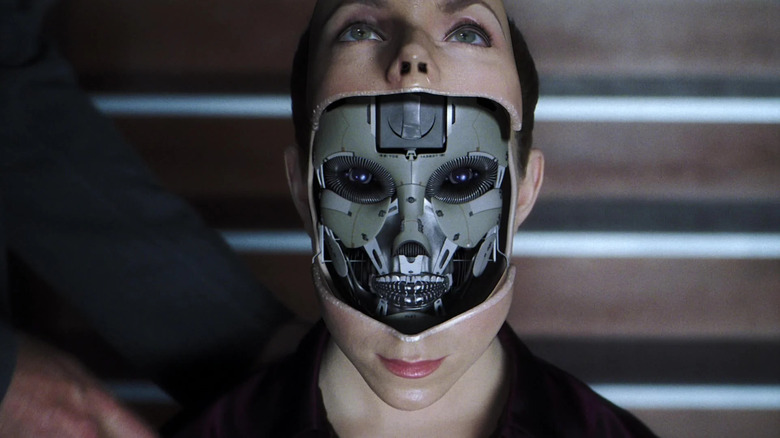
Many film fans will be able to tell you this, but Steven Spielberg's 2001 sci-fi film "A.I. Artificial Intelligence" was originally a project being pursued by his peer, the late Stanley Kubrick. The film was based on the 1969 short story "Super Toys Last All Summer Long" by Brian Aldiss, and Kubrick purchased the rights to the story way back in the early 1970s. The main character was a robot named David, and Kubrick felt that David should be portrayed by an actual robot. Indeed, one of the reasons Kubrick never actually made "A.I." was because he felt that VFX technology wasn't sufficiently advanced to accommodate his vision. This is "A.I." the movie, by the way. Not the tech that created A.I. "actress" Tilly Norwood.
Sometime during the 1990s, though, Kubrick felt that he was no longer the man for the job, and offered "A.I." to Spielberg instead. The project continued to develop passively for a few years. When Kubrick passed in 1999, the "A.I." project picked up again, with Spielberg making it in the hopes of honoring a fallen colleague and a master craftsman. The film came out in 2001, and it marked a turning point in Spielberg's ever-developing aesthetics. He made "A.I." with a more Kubrickian pace, and a more downbeat tone than he typically did. The android boy David was played by Haley Joel Osment, who had recently wowed audiences with his performance in 1999's "The Sixth Sense."
While Spielberg was still developing "A.I.," however, Spielberg reportedly wanted to follow Kubrick's original idea and have an actual robot play the role of David. According to a 2021 retrospective in The Ringer, Spielberg was already taking to VFX wizard Stan Winston about creating a complex animatronic for the character.
Steven Spielberg tried to have an animatronic built for David in A.I.
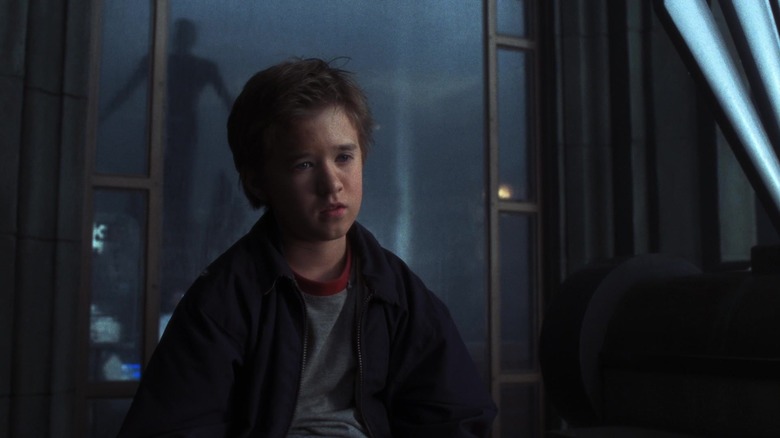
Hiring a human actor was a wise choice. Although David was an artificial being, the conceit of the movie is that he was programmed to feel love for his "mother." David was purchased by distraught parents after their own son was left comatose after an accident. The boy's mother, Monica (Frances O'Connor), hated the robot at first, but eventually found it might be able to serve as a "temp" son. She activated David's imprinting mechanism, which forced David to essentially begin actually loving Monica. Of course, because he was now programmed, David's love continued unabated. This became a problem for David after Monica was asked to return him to the factory once her real son awakened from his coma.
With a human actor in the role, David emerged as legitimately emotional, suffering in confusion, unsure as to why his beloved mother abandoned him. Osment made the character a tragic figure.
Producer Bonnie Curtis said in the Ringer interview, however, that Spielberg was legit pursuing a robotic actor for David. A human would play David's voice, of course, but the on-screen figure would be a complex mechanical puppet. As Curtis said:
"Stan Winston, who pulled off dinosaurs for you, comes and sits down and says, 'Let's try?' So we tried."
But they didn't try very hard. Evidently, only a few design sketches were made, and nothing was built. Spielberg, along with everyone else, saw Osment's performance in "The Sixth Sense," and was impressed enough to pursue him instead. The idea of making David an actual robot fell away, and cooler heads prevailed. Osment, incidentally, has continued to work into adulthood, although he is one of those child stars you wouldn't recognize today.
Stan Winston designed many other practical robots for A.I.
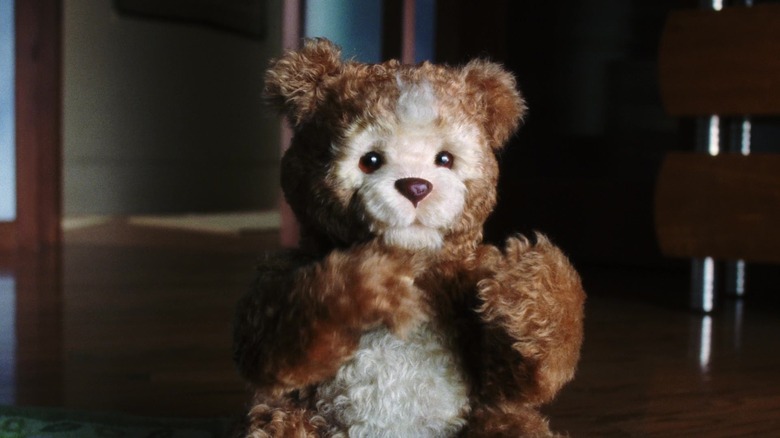
Although David was played by a human actor, it didn't mean that Stan Winston was out of a job. Indeed, Spielberg hired Winston to create multiple practical robot effects for "A.I.," most notably the walking, talking teddy bear Teddy (Jack Angel). Teddy was a massively complicated animatronic that could swivel and move convincingly. Lindsay MacGowan, the film's VFX coordinator, noted that "Teddy had more moving parts in him than the T-rex from 'Jurassic Park.'" Osment himself noted that the Teddy puppet, while small, weighed over 30 pounds, what with all its mechanical servos.
Teddy had six heads and required a lot of maneuvering to operate. It was worth the effort. Teddy is wholly convincing. Stan Winston, along with other VFX technicians Dennis Muren, Michael Lantieri, and Scott Farrar, were nominated for an Academy Award for their work. "A.I.," however, lost that year to "Lord of the Rings: The Fellowship of the Ring." Which, to be fair, also had impressive VFX.
Despite the impressive performances from both Osment and Teddy, "A.I." shouldn't be considered a lightweight, dazzling sci-fi romp in the mold of some of Spielberg's earlier adventure pictures. It's a headier, more brooding film about the hubris and extinction of humanity, and how our artificial, creations will not be able to understand the meaning of their own existence any more than we understand our own. Perhaps getting into Kubrick's head was good for Spielberg, as it allowed him to grow as an artist. After 2001, one can see Spielberg giving a lot more thought to his political dramas, like "Munich," than his action films, like that one adventure sequel. Everyone hates it, although star Harrison Ford has no hard feelings toward "Indiana Jones and the Kingdom of the Crystal Skull."