

Julia Roberts Thought Her And Hugh Grant's Box Office Hit Was The 'Dumbest Idea'
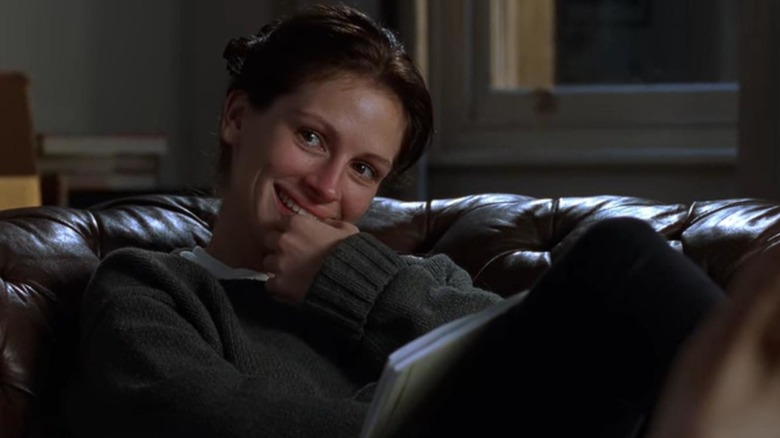
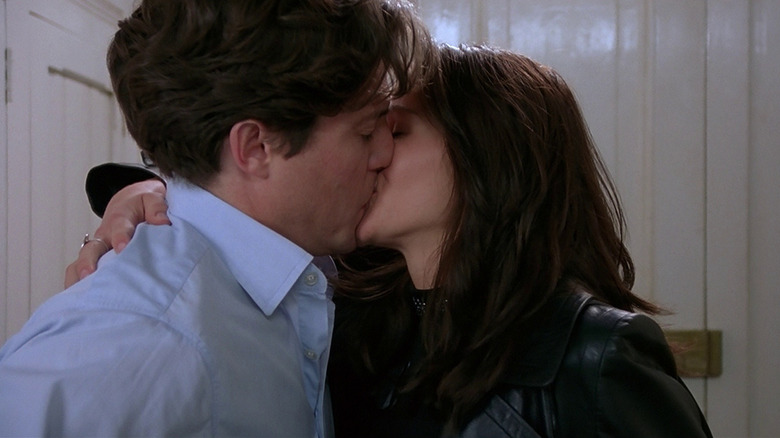
Roger Michell's 1999 romantic comedy "Notting Hill" has a pretty great premise. Hugh Grant, as he so often does, plays a charmingly flustered working-class British man named William who, recently divorced, is finding solace in his niche travel book store. One day, quite out of the blue, William's shop is visited by Anna Scott (Julia Roberts), a very Julia Roberts-like American movie star. William and Anna immediately develop a spark.
The central drama of "Notting Hill" springs from the struggles a major film actress has when just trying to fall in love like a regular person. William, meanwhile is hurt that he has to remain Anna's "secret," as she doesn't want to drag such a sweet, fragile guy into the media spotlight. "Notting Hill" does a great job of humanizing Julia Roberts, making it seem possible that dating a movie star isn't so impossible a task. Hugh Grant is perfect as the self-deprecating nebbish who wants nothing to do with glitz, but everything to do with love.
"Notting Hill" was a critical and commercial bonanza. It made $364 million on a $42 million budget, and critics generally agreed that Roberts and Grant were operating in their usual pitch-perfect, ultra charming milieu. Roberts emanated light, and Grant was the most puppy-dog-cute he had ever been. It had a great soundtrack, too.
Roberts, however, wasn't so fond of the movie at first. Indeed, she felt the premise was a little dumb. The actress admitted as much in a recent interview with Deadline, saying that playing a movie star was a dramatic cul-de-sac. Starting the movie as the biggest movie star of all time, she said, couldn't possibly provide a satisfying arc for her character. Richard Curtis' script, luckily, changed her mind.
Julia Roberts initially didn't like the concept for Notting Hill
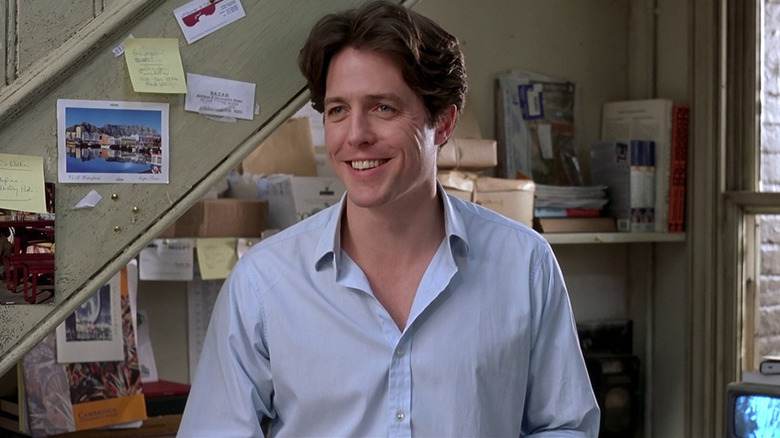
Screenwriter Richard Curtis, it should be noted, is one of the reigning champions of the romantic comedy genre. He began his career writing for "Mr. Bean," but broke into movies with "The Tall Guy," followed by his Oscar-nominated "Four Weddings and a Funeral." After "Notting Hill," Curtis would go on to write another Hugh Grant movie, "Bridget Jones's Diary," and he would write and direct the Christmas classic "Love Actually." He co-wrote the screenplays to Steven Spielberg's ultra-sentimental "War Horse," and helmed the fantasy romance "About Time." He knew what he was doing.
It was Curtis' screenplay that ultimately got Roberts on board with "Notting Hill." She recalls talking with her agent about the project, and utterly hating it at first, mostly because the premise was bad. In her words:
"Gosh, I just remember when my agent called me about 'Notting Hill' and I thought, 'Well, that sounds like the dumbest idea of any movie I could ever do. I'm going to play the world's biggest movie star and I do what? And then what happens? This sounds so f***ing stupid.' And then I read the script, and I was like, 'Oh. This is so charming. It's so funny. Oh, s***.' And then I went to lunch with Richard and Duncan and beloved Roger Michell, may he rest in peace."
Richard is Richard Curtis, of course. Duncan is the film's producer, Duncan Kenworthy. Sadly, Roger Michell passed away in 2021 at the age of 65. He directed 16 additional feature films after "Notting Hill," however, including "Changing Lanes," "Venus," "Morning Glory," and, most recently "Elizabeth: A Portrait in Parts," a documentary about Queen Elizabeth II.
Julia Roberts ended up having a great time on Notting Hill
According to the Deadline interview, Roberts had every intention of passing on "Notting Hill," and was only attending the meeting with Curtis, Kenworthy, and Michell to refuse the project in person. But she was drawn into the project not just because of Curtis' screenplay, but because of Curtis himself. Also, it seems that the director and producer were very warm, inviting, and, most importantly, convincing. The meeting made her realize that "Notting Hill" was going to be a worthwhile endeavor. As she put it:
"And they were just so charming and sweet and funny. And I thought, 'Wow, this is really going to happen.' And we had a beautiful time doing it. It was cast to perfection, all the friends, everybody. It was so great. And we had a beautiful time. And I think Roger, he just created the film in a way that it just, at every turn, it succeeded. It accomplished its goals with every... [...] Alec Baldwin! [...] That's brilliant casting."
The casting director on "Notting Hill," incidentally, was named Mary Selway. Casting can be a delicate art, and it's big of Roberts to give Selway credit for her good work. Alec Baldwin has a small, uncredited role in "Notting Hill" playing a character named Jeff King, the potential Hollywood-bound movie star that the Anna character has to reject in order to pursue a relationship with Will. Baldwin represents the parallel universe where Anna only dates other movie stars, and it's a universe she rejects.
The rest was history. "Notting Hill" became one of the highest-grossing films of the year, which was an impressive feat in 1999 (the year of "The Matrix," "The Mummy," "The Sixth Sense," and podracing masterclass "The Phantom Menace").