

Roger Ebert Was A Huge Fan Of Martin Scorsese's Little-Discussed '80s Comedy
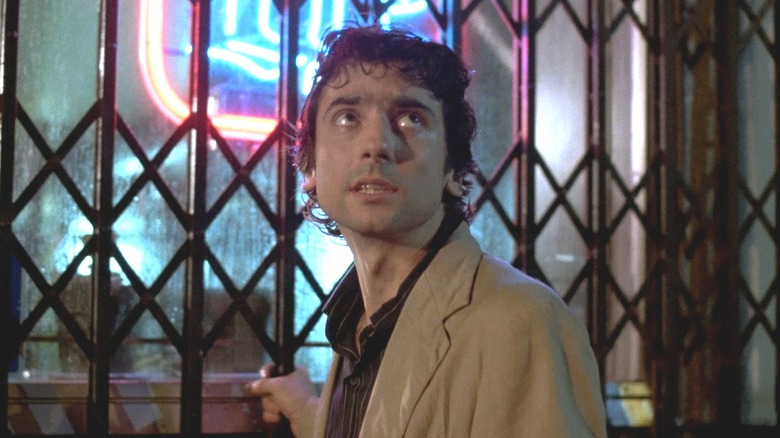
Martin Scorsese is synonymous with monumental genre films that feature complex character studies. While the "Raging Bull" and "Goodfellas" director is partial to stories of a dramatic bent, many of his films also contain a splash of humor. His Kafkaesque black comedy "After Hours" (which Tim Burton was once attached to direct) is a notable example of this tonal combination. The 1985 film explores the disorienting escapades of its protagonist over the course of a single night, and compared to the rest of Scorsese's celebrated filmography, "After Hours" remains underrated (despite being considered a cult classic). While the film didn't do well at the box office, its critical reception was positive. Acclaimed critic Roger Ebert even rated it four out of four stars, calling it a "nearly flawless example" of "pure filmmaking."
The plot of "After Hours" is simple: It starts with Paul (Griffin Dunne) encountering a woman named Kiki (Linda Fiorentino), who invites him to her SoHo apartment. After Paul's lone $20 bill flies out of a taxi window, he spends the entire night trying to get home. But many of the story's turns defy explanation, leaving us no choice but to buckle in for a wild ride.
Ebert's review highlights the film's astounding camerawork, where the trajectory of objects (like a key being thrown downwards) is used in dizzying POV shots. Unconventional close-ups were also used to create a sense of escalating paranoia, especially when Paul starts to feel that everyone's out to get him. This visual playfulness runs throughout "After Hours," lending it a unique flavor of absurdity that can only be unraveled inside Paul's mind. The fact that he meets a string of strange characters and gets entangled in increasingly bizarre incidents only bolsters the film's screwball logic and its frenetic energy.
Scorsese made After Hours after the cancellation of a passion project
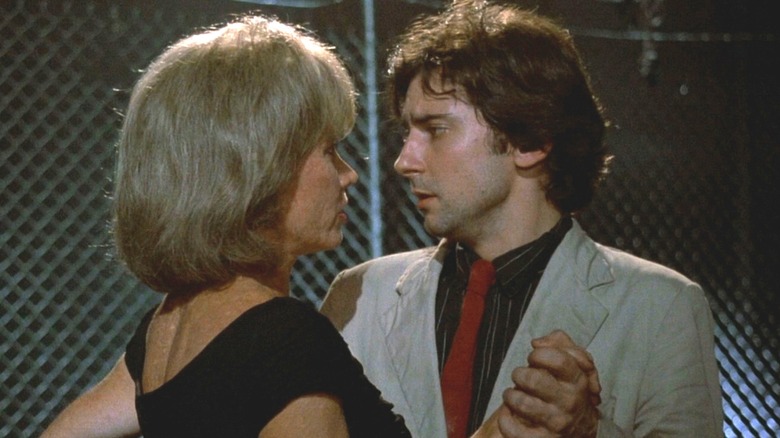
Scorsese wanted to make a movie about Jesus since he was young, and he was close to directing "The Last Temptation of Christ," which had a 1983 release date at the time. Unfortunately, the project was cancelled for a slew of reasons (a bloated budget arguably being the most impactful), which prompted Scorsese to make something completely different. "After Hours" might have reflected some of the director's feelings regarding his thwarted artistic impulses. In an interview with Film Comment, Scorsese explained why he chose to make "After Hours" in the face of personal disappointment:
"After 'The Last Temptation [of Christ]' was cancelled in '83, I had to get myself back in shape. Work out. And this was working out. First 'After Hours', on a small scale. The idea was that I should be able, if 'Last Temptation' ever came along again, to make it like 'After Hours', because that's all the money I'm gonna get for it."
In 1986, Universal Studios greenlit Scorsese's passion project, with the compromise that he would direct a more mainstream entry for them sometime after (that ended up being 1991's "Cape Fear," which is a remake of the eponymous 1962 film). Keeping these factors in mind, "After Hours" emerges as a curious entry in Scorsese's body of work, as it was partly born out of financial necessity while still embodying the full force of his deep love for filmmaking. Even without this context, the film functions as a thrilling parody of the film noir genre, where Paul's nighttime adventures seem relatable despite being outlandish. It exemplifies a sentiment many people can relate to: If life's joys and sorrows are truly arbitrary, why are the odds seemingly never in our favor?