

A Classic '50s Sci-Fi Movie Was Inspired By One Of Shakespeare's Most Underrated Plays
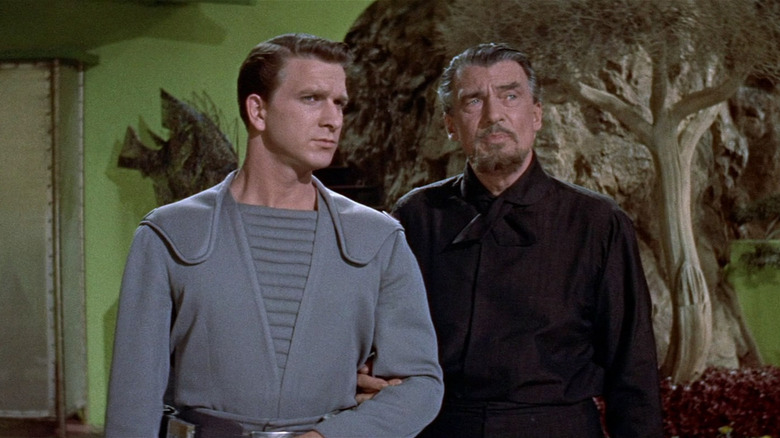
William Shakespeare's "The Tempest" wasn't staged until very late in his career, in the year 1611. Shakespeare would only write two more plays before his death, "Henry VIII" and "The Two Noble Kinsmen." The latter, he co-wrote with John Fletcher, so some Shakespearean scholars don't count it. "The Tempest" is an odd play in many regards, mostly because it doesn't neatly fit into Shakespeare's more frequently visited genres. It's definitely not one of the Bard's histories. It doesn't end in mass death, so it's not a tragedy. But it also doesn't end with a mass wedding, so it's not a comedy either. Some scholars refer to "The Tempest" and several of Shakespeare's other later plays as "romances," in that they have love stories embedded inside of them, even though they are comedic and tragic in turns.
Of the romances, however, "The Tempest" is easily the most popular. It's certainly staged more frequently than plays like "Pericles, Prince of Tyre" (1608), and "Cymbeline" (1610). For those unfamiliar with the plot, "The Tempest" follows a cantankerous wizard named Prospero who is living on a remote island with his daughter Miranda, a ghost-like servant named Ariel, and an earthy wild-man named Caliban. Prospero uses his magic to vengefully force a shipwreck on his passing arch-enemy, the usurper Antonio. Naturally, Miranda will fall in love with a prince named Ferdinand, one of the men in Antonio's crew, forcing Prospero to reconsider his revenge.
There have been film adaptations of "The Tempest" going back to 1905, and has even been transposed in genre a few times. William Wellman's 1948 Western "Yellow Sky" transported the play to 1867 Death Valley, for instance. Most famously, Fred M. Wilcox's 1956 sci-fi classic "Forbidden Planet" takes a lot of cues from "The Tempest."
Forbidden Planet has a lot of similarities to The Tempest
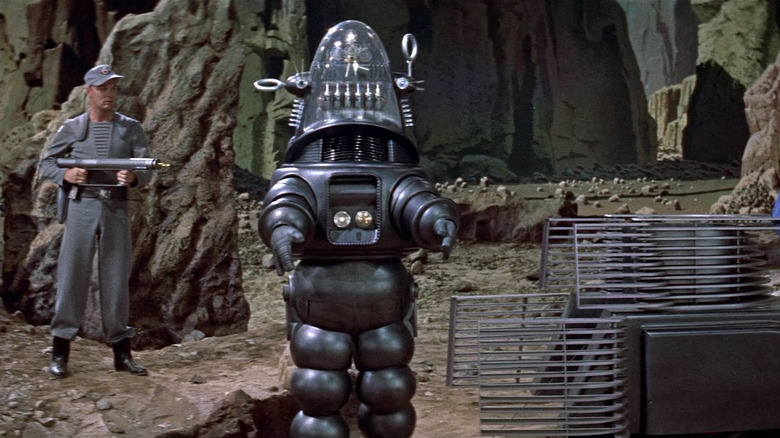
To be clear, "Forbidden Planet" is only sort of close to "The Tempest." Screenwriter Cyril Hume isn't credited as having adapted Shakespeare, and the comparisons to "The Tempest" mostly came from critics and fans. It's about as much as an adaptation of "The Tempest" as "The Lion King" is of "Hamlet" and/or "Henry IV, part I." "Forbidden Planet" takes place in the 23rd century, and is mostly set on a distant world called Altair IV. Commander Adams (Leslie Nielsen) has piloted a United Planets starship to Altair IV to investigate the disappearance of a starship called the Bellerophon, that went missing 20 year earlier.
The Commander and his crew find that Altair IV now only has three citizens on it, living in blissful isolation. There is the mysterious Dr. Morbius (Walter Pidgeon) who lives in an artificially constructed Eden-like lab. There is Alta (Anne Francis), his intelligent, pretty, and naive daughter. And there is Robbie (voice of Marvin Miller) an observant robot that is both helpful and a little intimidating. One can easily see Prospero in Dr. Morbius, Miranda in Alta, and Ariel in Robbie. There is also a Caliban-type monster on this planet, as it's been leaving large, outsize footprints in the desert sands outside the Commander's saucer-like ship. The monster is invisible, but an electric fence will later illuminate it, revealing it to be a giant, vicious monster with fangs and claws.
Also like Prospero, Dr. Morbius is something of a misanthrope. He claims that the survivors of the Bellerophon were killed by an alien virus, and only he and his daughter were immune.
Regardless, Forbidden Planet is great
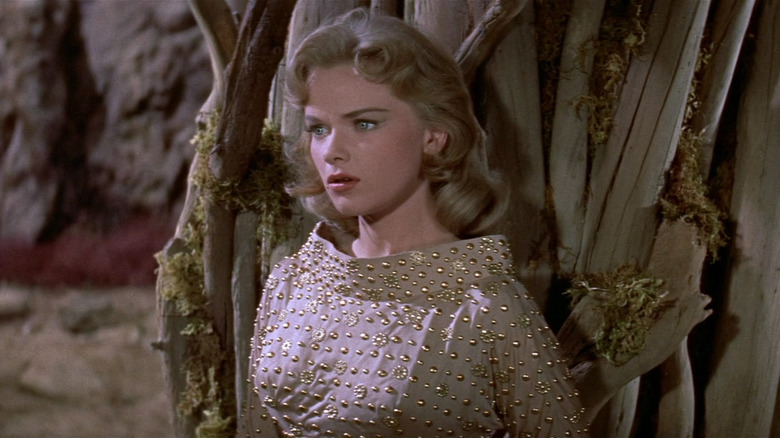
Alta has been living on Altair IV since she was an infant, so she doesn't know how to respond to the new people who are visiting her world and her home. She's not used to being modest, and Anne Francis spends a portion of the movie in a tiny diaphanous tunic. She briefly entertains the lasciviousness of Lieutenant Farman (Jack Kelly). Alta is a pretty clear analogue to Miranda. Robbie the Robot, meanwhile, only resembles Ariel in that he is a semi-magical servant of the Prospero character. In an amusing sequence, Robbie is secretly asked to replicate large quantities of booze for the thirsty, horny crewmen from the United Planets.
I shan't reveal the secrets of Altair IV, or what Dr. Morbius was hiding there, as these secrets deserve to be discovered organically. "Forbidden Planet" feels epic, and not just because of its Shakespearean leanings. The film was shot in a then-still-kinda-new Cinemascope aspect ratio of 2.40:1, an aspect ratio that debuted on a major Hollywood release three years earlier with the release of "The Robe." What's more, "Forbidden Planet" has eerie production design, building both human starships and weird advanced sci-fi tech with aplomb. Also, the sound is amazing, with an atmospheric score by Bebe and Louis Barron, who used new electronic instrumentation to create all-new sounds.
"Forbidden Planet" won an Academy Award for is special effects. The effects are still dazzling and convincing to this day; that monster is 100% terrifying. Sadly, the film's Shakespeare-inflected screenplay was not recognized. These days, "Forbidden Planet" is pretty widely accepted as a "Tempest" redux, and sci-fi fans are constantly discovering it. Even without the Shakespearean influence, however, it would still be one of the best sci-fi movies ever made.