

A '70s Disaster Movie Was So Epic That Two Rival Studios Teamed Up To Make It
Hollywood studios have a peculiar knack for greenlighting similarly themed movies at the same time. In 1989, there were four U.S.-produced fantasy or horror movies set underwater ("DeepStar Six," "Leviathan," "The Abyss," and "Lords of the Deep"). In 1997, we were gifted two volcano flicks ("Dante's Peak" and "Volcano"), and the following year, we got two films in which the Earth faces an extinction-level event from a big ol' space rock ("Deep Impact" and "Armageddon").
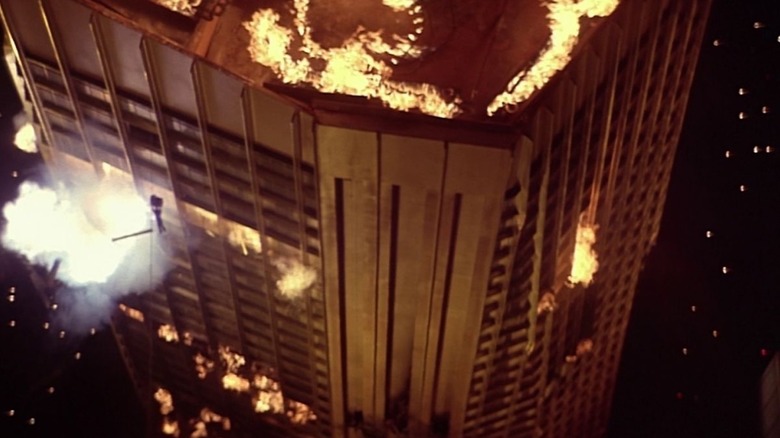
In 1974, Warner Bros. and 20th Century Fox nearly put two disaster movies set in a burning high-rise into production. When WB acquired the rights to Richard Martin Stern's novel "The Tower," producer Irwin Allen, the industry's so-called "Master of Disaster," convinced his home studio, 20th Century Fox, to buy Thomas N. Scortia and Frank M. Robinson's incredibly similar "The Glass Inferno." Both movies were expected to have sizable budgets, which heightened the studios' fears that they could cancel each other out at the box office. Cognizant of these concerns, Allen proposed that he adapt both novels as "The Towering Inferno," which would be a WB-Fox co-production. Costs would be split equally, with Fox distributing the movie domestically, while WB would handle the international release and television rights.
This paved the way for Allen to make a mega-movie budgeted at a then-extravagant $14 million. With that kind of money, he could chase some of the biggest stars in Hollywood and thrill audiences with lavish visual spectacle. While the production went smoothly on the technical end, director John Guillermin had to deal with some diva behavior from his two stars.
Paul Newman had fiery words for Steve McQueen
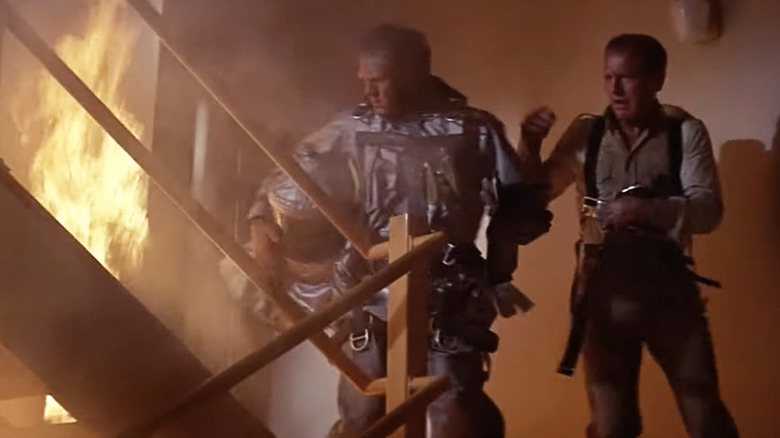
At the outset of principal photography, there might've been hope that Paul Newman (as Doug Roberts, the tower's architect) and Steve McQueen (as San Francisco Fire Department chief Michael O'Hallorhan) would bond due to their shared love of motor racing. This was not to be. McQueen, who had a reputation for challenging co-stars who might be getting more screen time than him (he gave Yul Brynner all kinds of trouble on the set of "The Magnificent Seven," for example), pestered screenwriter Sterling Silliphant to give him just as many lines as Newman. When Newman found out what McQueen was up to, he berated him for his "chicken s***" scheming.
Fortunately, this dispute didn't derail the production. "The Towering Inferno" was released on December 16, 1974 to mostly good reviews and scorching box office. The film went on to gross $203.3 million worldwide, and earned eight Academy Award nominations (including Best Picture and the first Best Supporting Actor nomination for the legendary Fred Astaire). Clearly, Allen's idea for a joint production paid off handsomely for both studios ... though Newman and McQueen would never work together again.