

Disney's Pandora Theme Park May Have Already Spoiled How The Avatar Movies End
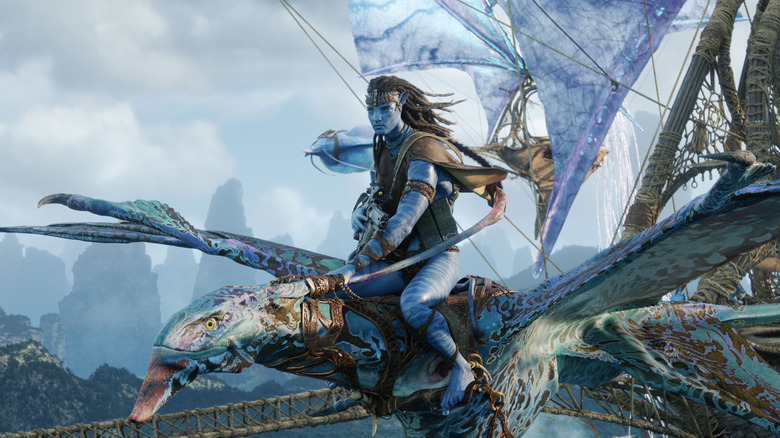
You cannot live like this, baby, in spoilers! Read no further if you haven't watched "Avatar: Fire & Ash" yet.
For the past 16 years, James Cameron has been deeply focused on bringing to life one of the most fully-realized, fleshed-out sci-fi worlds in recent memory with the "Avatar" movies. This is a universe so unique and beautifully brought to life that it's given audiences depression because they can't visit Pandora in real life.
Three films in, we've now seen the first two acts of the "Avatar" saga, with Jake Sully (Sam Worthington) having lit a spark in Pandora's residents, leading them to realize that pacifism is useless when facing an opponent that wants to eradicate you. The world of "Avatar" has been forever changed in the course of these three movies, with at least one human now having the ability to breathe the air of the forest moon and even being given a kuru and the ability to perform tsaheylu with Eywa — completely changing the game for the "Avatar" franchise going forward. And that's not mentioning the fact that we actually saw the Great Mother herself, with Eywa making an in-person appearance (kind of) in "Avatar: Fire and Ash."
So, now what? We still have two movies left in this franchise, assuming that Cameron gets to complete his vision and the greater "Avatar" saga doesn't come to a premature end halfway through. And while the filmmaker has threatened to simply hold a press conference and reveal everything that would've happened in the last two movies if they never come to pass (via Variety), avid theme park fans already know something about the future of Pandora ... sorta. That's because the "Pandora — The World of Avatar" area at Animal Kingdom in DisneyWorld is technically canon to the "Avatar" films.
Pandora - The World of Avatar explores the aftermath of the Avatar movies
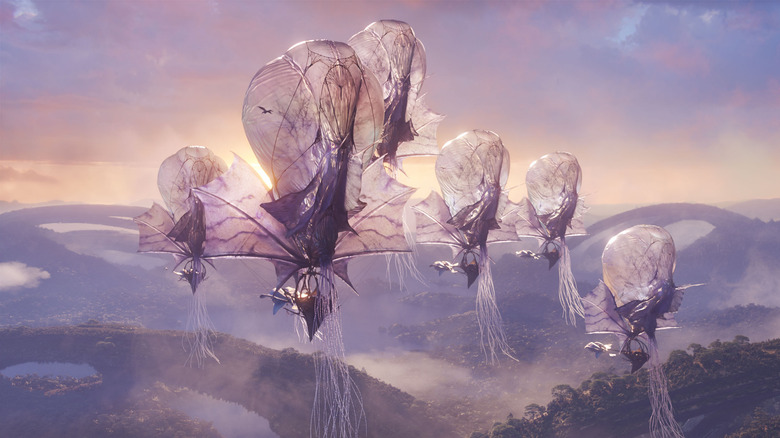
"Pandora — The World of Avatar" first opened in 2017, five years before "Avatar: The Way of Water" hit theaters. However, given that every theme park in the U.S. at the time was obsessed with the notion of "immersion," it wasn't enough to merely construct a cool park area with an "Avatar" theme. No, Disney also needed to convince those visiting it that they were on Pandora itself. That meant coming up with a reason why and how regular park attendees could visit the alien world.
Well, the solution was quite simple: make the whole thing canon. That's right! Just as Galaxy's Edge is technically canonical to the "Star Wars" movies and TV shows, "Pandora — The World of Avatar" is considered canon to the "Avatar" films. Specifically, the theme park attraction takes place a century after the war between the native Na'vi and the humans invading Pandora (as depicted in the movies) has ended. "The gunships are all down and rusting in the jungle. Humans are being welcomed to Pandora," as Cameron put it at the 2015 D23 presentation (via IGN).
Curiously, there are two details introduced in "Pandora — The World of Avatar" that have only recently been explored in the "Avatar" movies. The first involves the Windtraders, as in the nomadic air clan (aka the Tlalim) that Jake and his family travel near the start of "Avatar: Fire and Ash." There is a store at the theme park area called Windtraders, which barters in all sorts of Pandora souvenirs, mostly about Na'vi culture and Pandoran wildlife. This tracks with how the Windtrader clan in the movies stays strictly neutral during the war between humanity and the Na'vi, choosing to just focus on trading.
The future of Avatar

Then there's the air. Guests in the theme park can breathe the air on Pandora, unlike humans in the "Avatar" movies. Specifically, there's a plant that grows in the part of Pandora guests visit, known as the Flaska Reclinata, which detoxifies the atmosphere and allows people to breathe while keeping the Pandoran fauna away (since they can't breathe).
This is a rather big reveal, one that definitely changes the entire world of "Avatar." Indeed, we're already seeing the seeds being planted for this game-changer with "Fire and Ash." Should things go wrong, this development could lead to the rampant terraforming of Pandora and the eradication of the Na'vi. But the fact that the human/Na'vi war has canonically ended in the future with what appears to be a clear victory for the Na'vi, with the Pandoran natives now in charge and living peacefully with the remnants of humanity, makes it seem like there's hope yet for the future of Pandora at large.
Granted, all of this is assuming that Cameron and his collaborators are really letting the future of the "Avatar" franchise be dictated by a theme park attraction that only a fraction of those who watch these movies will ever visit. It's more likely that the only thing that really matters, canon-wise, is just the general idea that Pandora will be peaceful one day and that Na'vi and humans will learn to co-exist down the line. The specifics, including whether a random plant will allow for pockets of humanity to breathe on Pandora, might be best thought of as just a neat piece of theme park design and nothing else. Then again, if the "Avatar" films end after "Fire and Ash," at least we'll have some closure.
"Avatar: Fire and Ash" is now in theaters.