

Daredevil's Vincent D'Onofrio Was In One Of The Worst Philip K. Dick Adaptations Ever
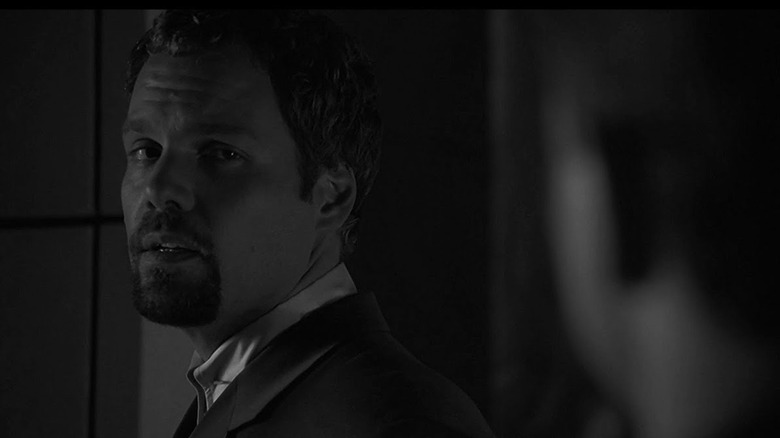
Gary Fleder's 2001 "Imposter" is a pretty terrible film that bombed miserably at the box office. On paper, it was a good idea, and looked very much like it should have succeeded. "Imposter" starred recognizable stars Gary Sinise, Madeleine Stowe, and Vincent D'Onofrio, and had supporting turns from Elizabeth Peña, Clarence Williams III, Mekhi Phifer, Tony Shalhoub, and Lindsay Crouse. It was co-written by Ehren Kruger, who penned "Scream 3" and "Arlington Road," and who would find great success in Hollywood later with films like "The Ring," the "Transformers" movies, and, more recently, "Top Gun: Maverick" and "F1." It was also co-written by David Twohy, the mastermind behind the "Riddick" movies, and writer of films like "Warlock," "Critters 2: The Main Course," and "Waterworld." Fleder, meanwhile, was an indie darling after directing "Things to Do in Denver When You're Dead," and a hitmaker after helming "Kiss the Girls."
Most notably of all, "Impostor" was based on a short story by Philip K. Dick. Dick had passed in 1982, but films based on his stories were typically well-regarded. He provided the inspiration for Ridley Scott's "Blade Runner," and Paul Verhoeven's "Total Recall," which were both beloved by sci-fi fans.
All of these elements together should have made for a great sci-fi movie. Sadly, it most certainly wasn't. The film is unclear, cheap, and muddled. Its interesting sci-fi ideas aren't presented well, and the characters — who may or may not be android clones — are always unsure as to what's going on. The $40 million film made $8 million at the box office, and has a mere 25% approval rating on Rotten Tomatoes. It could easily be counted among the worst of all Philip K. Dick adaptations.
Impostor is a really terrible movie that bombed
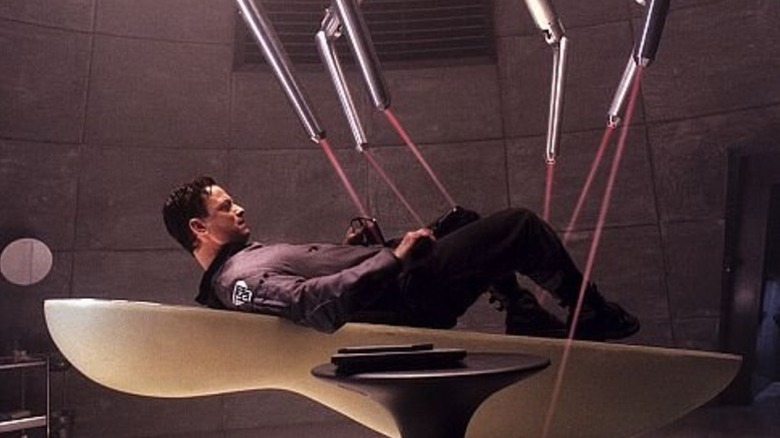
The premise of "Impostor" is deliciously full of paranoia. It takes place in the near future, wherein Earth is at war with an unseen species of aliens, the Centaurians. Cities are now located beneath protected shields, and the military oversees a dark dictatorship over its own people. The lead character, Spencer Olham (Sinise), is a robotics engineer who is arrested by the government (represented by D'Onofrio) for being an android clone of himself. In this world, replicants are running rampant, and are typically used as spies by an underground resistance movement. The replicants don't know they're replicants, as they have been given implanted memories, and some of them have bombs implanted in their bodies to sneak them into dangerous areas. The D'Onofrio character has reason to believe that Olham is a replicant impostor, and aims to drill into his chest to get any potential bombs out.
Olham manages to flee the chest-drilling, but now has to prove to the world — and to himself — that he's not a replicant, all while on the lam. This will involve a lot of near-misses and escapes, as well as medical help from his wife (Stowe), a doctor with access to scanning equipment. On paper, "Impostor" is like "The Fugitive," with a sci-fi existential crisis draped over it. This is a fine idea for a movie. And given the talent of the screenwriters, it should have worked.
But it didn't. In fact, it failed miserably. "Impostor" is a terrible, sloppy, and forgettable movie that no one has much talked about since 2001. Critics at the time noted that the intriguing sci-fi premise was never properly explored, with the Sinise character doing little more than running from place to place.
No one remembers Impostor
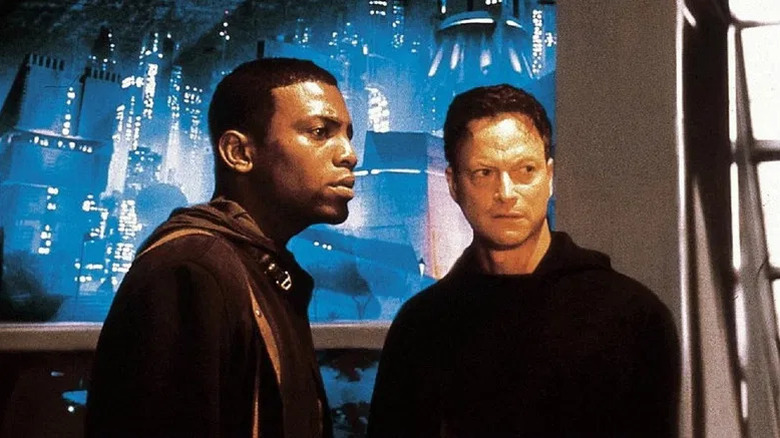
Many entering "Impostor" may have seen Philip K. Dick's name on the poster, and assumed that it would take place in a world similar to "Blade Runner." It may have even taken place in the same continuity, as both stories were about replicants evading capture in a dystopian, overrun sci-fi cityscape. The problem was that Robert Elswit's cinematography was so dim and dank that the visuals became unclear and indistinct. "Impostor" looks like it didn't have the budget to create a futuristic city, so it merely shut the lights off and hoped the audience would fill one in with their imaginations. "Impostor" wouldn't be able to match the influential and astonishing production design of "Blade Runner," but it wasn't even well-equipped enough to try.
Also, there is, as mentioned, an existential crisis at the center of "Impostor" that feels old hat to any "Blade Runner" fans. Is Olham a replicant, or is he a human being? Indeed, how many of the characters we're watching are secretly replicants? That seems tantalizing, but Sinine is never given any meaningful scenes where he questions the nature of his own existence. If he can prove he's human, he'll merely be let off the legal hook. If he's a replicant, however, how would that change his course of action? As it happens, it wouldn't. At least some "Blade Runner" fans are tantalized by the idea that Deckard (Harrison Ford) may be a replicant by the end of "Blade Runner" (even if it has no serious bearing on the plot). In "Impostor," there's no reason to care.
"Impostor" tanked, and it's easy to see why. Steven Spielberg "rescued" the author's work on the big screen the following year with "Minority Report."