

Seth MacFarlane Created The Orville To Fulfill A Need Star Trek Had Abandoned
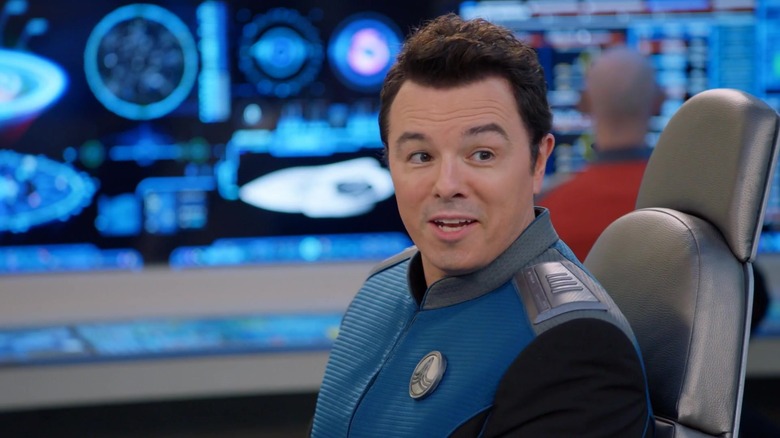
If one is feeling generous, one could easily count Seth MacFarlane's 2017 sci-fi/comedy series "The Orville" as a "Star Trek" series. Although MacFarlane was known for crass comedy shows and movies like "Family Guy," "American Dad!," and "Ted," he created "The Orville" to carry on the legacy of "Star Trek" more than he did as an excuse to make cheap sci-fi gags. There were, of course, plenty of gags and sitcom moments on "The Orville," but the spirit of the show was actually more grounded in Trek-like optimism than sex jokes and slapstick. It's certainly more mature than most of MacFarlane's fratboy-friendly animated shows.
MacFarlane has always been a Trekkie, going back to his childhood; one can easily find online a teenage fan film of MacFarlane imitating Captain Kirk. After he became successful, MacFarlane once actively sought to make a "Star Trek" series of his own with CBS, thinking that — at the time — the franchise had become fallow. When CBS rejected him, MacFarlane began working on "The Orville" as an antidote.
It should be recalled that "Star Trek" went through a painful period in the 2000s. "Star Trek: Voyager" went off the air in 2001, and "Star Trek: Enterprise" debuted shortly after 9/11, attracting a smaller, dispassionate audience. The series only lasted four seasons. The 2002 film "Star Trek: Nemesis" was also a bomb, pretty much spelling out that the franchise was dead. There was a successful, action-heavy, tonally radical "Star Trek" reboot in 2009, but from 2005 to 2017, there were no new Trek shows on TV.
MacFarlane was interviewed by Forbes in 2017, and he revealed that "The Orville" was a means to scratch a "Star Trek" itch. Without new Trek shows, he took matters into his own hands.
Seth MacFarlane loved the pacifist tendencies of Star Trek
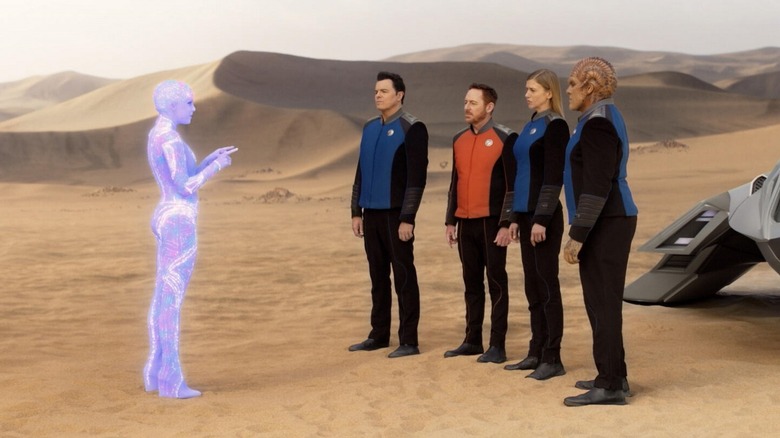
"The Orville" takes a lot of its fundamental structure and iconography specifically from "Star Trek: The Next Generation." The series takes place on a faster-than-light space vessel, operating on a mission of peace from a well-functioning U.N.-like organization that has united hundreds of alien worlds. Each ship is overseen by a space navy that dresses in red, blue, and yellow (or orange) uniforms. Each franchise follows the adventures of the ship's senior staff as they explore diplomatic, ethical, or scientific quandaries in deep space. "Next Generation" is set in the late 24th century, while "The Orville" fast-forwards it to the 25th. The similarities are unmistakable.
Even the creative staff between "Orville" and "NextGen" has some cross-pollination. "NextGen" writer Brannon Braga was an "Orville" executive producer, "NextGen" actor/director Jonathan Frakes helmed several "Orville" episodes, and "Deep Space Nine" actress Penny Johnson Gerald has a regular role on "The Orville."
So, yes, MacFarlane was clearly trying to recreate the vibe he remembers from Gene Roddenberry's show. Specifically, he loved the original show's sense of pacifism, something he carried over into "The Orville." MacFarlane said:
"I'm a huge fan and always have been. [...] Gene Roddenberry's philosophy was always very meaningful to me when I was a kid. I always loved that the phasers were set on stun. That was something you really only saw on that show. That there was actually an ethical code, that it wasn't about just shooting faceless bad guys. It was about respect for life. That was the philosophy of the show, and I swear to God that's the reason that if I find a spider in my house, I've got to put it outside. I can't kill it."
Quite admirable.
Seth MacFarlane created The Orville to scratch a Star Trek itch

It seems that when MacFarlane was working on "Ted 2" in 2015, he was really, really missing "Star Trek." At this point, "Star Trek: Discovery" was in the earliest stages of development, and nothing had really been announced to the public yet, so it seemed that "Star Trek" was dead. J.J. Abrams had achieved great success with the reboot movies "Star Trek" (2009) and "Star Trek Into Darkness" (2013), but any Trekkie will be able to tell you that those films are most certainly not in the spirit of Roddenberry's original. They are action pictures loaded with violence.
As such, MacFarlane went to CBS and said that if they weren't doing anything with "Star Trek" on TV, then "I'd love to take a crack at it." Of course, CBS was working on something new — "Discovery" — which was more in the spirit of the 2009 movie. Indeed, MacFarlane, like many Trekkies, was shocked to see the new direction "Discovery" went it when it was released. The new "Star Trek" show was not only more violent than ever before, but skewed away from the traditional episodic structure that "Star Trek" had always abided by. Because the new "Trek" was so different, MacFarlane has no qualms about making a sci-fi show that was directly inspired by classic "Trek." He said:
"'Star Trek' has chosen to go along a different path or try something different than what they've done before, which is great. But it's also left a wide, open space for the kind of episodic science fiction that they used to do, and I still have a huge appetite for that. I feel like a lot of people, a lot of fans do as well."
He's right.