

Roger Ebert Said This Hated Superhero Was 'More Fun Than We Deserve'
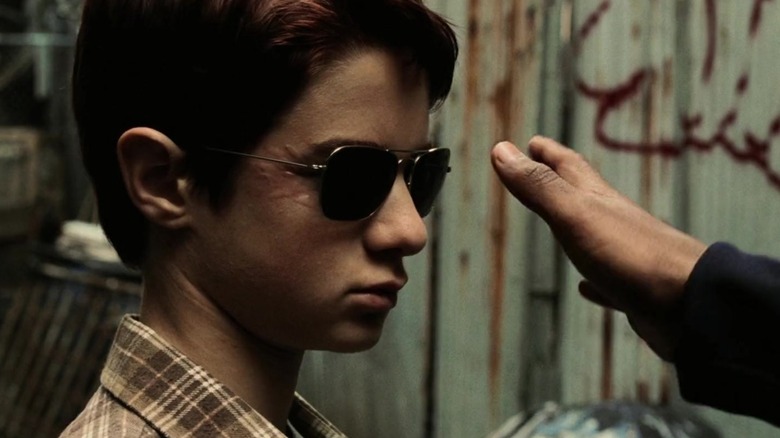
Mark Steven Johnson's 2003 superhero flick "Daredevil" is far better than its reputation. Really, it's fine. It possesses a fun, if typical, superhero tone that one might call "Diet Batman," and it depicts a beloved Marvel character rather well. Daredevil," as Marvel fans can tell you, lost his sight in a chemical accident, but mysteriously developed superhuman hearing, touch, and balance in return. His sense of hearing was so keen that Daredevil could hear people's heartbeats accelerate when they were lying. This was a handy power to have when working as a lawyer, which Daredevil was during the daylight hours.
Also, the filmmakers were able to envision Daredevil's superpowers in an interesting way. They found a way to visually represent sound waves echoing around a room, handily communicating to audiences that Daredevil was echo-locating. Also, the costume was page-accurate, with Ben Affleck sporting an all-red leather bodysuit. There was more than a little fetishization about the suit. And, of course, there was the inclusion of a scenery-chewing Colin Farrell as Bullseye, a supervillain assassin with supernatural aim; he could kill you with a well-thrown paperclip. Kevin Smith had a small role, giving "Daredevil" some comic book cred.
There was a lot of backlash against the film at the time, mostly having to do with the title star, Ben Affleck. Affleck was very much in the news thanks to his high-profile relationship with Jennifer Lopez, and people began to hate how overexposed he was becoming. Also, it was very 2003, featuring an instantly dated soundtrack and a broody tone that was very de rigueur at the time.
Roger Ebert, however, gave "Daredevil" a pass. In his three-star review, Ebert said that it was more fun than it had any right to be.
Ebert thought Daredevil was just fine
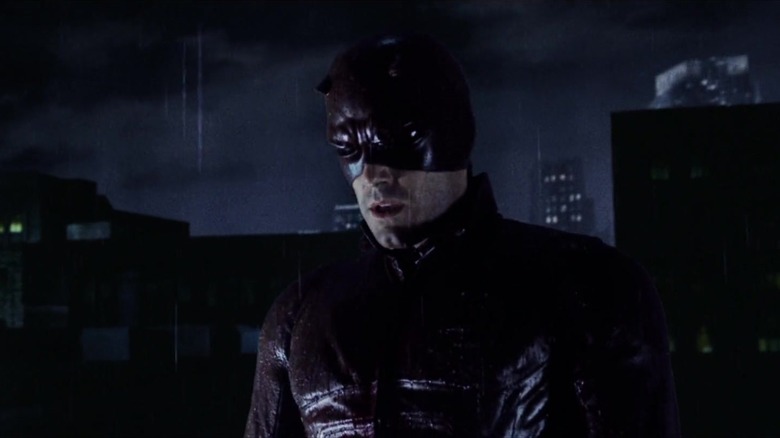
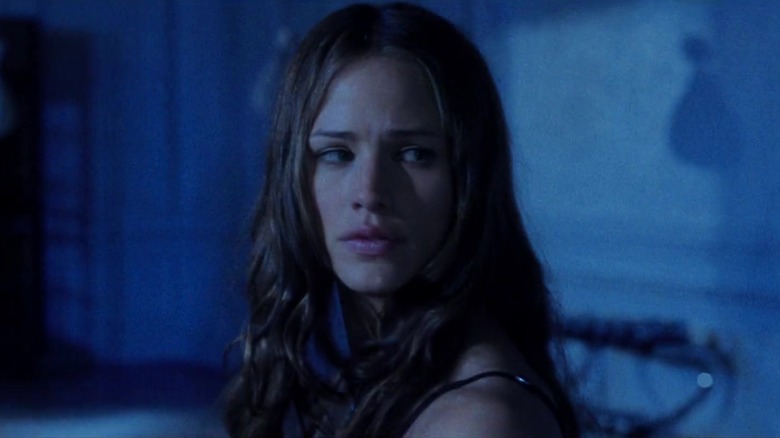
The rest of the film's cast was also notable. Jennifer Ganer played Elektra, a trained fighter who — as her namesake might imply — will lose her father, putting her on the road to revenge. The film's central villain, a crime boss called merely the Kingpin, is played by the imposing Michael Clark Duncan. Jon Favreau plays Franklin "Foggy" Nelson, a friend of Daredevil's daytime alter-ego, Matt Murdock. Favreau's character should not be mixed up with Harold "Happy" Hogan, the role he played multiple times throughout the Marvel Cinematic Universe. "Daredevil" predates the MCU. Joe Pantoliano plays the irked New York cop, frustrated that there's a vigilante at work.
Ebert's easygoing approach to "Daredevil" might have been because he wasn't a comic book nerd. He didn't hold the character to be sacred and didn't feel that the filmmakers should be beholden to a specific tone. Indeed, Ebert amusingly dismisses all notions of comic book lore, noting that "There is an explanation for [Daredevil's hyper-balance] ability, but I tend to tune out such explanations because, after all, what do they really explain? I don't care what you say, it's Superman's cape that makes him fly."
Instead, he looked at the characters and the story, and found them to be perfectly adequate. He wrote:
"The movie is actually pretty good. Affleck and Garner probe for the believable corners of their characters, do not overact, are given semi-particular dialogue, and are in a very good-looking movie. Most of the tension takes place between the characters, not the props. There is, of course, a fancy formal ball to which everyone is invited (Commissioner Gordon must have been at the rival affair across town)."
He's right. This all functions quite well.
Seriously, why did everyone hate Daredevil?
It should be stated, though, that Ebert wasn't ecstatic about "Daredevil," he merely liked it. "The movie is, in short, your money's worth," he wrote, "better than we expect, more fun than we deserve." He added at the end of his review that he, even in 2003, was already quite tired of superheroes, writing that "I am getting a little worn out describing the origin stories and powers of superheroes, and their relationships to archvillains, gnashing henchmen and brave, muscular female pals." He finished by saying, "Some of their movies, like this one, are better than others."
It should be recalled that Ebert's weariness with superheroes was in full effect when the Marvel Cinematic Universe began revving up. He loved Jon Favreau's "Iron Man," but loathed Kenneth Branagh's "Thor," giving the former four stars and the latter one-and-a-half. His review of "Thor" was so negative, it spawned a months-long conversation with Marvel fans who wailed that Ebert was out of touch. When the super-crossover event "The Avengers" was released in 2012, he thought it, too, was merely okay, giving it three stars, and finding the superheroes to be only mildly amusing. Ebert didn't care about interconnectivity and wasn't excited to see the Avengers interact. Evert passed in 2013, and one can only imagine what he would have thought about the gummed-up ultra-climax of "Avengers: Endgame," or the hideously crass, commercial act of onanism that was "Deadpool & Wolverine."
Incidentally, Jennifer Garner reprised her role as Elektra for "Deadpool & Wolverine," making the 2003 "Daredevil" film an official part of the MCU. Ebert, I can assure you, would not have cared.