

Netflix's Jay Kelly Has A Spectacular Opening Shot That's More Impressive Than You Think
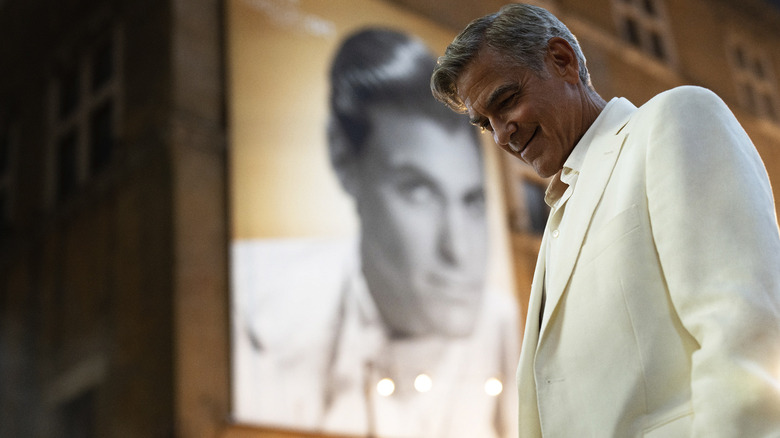
Noah Baumbach's film "Jay Kelly" begins with a wonderful oner that shows the hustle and bustle of a film set on a sound stage, transitions into George Clooney's titular movie star character performing a couple takes from the movie-within-the-movie, and ends when Kelly and his director, played by "Andor" actor Kyle Sollner, agree that they have what they need. It's a long, intricate shot reminiscent of Robert Altman's famous opening oner from "The Player," which also takes audiences behind the curtain of how movies are made. But before Baumbach's shot really gets going, the very first thing you see after the Netflix logo is blackness encroached upon by white smoke, with the smoke slowly revealing black text of a quote from author Sylvia Plath: "It's a hell of a responsibility to be yourself. It's much easier to be somebody else or nobody at all."
I assumed that quote was added in post-production, as they are in 99.9% of films, but on an episode of the Director's Guild of America podcast, Baumbach revealed that the quote was actually a physical part of the shot:
"We also did the quote as part of the [oner], so the quote is on glass, the Sylvia Plath quote. It's black on glass, so when it's dark, you don't see anything, and then the white smoke, which was there, comes up and reveals it and then we rack focus to the guy who says 'We're coming to the end,' and then we start the movie."
Jay Kelly's opening scene is full of melancholy for the end of an era
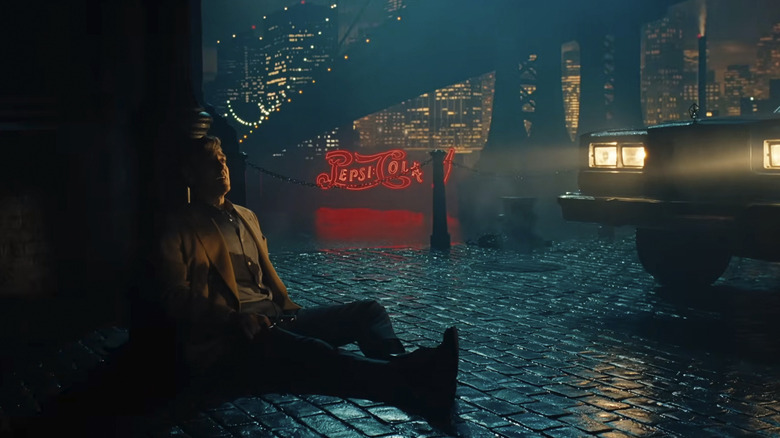
Physicalizing that quote on actual glass is not the only old-school trick utilized in the opening scene of this movie. Baumbach and his team swing the camera throughout the sound stage, dipping into various conversations of Adam Sandler's character and other less spotlighted artists as it glides over a set that feels incongruous until the camera arrives in the exact right spot and you realize it was designed as a bit of forced perspective, where everything aligns perfectly from one specific angle.
You rarely see forced perspective in major movies these days, and employing these techniques seems to be the director's way of underlining a theme of the film: an era is coming to an end. During the shot, a technician on camera says, "One day, it'll be the last movie for all of us. They'll turn out the lights, and that'll be that." Soon after, Jay — playing a character in the movie-within-a-movie — says, "I'm lucky. My time passed while I was still alive. I got to see it end before it ended."
I think many of us who grew up loving cinema feel like we can relate to that, because we are witnessing a major transition of the industry unfold before our eyes. But these lines of dialogue are relatable even for folks outside of the entertainment industry, since practically every aspect of American life feels like it's being made worse in order to enrich a handful of billionaires. No one knows what the future of cinema will be, but as long as there are people like Noah Baumbach putting the extra effort in to use classic techniques as he does here, it'll never fully die.
You can see for yourself how the opening scene came together in "The Making of Jay Kelly," which is now streaming on Netflix.