

The Testament Of Ann Lee's Incredible Musical Numbers Are Based In Historical Fact
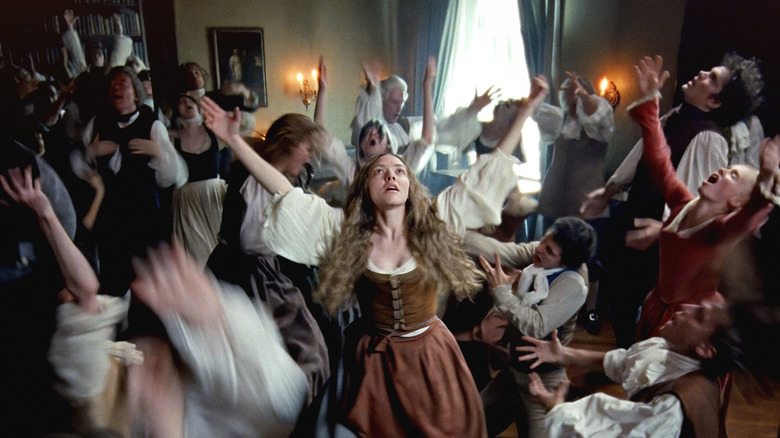
"The Testament of Ann Lee," directed by Mona Fastvold — partner of fellow director Brady Corbet, with whom she worked on "The Brutalist" and who co-wrote this historical musical epic with her — depicts the founder of the Shaker movement, portrayed by Amanda Seyfried. As Fastvold and some of her colleagues (including Seyfried) discussed over a variety of interviews before the film's wide release on Christmas, the director and her composer, Daniel Blumberg, detailed how they ensured that real Shaker hymns were a part of the film.
Speaking to IndieWire, Blumberg — who won an Oscar for his score for "The Brutalist" — said that he found himself fascinated by "the early formation of the Shakers, where they were using wordless hymns, like these very extreme singers I'd seen over the years," name-checking singers including Phil Minton and Maggie Nicols. From there, Blumberg hoped to push the concept of these wordless hymns as far as possible.
For her part, Fastvold said that she visited a public library in Massachussetts and a museum called Hancock Shaker Village, which both had sheet music and songs "written out" so she and Blumberg could "listen to some of the wordless hymns." Still, as she notes, Blumberg put his own stamp on it. "Of course it sounds very different from the movie, even though the melody is the same or the lyrics are the same or slightly change. Daniel will do a strange counter-harmony or a key shift, and all of a sudden, it just would transform something in a really unique way."
Still, despite Fastvold's clear connection to music for "The Testament of Ann Lee," she wasn't sure she was really making a "musical."
The Testament of Ann Lee director Mona Fastvold was hesitant to call the film a 'musical' at first
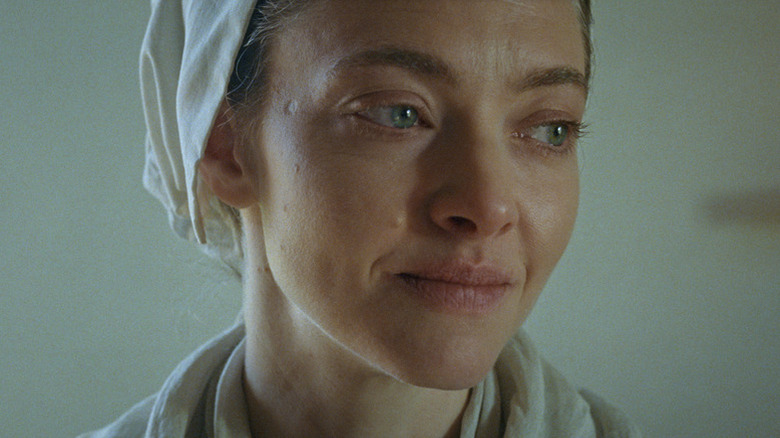
Speaking to The Hollywood Reporter, Mona Fastvold admitted that she shied away from calling "The Testament of Ann Lee" a musical for awhile, although it's certainly not a conventional musical by any standards. "Because the Shakers worshipped through ecstatic song and dance, it had to be a musical and movement piece, which is what I called it for a very long time," Fastvold said before saying Brady Corbet stepped in and set her straight, so to speak. "And then Brady ultimately just said, 'Mona, it's a musical, that's what this is when there are that amount of music and songs in the film.'"
There is one big distinction between a traditional movie musical and the musical numbers featured in "The Testament of Ann Lee" — because the Shakers didn't use music and dance simply to perform (as Amanda Seyfried's co-star Lewis Pullman wryly noted, "It's like they're not sitting down for breakfast and singing about how hot the coffee is or whatever"). That's why Fastvold and Daniel Blumberg worked to incorporate the movie's sound design into the music, and that's also why Seyfried had to make some adjustments as a performer.
"[The music] had to come from inwards and she had to stop listening to herself," Fastvold said of "re-training" Seyfried from a musical perspective. "We would lay on the floor of the studio and cry and give birth and laugh and scream and try all kinds of different ways of finding a completely different voice for this character. "She has all of this amazing training that's there, so she can access that and sing pitch perfect, but she almost had to unlearn all of that a little bit."
Ann Lee was a real historical figure, and Mona Fastvold wanted to pay homage to her in this movie
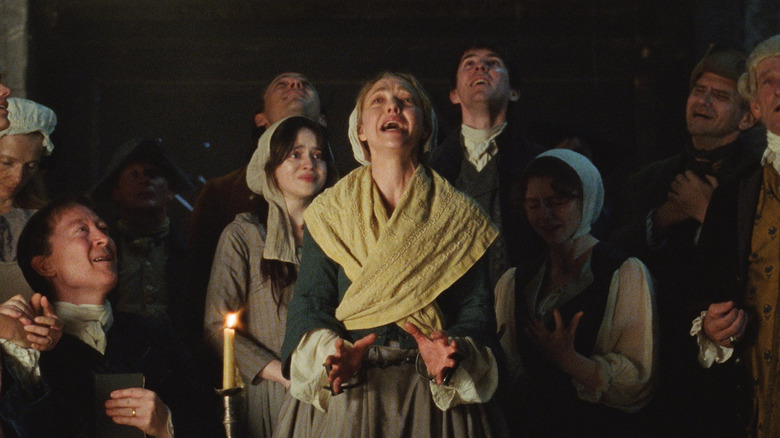
Okay, so hold a second — if the Shaker songs and hymns in "The Testament of Ann Lee" are true to the historical record, what about the woman herself? Ann Lee was a real person who, by all historical accounts, came from England to American colonies in the 18th century and is credited with the creation of the Shaker faith in America; for reference, the Shaker religion is sort of a "spin-off" of the Quaker religion (they were often referred to as "Shaking Quakers" because of the way they "danced" to express their faith).
"She took this horrible trauma and turned that suffering into compassion, into community, into how she could mother the world," Fastvold told Vanity Fair about the real Ann Lee. "It's all about worship through labor, creating something of beauty and of meaning and giving everything you have to it. As someone who wishes to try and create impossible things, that really spoke to me."
One can imagine that this was definitely a daunting task for Seyfried, and even though she told the outlet that she was intimidated, she found inspiration in the Shaker movement. "The ecstatic dancing and thumping and pounding, the frenzy that the Shakers lived in—I love that. It makes me feel alive," Seyfried mused. "That's not the thing that intimidates me." The thing that did intimidate her was playing a powerful religious leader viewed by her followers as the second coming of Christ, but Seyfried, one of the finest actors of her generation, pulls this off beautifully.
If you want to see it for yourself, "The Testament of Ann Lee" hits theaters on Christmas Day, and it's one of the best movies of 2025.