

Foundation's Hari Seldon Reminded Jared Harris Of A Terrifying Sci-Fi Villain
Apple TV's "Foundation" is a bold, audacious adaptation that would've been considered unthinkable just a few years ago, much like Denis Villeneuve's film versions of "Dune" and Peter Jackson's "Lord of the Rings" movie trilogy were once upon a time. Isaac Asimov's original books are gargantuan, spanning millennia and dozens of planets (with even more characters). Indeed, their themes and ideas are so complex that it would've once seemed like a fool's errant to try to simplify the story to work as a film or capture it on a TV budget.
The "Foundation" series, however, excels at doing just that. It successfully brings Asimov's universe to life via astonishing visuals and a huge scope, all the while condensing and translating the narrative into a digestible sci-fi TV epic. Another thing the show does well is humanize characters that were otherwise kind of flat on the page and lacking when it came to depth (primarily the women in Asimov's work).
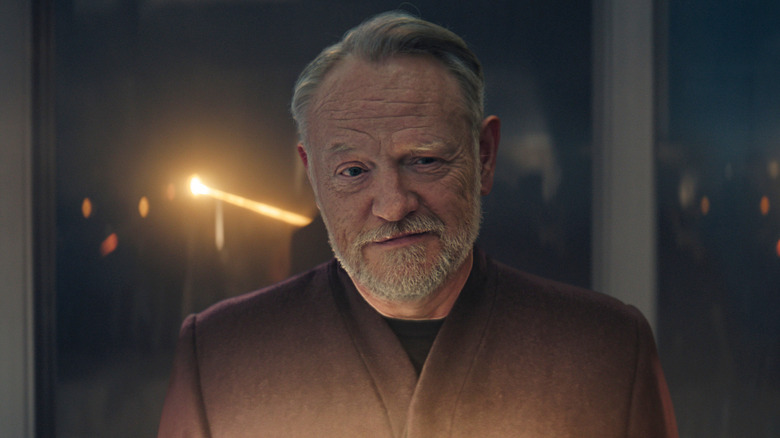
Take Hari Seldon, the man that kickstarts the entire story when he comes up with psychohistory, a mathematical study that predicts the fall of the Galactic Empire. Seldon dies pretty much as soon as he enters the story, yet he sticks around as a holographic artificial intelligence that interacts with people every hundred years or so in the aftermath of a massive "crisis" that affects history in a major way.
Speaking with the Lost Angeles Times in 2023, Jared Harris, who plays Seldon in the Apple TV show, compared the character to an iconic "2001: A Space Odyssey" villain. "The way [Seldon] was initially written reminded me of HAL [9000]; he had this sort of disembodied, vaguely threatening [quality]," the actor explained. "I thought, 'He's got to be a human being.' But it wasn't."
Hari Seldon was initially more like Hal 9000 on Foundation
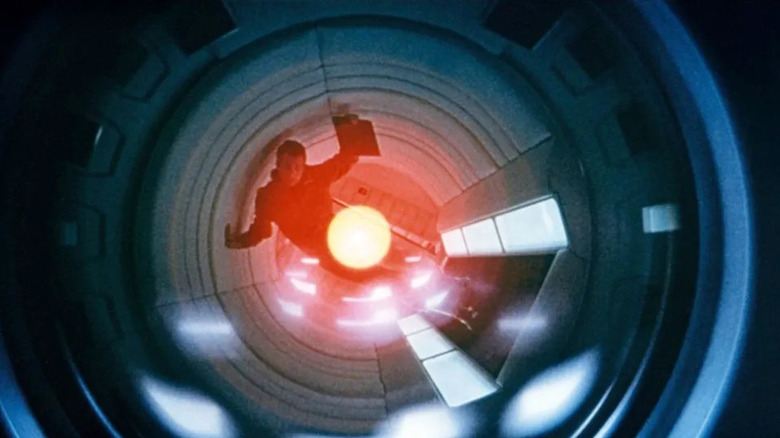
Harris describing Seldon as robotic makes sense. The book version of Seldon simply appears as pre-recorded messages that play after a crisis, which don't give much of a sense of the character's humanity. It's also interesting to note that the small screen iteration of Seldon was once closer to the way he's portrayed in Asimov's work, as that's not at all the case in the actual show.
"One of the questions I had from the very beginning with this character is that he was a sort of a cipher; he didn't seem human," Harris continued. "The conversations have always been about how do we make him more than just the MacGuffin, because he's got this sort of magical box that tells the future, but no one really knows how it works. It's just a box you open and go, 'Look, this is what's going to happen next.'"
For sure, the actor's take on Seldon, especially in "Foundation" seasons 2 and 3, is as human as any other character on the show (if not more so). Even as an AI with the real Seldon's memories, he expresses pride, fear, and joy. He even dooms the Foundation and helps the Empire while throwing a tantrum to gain the attention of Prime Hari, the original version that was brought back from the dead. (It's a weird, long story.)
But it's not just the show's writing, as Harris himself also brings a lot to the table. Season 3 features a major development for Seldon, and the way it plays out on the series changed drastically thanks to a suggestion from Harris. This is to say, we got a much better version of the character in the end.