

DC's Green Lantern Corps Introduced Its Own Version Of A Classic Star Trek Concept
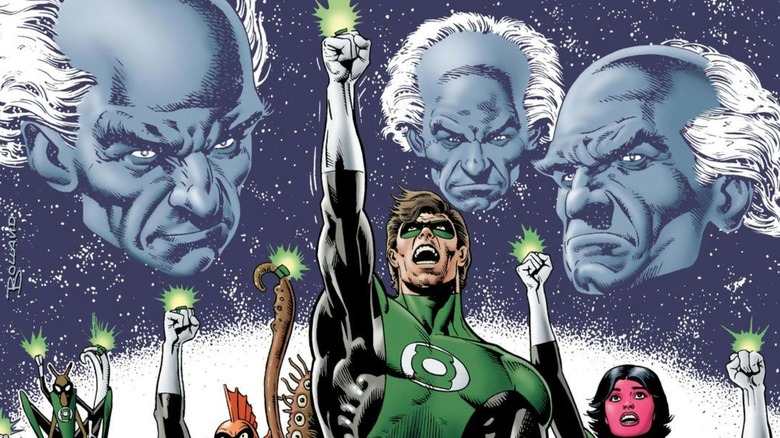
DC's "Green Lantern" comics followed an intergalactic police corps; the Green Lanterns members from various alien races, chosen to safeguard the universe sector-by-sector with rings that can create anything out of green energy. That means "Green Lantern" comics often walk the line between superhero comics and space opera.
A new issue "Green Lantern Corps" #10 (written by Morgan Hampton, drawn by Fernando Pasarin) leans on the greatest space franchise of them all: "Star Trek." One of the issue's subplots follows some rookie Green Lanterns in training under the pig-faced drill sergeant, Kilowog. Said rookies — Teen Lantern Keli Quintela, the android Aya, squirrel-like Narf, and Vexar'u (a Tamaranean, like Starfire from the Teen Titans) — have to run an obstacle course without their rings. Their final test, the Aleta Zahir, is described as a "no-win dilemma" and sees an armored opponent made from Green energy attack them. They manage to defeat him, but that still leaves them open for Kilowog to trap them in a bubble with his ring.
"Congratulations, you've just lost the Aleta Zahir. But it ain't meant to be passed," he explains. The real purpose of the test is to teach Lanterns to work as a team and think without their rings. The unbeatable test, and hidden purpose of it, calls to mind Starfleet's Kobayashi Maru test.
The set-up of the test is this: a Starfleet cadet is put in a simulator where they roleplay as a starship captain. Their ship picks up a distress signal from a freighter, the Kobayashi Maru, which is stranded in the neutral zone between the Federation and the Klingon Empire. Crossing into the neutral zone is considered an act of war. If the student chooses to try to rescue the Kobayashi Maru, a swarm of Klingon ships appear and destroy their ship.
The Green Lanterns' Aleta Zahir test is like Star Trek's Kobayashi Maru
The Kobayashi Maru is unwinnable because the real purpose of the test isn't for the student to pass it. Instead, it's to assess how a cadet handles a no-win scenario. Once you go out into the field as a soldier, or a leader, or any vocation really, you have to deal with situations where there's no one good answer. The Kobayashi Maru test isn't there to measure a cadet's aptitude, it's to teach them about experiencing failure.
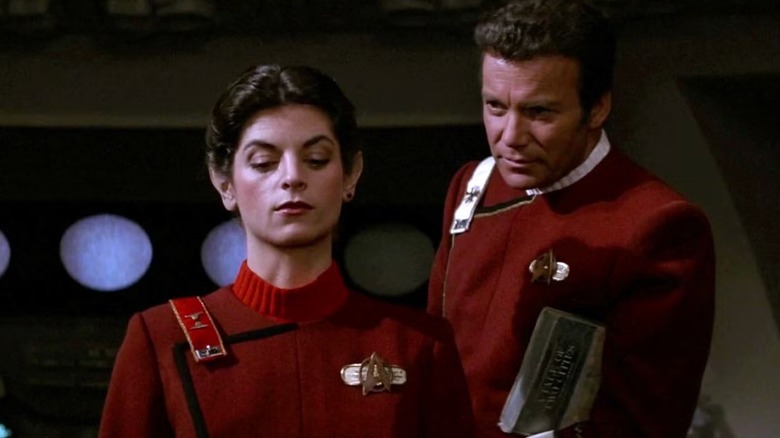
The concept originates from the 1982 movie, "Star Trek II: The Wrath of Khan," where Vulcan cadet Saavik (Kirstie Alley) takes and fails the test like every other Starfleet cadet — except one, James T. Kirk (William Shatner). Kirk beat the test by reprogramming it; some would say he cheated, but Kirk argued he doesn't believe in no-win scenarios. Right there, that tells you something about him; he thinks outside the box to get results and if he doesn't like the terms of a situation, he won't accept them.
The motif of the Kobayashi Maru comes back at the end of the film, where Spock (Leonard Nimoy) sacrifices himself to save the Enterprise. Spock tells Kirk that his sacrifice was, in essence, his solution to the Kobayashi Maru test; Spock, like any logical Vulcan, knows "the needs of the many outweigh the needs of the few, or the one." Kirk, too, finally finds a true no-win situation. He defeated Khan (Ricardo Montalbán) and saved his ship, but he lost his best friend.
How Captain Kirk beat the Kobayashi Maru test
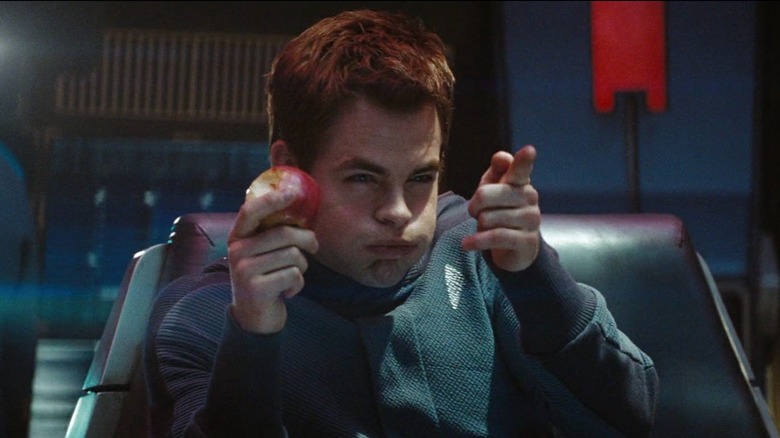
The 2009 "Star Trek" movie, a prequel/reboot set in an alternate reality, showed Kirk (Chris Pine) taking the test and cheating brazenly. He hacked the simulator so that the Klingon ships all lose their shields and become so fragile that a single photon torpedo can take them out. The 1989 novel, "The Kobayashi Maru" by Julia Ecklar, shows a different version. The novel is non-canon, but I prefer this more subtle take on Kirk outsmarting the test.
In the novel, Kirk reprogrammed the simulation so the Klingons would recognize "Captain Kirk" as a famous Starfleet captain. His reputation makes the Klingons move aside and let Kirk rescue the Kobayashi Maru. After all, Kirk had every intention of becoming a galaxy-renowned captain, and that's just what he did.
Ecklar's book shows how some of the other Enterprise senior staff took the Kobayashi Maru test, and the unique ways they all failed. Sulu chose to not rescue the freighter and risk starting a war, Chekov initiated his ship's self-destruct to take out the Klingons, and Scotty used an engineering trick to beat the Klingons that worked in the simulation, but not in reality.
The 2008 "Star Trek: Enterprise" novel "Kobayashi Maru" by Michael A. Martin & Andy Mangels suggested the test is based on an event in Starfleet history. In 2155, Captain Jonathan Archer (Scott Bakula) faced a no-win situation; he was ordered to rescue the disabled Kobayashi Maru, but facing an attack by the Romulans, he was forced to leave the ship behind to save his own crew. Thus, the Kobayashi Maru test was designed to prepare Starfleet officers for situations where they have to choose who to save — a situation Green Lanterns need to prepare for, too.